Tefera Telahun Kasa, Abebe Solomon Mekonnen, Hunegnaw Melkamu Tamir, Mekasha Freezer Girma
Department of Nursing, Dessie Health Science College, Dessie, Ethiopia.
Department of Human Nutrition, Institute of Public Health, College of Medicine and Health Science, University of Gondar, Gondar, Ethiopia.
J Nutr Metab. 2020 Sep 1;2020:5096201. doi: 10.1155/2020/5096201. eCollection 2020.
Malnutrition has been among the most common public health problems in the world, especially in developing countries including Ethiopia. Even though the Ethiopian government launched stabilization centers in different hospitals, there are limited data on how long children will stay in treatment centers to recover from severe acute malnutrition. This study aimed to assess the time to recovery and its predictors among children 6-59 months with severe acute malnutrition admitted to public hospitals in East Amhara, Northeast Ethiopia.
Institution-based, prospective cohort study was conducted in seven public hospitals in East Amhara and a total of 341 children were included in the study. The results were determined by Kaplan-Meier procedure, log-rank test, and Cox-regression to predict the time to recovery and to identify the predictors of recovery time. Variables having value ≤0.2 during binary analysis were entered into multivarable Cox proportional hazards regression analysis. value <0.05 was considered statistically significant.
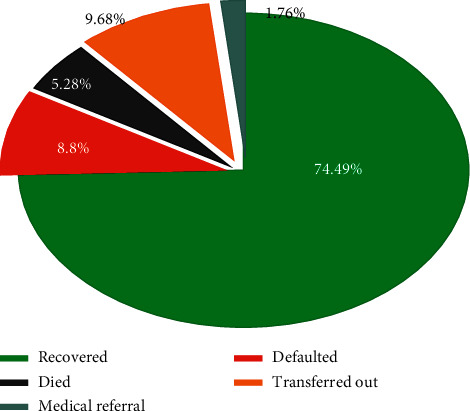
The nutritional recovery rate was 6.9 per 100 person-days with a median nutritional recovery time of 11 days (an interquartile range of 6). The independent predictors like using NG tube for feeding (AHR = 0.44, 95% CI: 0.27-0.71), not entering phase 2 on day 10 (AHR = 0.19, 95% CI: 0.12-0.29), and being admitted to referral hospitals (AHR = 0.52 95% CI: 0.37-0.73) were associated with longer periods of nutritional recovery time.
Both the recovery rate and the recovery time were within the acceptable minimum standards. But, special attention has to be given to children who failed to enter phase 2 on day 10, for those who needed NG tube for feeding, and for those admitted to referral hospitals during inpatient management.
营养不良一直是世界上最常见的公共卫生问题之一,尤其是在包括埃塞俄比亚在内的发展中国家。尽管埃塞俄比亚政府在不同医院设立了稳定中心,但关于儿童从严重急性营养不良中康复所需在治疗中心停留的时间的数据有限。本研究旨在评估埃塞俄比亚东北部阿姆哈拉东部公立医院收治的6至59个月患有严重急性营养不良儿童的康复时间及其预测因素。
在阿姆哈拉东部的七家公立医院开展了基于机构的前瞻性队列研究,共纳入341名儿童。通过Kaplan-Meier法、对数秩检验和Cox回归来确定结果,以预测康复时间并识别康复时间的预测因素。在二元分析中p值≤0.2的变量被纳入多变量Cox比例风险回归分析。p值<0.05被认为具有统计学意义。
营养康复率为每100人日6.9例,营养康复时间中位数为11天(四分位间距为6天)。独立预测因素如使用鼻胃管喂养(风险比[AHR]=0.44,95%置信区间[CI]:0.27-0.71)、第10天未进入第二阶段(AHR=0.19,95%CI:0.12-0.29)以及入住转诊医院(AHR=0.52,95%CI:0.37-0.73)与较长的营养康复时间相关。
康复率和康复时间均在可接受的最低标准范围内。但是,对于在住院治疗期间第10天未进入第二阶段的儿童、需要鼻胃管喂养的儿童以及入住转诊医院的儿童,必须给予特别关注。