Gülsen Askin, Yigitbas Burcu Arpinar, Uslu Berat, Drömann Daniel, Kilinc Oguz
Department of Pneumology, Airway Research Center North (ARCN), Member of the German Center for Lung Research (DZL), University of Luebeck, Germany.
Department of Pneumology, Yedikule Chest Disease and Thoracic Surgery Hospital, Istanbul, Turkey.
Pulm Med. 2020 Sep 8;2020:7590207. doi: 10.1155/2020/7590207. eCollection 2020.
Coronavirus disease 2019 (COVID-19) is caused by severe acute respiratory syndrome coronavirus 2 (SAR2-COV-2) and was first identified in Wuhan, China, in December of 2019, but quickly spread to the rest of the world, causing a pandemic. While some studies have found no link between smoking status and severe COVID-19, others demonstrated a significant one. The present study aimed to determine the relationship between smoking and clinical COVID-19 severity via a systematic meta-analysis approach.
We searched the Google Scholar, PubMed, Scopus, Web of Science, and Embase databases to identify clinical studies suitable for inclusion in this meta-analysis. Studies reporting smoking status and comparing nonsevere and severe patients were included. Nonsevere cases were described as mild, common type, nonintensive care unit (ICU) treatment, survivors, and severe cases as critical, need for ICU, refractory, and nonsurvivors.
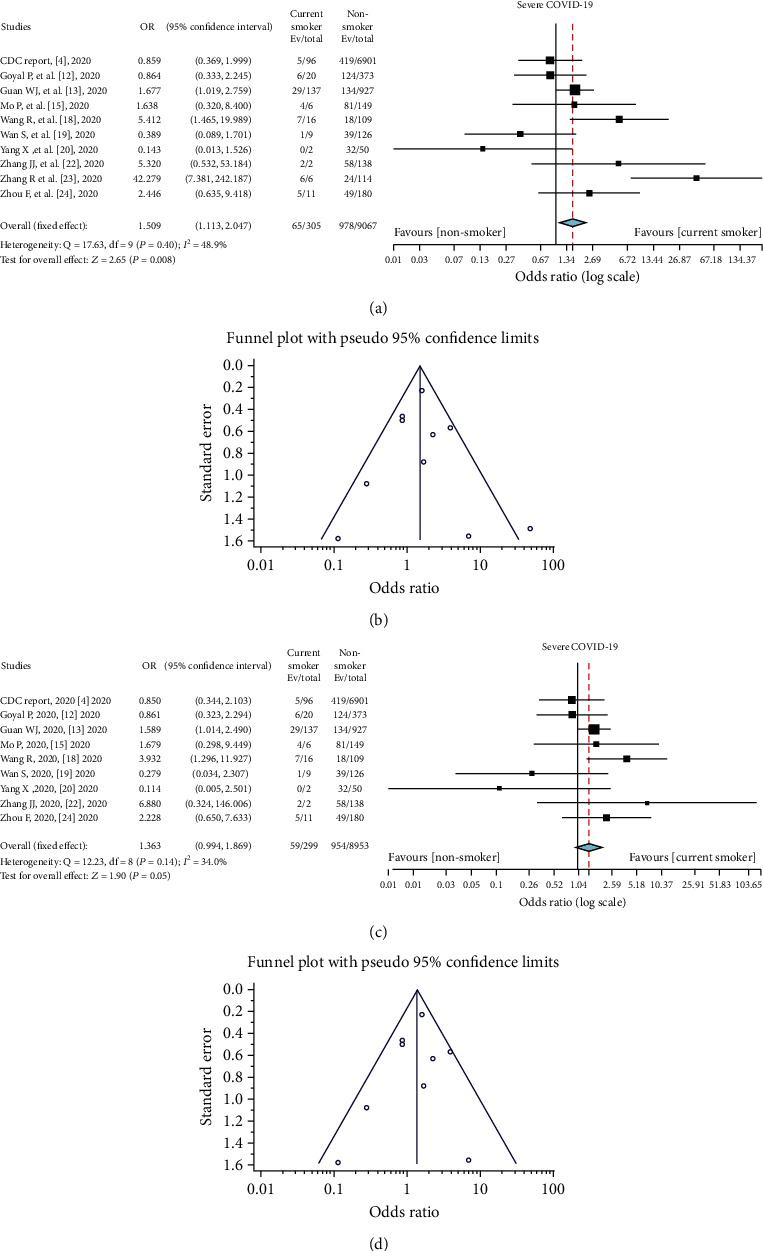
A total of 16 articles detailing 11322 COVID-19 patients were included. Our meta-analysis revealed a relationship between a history of smoking and severe COVID-19 cases (OR = 2.17; 95% CI: 1.37-3.46; < .001). Additionally, we found an association between the current smoking status and severe COVID-19 (OR = 1.51; 95% CI: 1.12-2.05; < .008). In 10.7% (978/9067) of nonsmokers, COVID-19 was severe, while in active smokers, severe COVID-19 occurred in 21.2% (65/305) of cases.
Active smoking and a history of smoking are clearly associated with severe COVID-19. The SARS-COV-2 epidemic should serve as an impetus for patients and those at risk to maintain good health practices and discontinue smoking. The trial is registered with the International Prospective Register of Systematic Reviews (PROSPERO) CRD42020180173.
2019年冠状病毒病(COVID-19)由严重急性呼吸综合征冠状病毒2(SARS-CoV-2)引起,于2019年12月在中国武汉首次发现,但迅速蔓延至世界其他地区,引发了一场大流行。虽然一些研究未发现吸烟状况与重症COVID-19之间存在关联,但其他研究则表明存在显著关联。本研究旨在通过系统的荟萃分析方法确定吸烟与临床COVID-19严重程度之间的关系。
我们检索了谷歌学术、PubMed、Scopus、科学网和Embase数据库,以识别适合纳入本荟萃分析的临床研究。纳入报告吸烟状况并比较非重症和重症患者的研究。非重症病例被描述为轻症、普通型、非重症监护病房(ICU)治疗、幸存者,重症病例被描述为危重症、需要ICU、难治性和非幸存者。
共纳入16篇详细介绍11322例COVID-19患者的文章。我们的荟萃分析揭示了吸烟史与重症COVID-19病例之间的关系(OR = 2.17;95%CI:1.37 - 3.46;P <.001)。此外,我们发现当前吸烟状况与重症COVID-19之间存在关联(OR = 1.51;95%CI:1.12 - 2.05;P <.008)。在10.7%(978/9067)的非吸烟者中,COVID-19为重症,而在现吸烟者中,21.2%(65/305)的病例为重症COVID-19。
现吸烟和吸烟史与重症COVID-19明显相关。SARS-CoV-2疫情应促使患者和有风险者保持良好的健康习惯并戒烟。该试验已在国际前瞻性系统评价注册库(PROSPERO)注册,注册号为CRD42020180173。