Department of Community Medicine, UiT The Arctic University of Norway, Tromsø, Norway.
International Research Competence Centre, Northern State Medical University, Arkhangelsk, Russian Federation.
PLoS One. 2024 Oct 11;19(10):e0311287. doi: 10.1371/journal.pone.0311287. eCollection 2024.
The spectrum of COVID-19 manifestations makes it challenging to estimate the exact proportion of people who had the infection in a population, with the proportion of asymptomatic cases likely being underestimated. We aimed to assess and describe the spectrum of COVID-19 cases in a sample of adult population aged 40-74 years in Arkhangelsk, Northwest Russia, a year after the start of the pandemic.
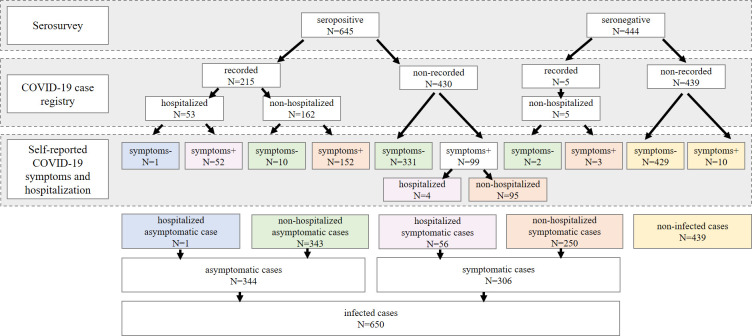
A population-based survey conducted between February 24, 2021 and June 30, 2021 with an unvaccinated sample aged 40-74 years (N = 1089) combined a serological survey data, national COVID-19 case registry, and self-reported data on COVID-19 experience and symptoms. Based on the agreement between these sources, we classified the study participants as non-infected and previously infected (asymptomatic, non-hospitalized and hospitalized symptomatic) cases, and compared these groups regarding demographics, lifestyle and health characteristics.
After a year of the pandemic in Arkhangelsk, 59.7% 95% confidence intervals (CI) (56.7; 62.6) of the surveyed population had had COVID-19. Among those who had been infected, symptomatic cases comprised 47.1% 95% CI (43.2; 51.0), with 8.6% 95% CI (6.6; 11.1) of them having been hospitalized. Of the asymptomatic cases, 96.2% were not captured by the healthcare system. Older age was positively associated, while smoking showed a negative association with symptomatic COVID-19. Individuals older than 65 years, and those with poor self-rated health were more likely to be hospitalized.
More than half of the infected individuals were not captured by the healthcare-based registry, mainly those with asymptomatic infections. COVID-19 severity was positively associated with older age and poor self-rated health, and inversely associated with smoking. Combining different sources of surveillance data could reduce the number of unidentified asymptomatic cases and enhance surveillance for emerging infections.
COVID-19 的临床表现范围广泛,因此难以估计人群中确切的感染比例,无症状病例的比例可能被低估。我们旨在评估和描述俄罗斯西北部阿尔汉格尔斯克的 40-74 岁成年人样本中 COVID-19 病例的表现谱,这是大流行开始一年后。
一项基于人群的调查于 2021 年 2 月 24 日至 2021 年 6 月 30 日进行,样本为未接种疫苗的 40-74 岁人群(N=1089),结合了血清学调查数据、国家 COVID-19 病例登记处以及 COVID-19 经历和症状的自我报告数据。基于这些来源的一致性,我们将研究参与者分为未感染和既往感染(无症状、非住院和住院有症状)病例,并比较了这些组的人口统计学、生活方式和健康特征。
在阿尔汉格尔斯克大流行一年后,接受调查的人群中有 59.7%(95%置信区间[CI]:56.7;62.6)感染了 COVID-19。在已感染者中,有症状病例占 47.1%(95%CI:43.2;51.0),其中 8.6%(95%CI:6.6;11.1)住院。无症状病例中有 96.2%未被医疗系统捕捉。年龄较大与有症状 COVID-19 呈正相关,而吸烟则呈负相关。65 岁以上的个体和自我报告健康状况较差的个体更有可能住院。
超过一半的感染者未被基于医疗保健的登记处捕捉,主要是无症状感染者。COVID-19 的严重程度与年龄较大和自我报告健康状况较差呈正相关,与吸烟呈负相关。结合不同的监测数据来源可以减少未识别的无症状病例数量,并增强对新出现感染的监测。