Department of Radiology, Leiden University Medical Center, Leiden, The Netherlands.
Biomedical Photonic Imaging Group, University of Twente, Enschede, The Netherlands.
PLoS One. 2020 Sep 23;15(9):e0239438. doi: 10.1371/journal.pone.0239438. eCollection 2020.
Radiomic features, extracted from positron emission tomography, aim to characterize tumour biology based on tracer intensity, tumour geometry and/or tracer uptake heterogeneity. Currently, radiomic features are derived from static images. However, temporal changes in tracer uptake might reveal new aspects of tumour biology. This study aims to explore additional information of these novel dynamic radiomic features compared to those derived from static or metabolic rate images.
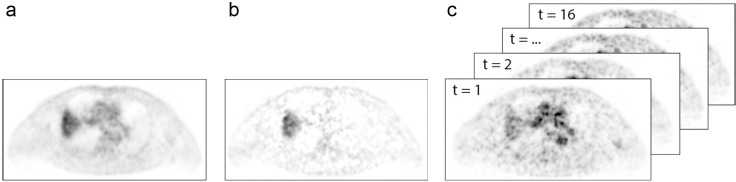
Thirty-five patients with non-small cell lung carcinoma underwent dynamic [18F]FDG PET/CT scans. Spatial intensity, shape and texture radiomic features were derived from volumes of interest delineated on static PET and parametric metabolic rate PET. Dynamic grey level cooccurrence matrix (GLCM) and grey level run length matrix (GLRLM) features, assessing the temporal domain unidirectionally, were calculated on eight and sixteen time frames of equal length. Spearman's rank correlations of parametric and dynamic features with static features were calculated to identify features with potential additional information. Survival analysis was performed for the non-redundant temporal features and a selection of static features using Kaplan-Meier analysis.
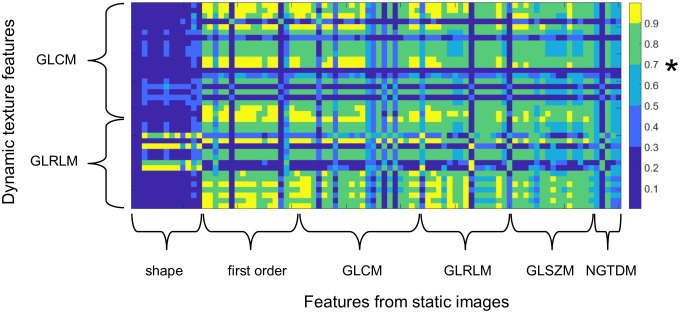
Three out of 90 parametric features showed moderate correlations with corresponding static features (ρ≥0.61), all other features showed high correlations (ρ>0.7). Dynamic features are robust independent of frame duration. Five out of 22 dynamic GLCM features showed a negligible to moderate correlation with any static feature, suggesting additional information. All sixteen dynamic GLRLM features showed high correlations with static features, implying redundancy. Log-rank analyses of Kaplan-Meier survival curves for all features dichotomised at the median were insignificant.
This study suggests that, compared to static features, some dynamic GLCM radiomic features show different information, whereas parametric features provide minimal additional information. Future studies should be conducted in larger populations to assess whether there is a clinical benefit of radiomics using the temporal domain over traditional radiomics.
从正电子发射断层扫描(PET)中提取的放射组学特征旨在根据示踪剂强度、肿瘤几何形状和/或示踪剂摄取异质性来描述肿瘤生物学。目前,放射组学特征是从静态图像中提取的。然而,示踪剂摄取的时间变化可能会揭示肿瘤生物学的新方面。本研究旨在探索与静态或代谢率图像相比,这些新的动态放射组学特征提供的额外信息。
35 例非小细胞肺癌患者接受了动态[18F]FDG PET/CT 扫描。从静态 PET 和参数代谢率 PET 上勾画的感兴趣区提取空间强度、形状和纹理放射组学特征。在 8 个和 16 个相等长度的时间框架上计算评估时间域单向性的动态灰度共生矩阵(GLCM)和灰度游程长度矩阵(GLRLM)特征。用 Spearman 秩相关系数计算参数和动态特征与静态特征之间的相关性,以识别具有潜在附加信息的特征。使用 Kaplan-Meier 分析对非冗余时间特征和一组静态特征进行生存分析。
90 个参数特征中有 3 个与相应的静态特征呈中度相关(ρ≥0.61),其他所有特征均呈高度相关(ρ>0.7)。动态特征与帧持续时间无关。22 个动态 GLCM 特征中有 5 个与任何静态特征具有可忽略至中度的相关性,表明存在额外信息。所有 16 个动态 GLRLM 特征与静态特征高度相关,表明存在冗余。对所有特征在中位数处进行二分后,Kaplan-Meier 生存曲线的对数秩检验均无显著性。
本研究表明,与静态特征相比,一些动态 GLCM 放射组学特征显示出不同的信息,而参数特征提供的附加信息有限。未来的研究应在更大的人群中进行,以评估使用时域的放射组学与传统放射组学相比是否具有临床益处。