Freeman Patrick, Mielgo Ainhoa
Department of Molecular and Clinical Cancer Medicine, First floor Sherrington Building, University of Liverpool, Liverpool L69 3GE, UK.
Cancers (Basel). 2020 Sep 21;12(9):2687. doi: 10.3390/cancers12092687.
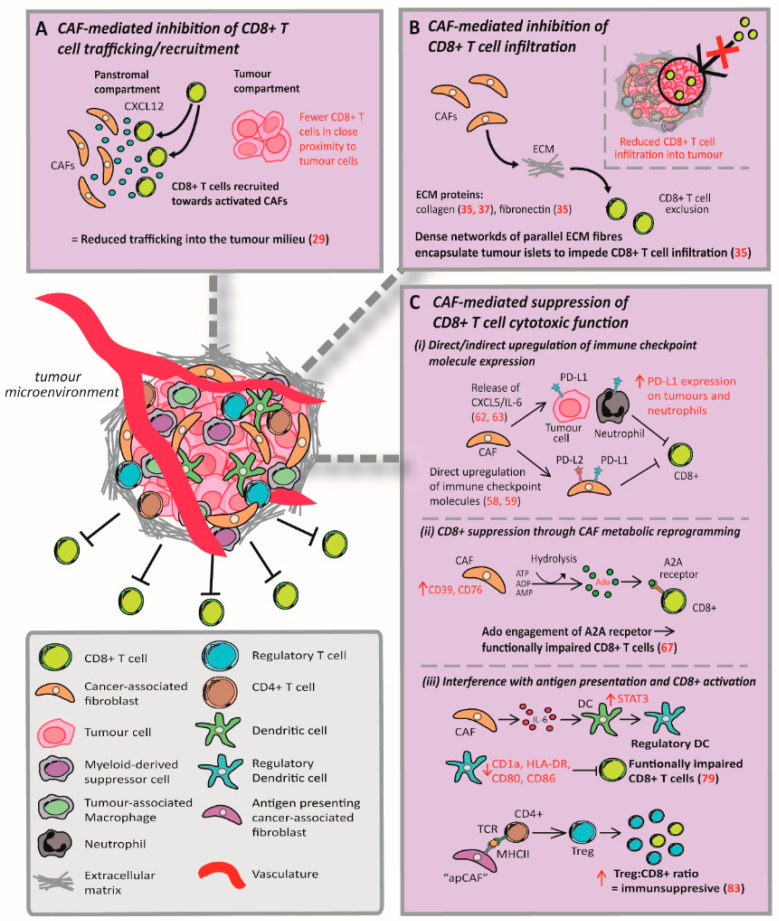
The tumour microenvironment (TME) is the complex environment in which various non-cancerous stromal cell populations co-exist, co-evolve and interact with tumour cells, having a profound impact on the progression of solid tumours. The TME is comprised of various extracellular matrix (ECM) proteins in addition to a variety of immune and stromal cells. These include tumour-associated macrophages, regulatory T cells (Tregs), myeloid-derived suppressor cells, as well as endothelial cells, pericytes and cancer-associated fibroblasts (CAFs). CAFs are the most abundant stromal cell population in many tumours and support cancer progression, metastasis and resistance to therapies through bidirectional signalling with both tumour cells and other cells within the TME. More recently, CAFs have been shown to also affect the anti-tumour immune response through direct and indirect interactions with immune cells. In this review, we specifically focus on the interactions between CAFs and cytotoxic CD8+ T cells, and on how these interactions affect T cell recruitment, infiltration and function in the tumour. We additionally provide insight into the therapeutic implications of targeting these interactions, particularly in the context of cancer immunotherapy.
肿瘤微环境(TME)是一个复杂的环境,各种非癌性基质细胞群体在其中与肿瘤细胞共存、共同进化并相互作用,对实体瘤的进展产生深远影响。除了各种免疫细胞和基质细胞外,TME还由多种细胞外基质(ECM)蛋白组成。这些细胞包括肿瘤相关巨噬细胞、调节性T细胞(Tregs)、髓系来源的抑制细胞,以及内皮细胞、周细胞和癌症相关成纤维细胞(CAF)。CAF是许多肿瘤中最丰富的基质细胞群体,通过与肿瘤细胞和TME内的其他细胞进行双向信号传导来支持癌症进展、转移和对治疗的抵抗。最近,研究表明CAF还通过与免疫细胞的直接和间接相互作用影响抗肿瘤免疫反应。在这篇综述中,我们特别关注CAF与细胞毒性CD8 + T细胞之间的相互作用,以及这些相互作用如何影响T细胞在肿瘤中的募集、浸润和功能。我们还深入探讨了针对这些相互作用的治疗意义,特别是在癌症免疫治疗的背景下。