Department of Molecular and Translational Medicine, Section of Microbiology, University of Brescia, Brescia, Italy.
Flavivirus Laboratory, Oswaldo Cruz Institute, Oswaldo Cruz Foundation, Rio De Janeiro, Brazil.
J Transl Med. 2020 Sep 23;18(1):362. doi: 10.1186/s12967-020-02535-1.
Since the first outbreak of SARS-CoV-2, the clinical characteristics of the Coronavirus Disease 2019 (COVID-19) have been progressively changed. Data reporting a viral intra-host and inter-host evolution favouring the appearance of mild SARS-CoV-2 strains are since being accumulating. To better understand the evolution of SARS-CoV-2 pathogenicity and its adaptation to the host, it is therefore crucial to investigate the genetic and phenotypic characteristics of SARS-CoV-2 strains circulating lately in the epidemic.
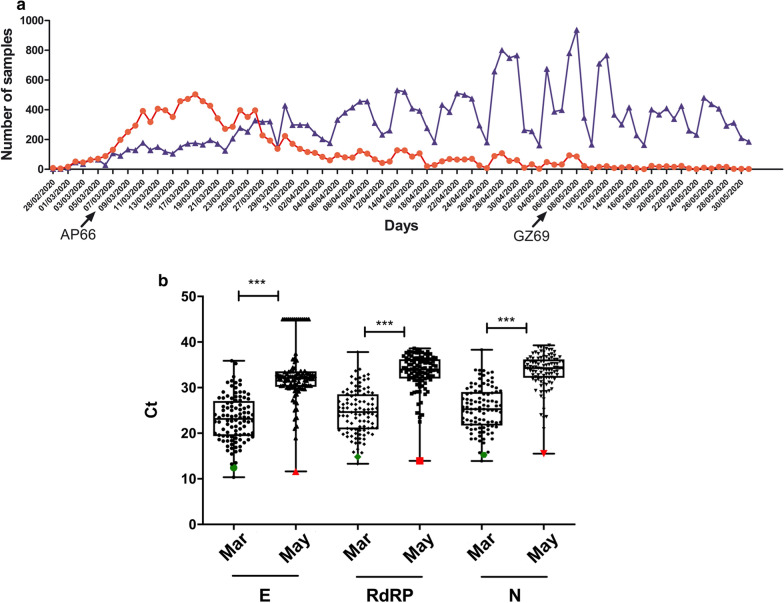
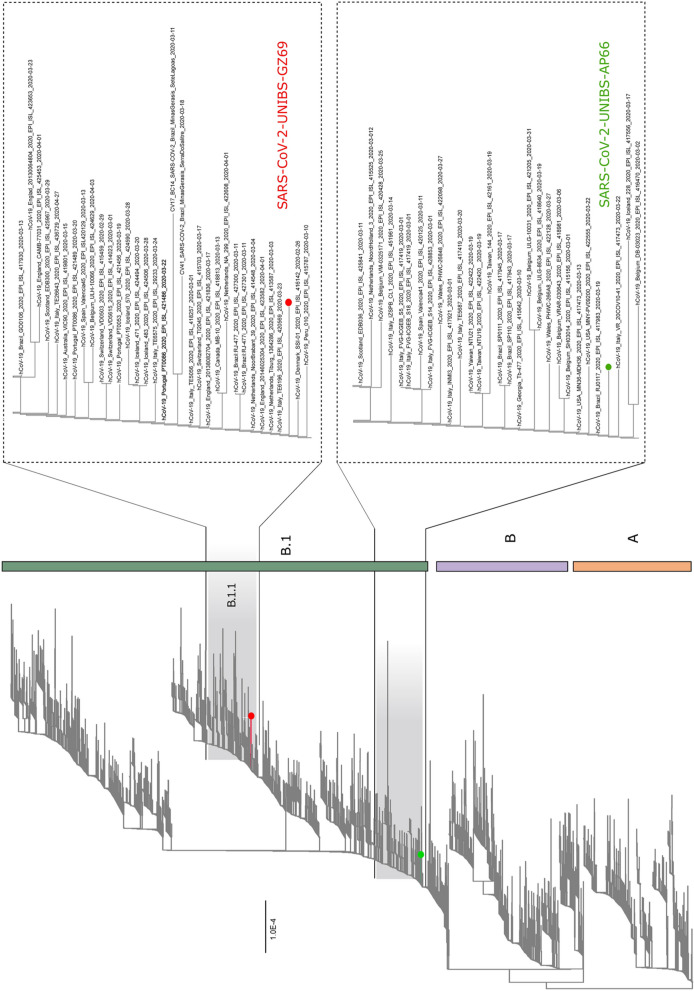
Nasopharyngeal swabs have been analyzed for viral load in the early (March 2020) and late (May 2020) phases of epidemic in Brescia, Italy. Isolation of SARS-CoV-2 from 2 high viral load specimens identified on March 9 (AP66) and on May 8 (GZ69) was performed on Vero E6 cells. Amount of virus released was assessed by quantitative PCR. Genotypic characterization of AP66 and GZ69 was performed by next generation sequencing followed by an in-depth in silico analysis of nucleotide mutations.
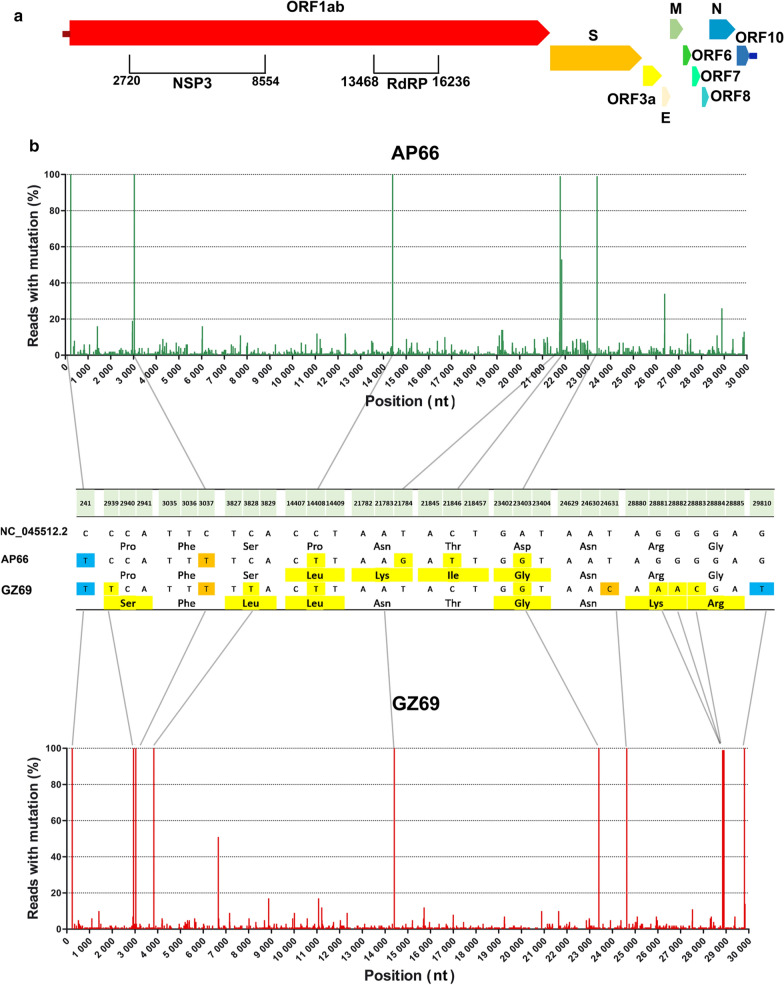
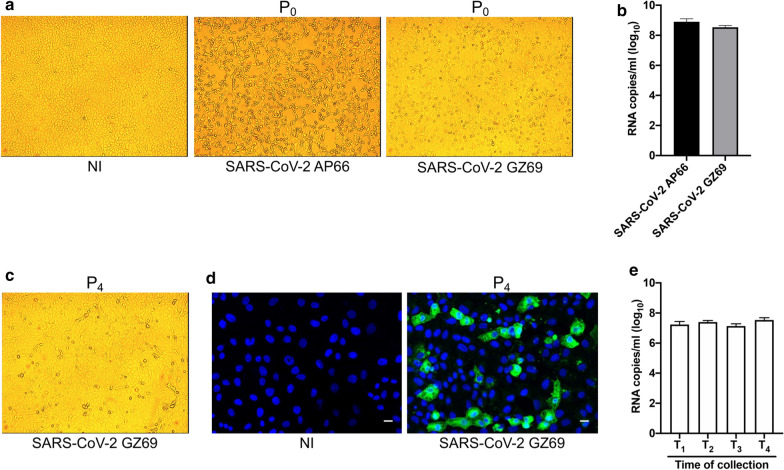
The SARS-CoV-2 GZ69 strain, isolated in May from an asymptomatic healthcare worker, showed an unprecedented capability of replication in Vero E6 cells in the absence of any evident cytopathic effect. Vero E6 subculturing, up to passage 4, showed that SARS-CoV-2 GZ69 infection was as productive as the one sustained by the cytopathic strain AP66. Whole genome sequencing of the persistently replicating SARS-CoV-2 GZ69 has shown that this strain differs from the early AP66 variant in 9 nucleotide positions (C2939T; C3828T; G21784T; T21846C; T24631C; G28881A; G28882A; G28883C; G29810T) which lead to 6 non-synonymous substitutions spanning on ORF1ab (P892S; S1188L), S (K74N; I95T) and N (R203K, G204R) proteins.
Identification of the peculiar SARS-CoV-2 GZ69 strain in the late Italian epidemic highlights the need to better characterize viral variants circulating among asymptomatic or paucisymptomatic individuals. The current approach could unravel the ways for future studies aimed at analyzing the selection process which favours viral mutations in the human host.
自 SARS-CoV-2 首次爆发以来,2019 年冠状病毒病(COVID-19)的临床特征逐渐发生变化。越来越多的数据表明,病毒在宿主内和宿主间进化有利于出现轻症 SARS-CoV-2 株。因此,为了更好地了解 SARS-CoV-2 的致病性演变及其对宿主的适应性,研究最近在流行中循环的 SARS-CoV-2 株的遗传和表型特征至关重要。
对意大利布雷西亚的疫情早期(2020 年 3 月)和晚期(2020 年 5 月)的鼻咽拭子进行了病毒载量分析。从 3 月 9 日(AP66)和 5 月 8 日(GZ69)两个高病毒载量标本中分离 SARS-CoV-2,在 Vero E6 细胞中进行。通过定量 PCR 评估病毒释放量。通过下一代测序对 AP66 和 GZ69 进行基因特征分析,并对核苷酸突变进行深入的计算机分析。
5 月从一名无症状医护人员中分离出的 SARS-CoV-2 GZ69 株在没有明显细胞病变效应的情况下,在 Vero E6 细胞中表现出前所未有的复制能力。Vero E6 传代培养至第 4 代,表明 SARS-CoV-2 GZ69 感染与持续感染的细胞病变株 AP66 一样具有生产力。对持续复制的 SARS-CoV-2 GZ69 的全基因组测序表明,与早期的 AP66 变体相比,该株在 9 个核苷酸位置(C2939T;C3828T;G21784T;T21846C;T24631C;G28881A;G28882A;G28883C;G29810T)发生变化,导致 ORF1ab(P892S;S1188L)、S(K74N;I95T)和 N(R203K、G204R)蛋白上发生 6 个非同义替换。
在意大利晚期疫情中发现了特殊的 SARS-CoV-2 GZ69 株,这凸显了需要更好地描述无症状或症状轻微个体中循环的病毒变异。目前的方法可以揭示未来研究的途径,这些研究旨在分析有利于病毒在人体宿主中发生突变的选择过程。