• 文献检索
  • 文档翻译
  • 深度研究
  • 学术资讯
  • Suppr Zotero 插件Zotero 插件
  • 邀请有礼
  • 套餐&价格
  • 历史记录
应用&插件
Suppr Zotero 插件Zotero 插件浏览器插件Mac 客户端Windows 客户端微信小程序
定价
高级版会员购买积分包购买API积分包
服务
文献检索文档翻译深度研究API 文档MCP 服务
关于我们
关于 Suppr公司介绍联系我们用户协议隐私条款
关注我们

Suppr 超能文献

核心技术专利:CN118964589B侵权必究
粤ICP备2023148730 号-1Suppr @ 2026

文献检索

告别复杂PubMed语法,用中文像聊天一样搜索,搜遍4000万医学文献。AI智能推荐,让科研检索更轻松。

立即免费搜索

文件翻译

保留排版,准确专业,支持PDF/Word/PPT等文件格式,支持 12+语言互译。

免费翻译文档

深度研究

AI帮你快速写综述,25分钟生成高质量综述,智能提取关键信息,辅助科研写作。

立即免费体验

预测澳大利亚罗斯河病毒的流行病学模型:系统评价。

Epidemiological models for predicting Ross River virus in Australia: A systematic review.

机构信息

Mater Research Institute-University of Queensland (MRI-UQ), Brisbane, Queensland, Australia.

Research and Development, Australian Red Cross Lifeblood, Brisbane, Queensland, Australia.

出版信息

PLoS Negl Trop Dis. 2020 Sep 24;14(9):e0008621. doi: 10.1371/journal.pntd.0008621. eCollection 2020 Sep.

DOI:10.1371/journal.pntd.0008621
PMID:32970673
原文链接:https://pmc.ncbi.nlm.nih.gov/articles/PMC7537878/
Abstract

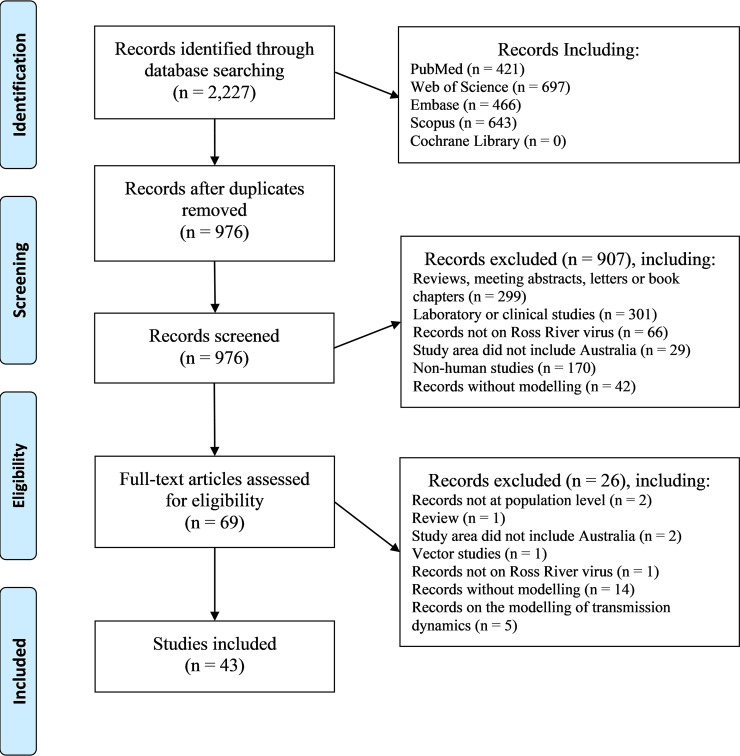
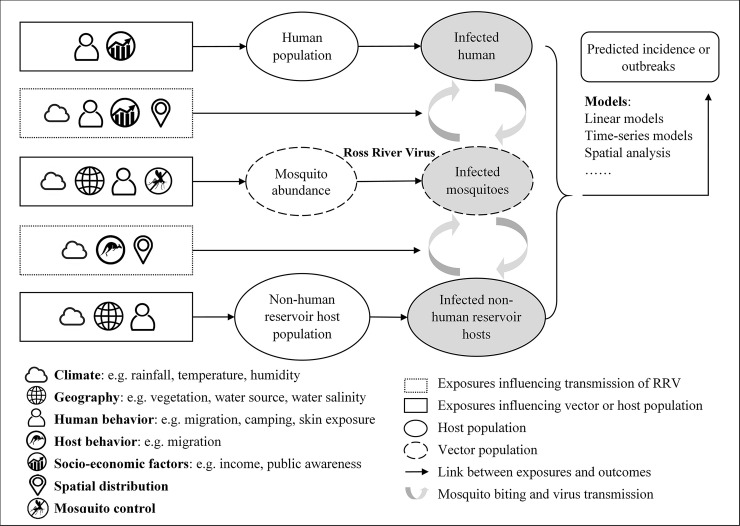
Ross River virus (RRV) is the most common and widespread arbovirus in Australia. Epidemiological models of RRV increase understanding of RRV transmission and help provide early warning of outbreaks to reduce incidence. However, RRV predictive models have not been systematically reviewed, analysed, and compared. The hypothesis of this systematic review was that summarising the epidemiological models applied to predict RRV disease and analysing model performance could elucidate drivers of RRV incidence and transmission patterns. We performed a systematic literature search in PubMed, EMBASE, Web of Science, Cochrane Library, and Scopus for studies of RRV using population-based data, incorporating at least one epidemiological model and analysing the association between exposures and RRV disease. Forty-three articles, all of high or medium quality, were included. Twenty-two (51.2%) used generalised linear models and 11 (25.6%) used time-series models. Climate and weather data were used in 27 (62.8%) and mosquito abundance or related data were used in 14 (32.6%) articles as model covariates. A total of 140 models were included across the articles. Rainfall (69 models, 49.3%), temperature (66, 47.1%) and tide height (45, 32.1%) were the three most commonly used exposures. Ten (23.3%) studies published data related to model performance. This review summarises current knowledge of RRV modelling and reveals a research gap in comparing predictive methods. To improve predictive accuracy, new methods for forecasting, such as non-linear mixed models and machine learning approaches, warrant investigation.

摘要

罗斯河病毒(RRV)是澳大利亚最常见和分布最广的虫媒病毒。RRV 的流行病学模型增加了对 RRV 传播的理解,并有助于提供爆发的早期预警,以降低发病率。然而,RRV 的预测模型尚未得到系统的审查、分析和比较。本系统评价的假设是,总结应用于预测 RRV 疾病的流行病学模型,并分析模型性能,可以阐明 RRV 发病率和传播模式的驱动因素。我们在 PubMed、EMBASE、Web of Science、Cochrane Library 和 Scopus 中进行了系统的文献检索,以寻找使用基于人群的数据研究 RRV 的研究,这些研究纳入了至少一个流行病学模型,并分析了暴露与 RRV 疾病之间的关联。共纳入 43 篇文章,均为高质量或中高质量文章。其中 22 篇(51.2%)使用了广义线性模型,11 篇(25.6%)使用了时间序列模型。27 篇(62.8%)文章将气候和天气数据作为模型协变量,14 篇(32.6%)文章将蚊子丰度或相关数据作为模型协变量。这些文章共纳入了 140 个模型。降雨量(69 个模型,49.3%)、温度(66 个,47.1%)和潮高(45 个,32.1%)是使用最广泛的三种暴露因素。有 10 项研究(23.3%)发表了与模型性能相关的数据。本综述总结了目前对 RRV 建模的认识,并揭示了在比较预测方法方面存在的研究空白。为了提高预测准确性,值得研究用于预测的新方法,如非线性混合模型和机器学习方法。
https://cdn.ncbi.nlm.nih.gov/pmc/blobs/4476/7537878/15487276884b/pntd.0008621.g002.jpg
https://cdn.ncbi.nlm.nih.gov/pmc/blobs/4476/7537878/5c29208005d8/pntd.0008621.g001.jpg
https://cdn.ncbi.nlm.nih.gov/pmc/blobs/4476/7537878/15487276884b/pntd.0008621.g002.jpg
https://cdn.ncbi.nlm.nih.gov/pmc/blobs/4476/7537878/5c29208005d8/pntd.0008621.g001.jpg
https://cdn.ncbi.nlm.nih.gov/pmc/blobs/4476/7537878/15487276884b/pntd.0008621.g002.jpg

相似文献

1
Epidemiological models for predicting Ross River virus in Australia: A systematic review.预测澳大利亚罗斯河病毒的流行病学模型:系统评价。
PLoS Negl Trop Dis. 2020 Sep 24;14(9):e0008621. doi: 10.1371/journal.pntd.0008621. eCollection 2020 Sep.
2
Climate variability, social and environmental factors, and ross river virus transmission: research development and future research needs.气候变率、社会与环境因素以及罗斯河病毒传播:研究进展与未来研究需求
Environ Health Perspect. 2008 Dec;116(12):1591-7. doi: 10.1289/ehp.11680. Epub 2008 Jul 24.
3
Predictive indicators for Ross River virus infection in the Darwin area of tropical northern Australia, using long-term mosquito trapping data.利用长期蚊虫诱捕数据预测澳大利亚北部热带地区达尔文市罗斯河病毒感染的指标
Trop Med Int Health. 2008 Jul;13(7):943-52. doi: 10.1111/j.1365-3156.2008.02095.x. Epub 2008 May 13.
4
Different responses of Ross River virus to climate variability between coastline and inland cities in Queensland, Australia.澳大利亚昆士兰州沿海和内陆城市罗斯河病毒对气候变化的不同反应。
Occup Environ Med. 2002 Nov;59(11):739-44. doi: 10.1136/oem.59.11.739.
5
Analysis and prediction of Ross River virus transmission in New South Wales, Australia.澳大利亚新南威尔士州罗斯河病毒传播的分析与预测
Vector Borne Zoonotic Dis. 2014 Jun;14(6):422-38. doi: 10.1089/vbz.2012.1284. Epub 2014 Apr 18.
6
The forecasting of dynamical Ross River virus outbreaks: Victoria, Australia.动力性罗斯河病毒爆发的预测:澳大利亚维多利亚州。
Epidemics. 2020 Mar;30:100377. doi: 10.1016/j.epidem.2019.100377. Epub 2019 Nov 5.
7
Ross River Virus Disease Activity Associated With Naturally Occurring Nontidal Flood Events in Australia: A Systematic Review.澳大利亚自然发生的非潮汐洪水事件相关的罗斯河病毒病活动:一项系统评价
J Med Entomol. 2014 Nov 1;51(6):1097-108. doi: 10.1603/ME14007.
8
Predictive modelling of Ross River virus notifications in southeastern Australia.澳大利亚东南部罗斯河病毒通报的预测模型
Epidemiol Infect. 2017 Feb;145(3):440-450. doi: 10.1017/S0950268816002594. Epub 2016 Nov 21.
9
Fine-temporal forecasting of outbreak probability and severity: Ross River virus in Western Australia.疫情发生概率和严重程度的精细时间预测:西澳大利亚州的罗斯河病毒
Epidemiol Infect. 2017 Oct;145(14):2949-2960. doi: 10.1017/S095026881700190X. Epub 2017 Sep 4.
10
Flooding and Arboviral Disease: Predicting Ross River Virus Disease Outbreaks Across Inland Regions of South-Eastern Australia.洪水与虫媒病毒病:预测澳大利亚东南部内陆地区的罗斯河病毒病疫情
J Med Entomol. 2020 Jan 9;57(1):241-251. doi: 10.1093/jme/tjz120.

引用本文的文献

1
Arbovirus Transmission in Australia from 2002 to 2017.2002年至2017年澳大利亚虫媒病毒的传播情况
Biology (Basel). 2024 Jul 15;13(7):524. doi: 10.3390/biology13070524.
2
Prediction of Ross River Virus Incidence Using Mosquito Data in Three Cities of Queensland, Australia.利用澳大利亚昆士兰州三个城市的蚊虫数据预测罗斯河病毒发病率
Biology (Basel). 2023 Nov 13;12(11):1429. doi: 10.3390/biology12111429.
3
A Multi-Species Simulation of Mosquito Disease Vector Development in Temperate Australian Tidal Wetlands Using Publicly Available Data.

本文引用的文献

1
The forecasting of dynamical Ross River virus outbreaks: Victoria, Australia.动力性罗斯河病毒爆发的预测:澳大利亚维多利亚州。
Epidemics. 2020 Mar;30:100377. doi: 10.1016/j.epidem.2019.100377. Epub 2019 Nov 5.
2
Flooding and Arboviral Disease: Predicting Ross River Virus Disease Outbreaks Across Inland Regions of South-Eastern Australia.洪水与虫媒病毒病:预测澳大利亚东南部内陆地区的罗斯河病毒病疫情
J Med Entomol. 2020 Jan 9;57(1):241-251. doi: 10.1093/jme/tjz120.
3
Bayesian spatial and spatio-temporal approaches to modelling dengue fever: a systematic review.
利用公开数据对澳大利亚温带潮汐湿地蚊虫疾病媒介发育进行的多物种模拟。
Trop Med Infect Dis. 2023 Apr 3;8(4):215. doi: 10.3390/tropicalmed8040215.
4
Prediction of Ross River virus incidence in Queensland, Australia: building and comparing models.预测澳大利亚昆士兰州罗斯河病毒的发病率:模型的建立与比较。
PeerJ. 2022 Nov 8;10:e14213. doi: 10.7717/peerj.14213. eCollection 2022.
5
Epidemiological Study of Multiple Zoonotic Mosquito-Borne Alphaviruses in Horses in Queensland, Australia (2018-2020).澳大利亚昆士兰州马中多种动物源媒介黄病毒的流行病学研究(2018-2020 年)。
Viruses. 2022 Aug 23;14(9):1846. doi: 10.3390/v14091846.
6
Spatial and Temporal Patterns of Ross River Virus in Queensland, 2001-2020.2001 - 2020年昆士兰州罗斯河病毒的时空模式
Trop Med Infect Dis. 2021 Aug 3;6(3):145. doi: 10.3390/tropicalmed6030145.
7
Ross River Virus Infection: A Cross-Disciplinary Review with a Veterinary Perspective.罗斯河病毒感染:从兽医角度的跨学科综述
Pathogens. 2021 Mar 17;10(3):357. doi: 10.3390/pathogens10030357.
8
Optimising predictive modelling of Ross River virus using meteorological variables.利用气象变量优化罗斯河病毒的预测模型
PLoS Negl Trop Dis. 2021 Mar 9;15(3):e0009252. doi: 10.1371/journal.pntd.0009252. eCollection 2021 Mar.
用于登革热建模的贝叶斯空间和时空方法:一项系统综述。
Epidemiol Infect. 2018 Oct 29;147:e33. doi: 10.1017/S0950268818002807.
4
Unexplored Opportunities: Use of Climate- and Weather-Driven Early Warning Systems to Reduce the Burden of Infectious Diseases.未探索的机遇:利用气候和天气驱动的早期预警系统来减轻传染病负担。
Curr Environ Health Rep. 2018 Dec;5(4):430-438. doi: 10.1007/s40572-018-0221-0.
5
Mosquito and Virus Surveillance as a Predictor of Human Ross River Virus Infection in South-West Western Australia: How Useful Is It?蚊虫与病毒监测在预测澳大利亚西南部人类罗斯河病毒感染中的作用:有多大用处?
Am J Trop Med Hyg. 2018 Oct;99(4):1066-1073. doi: 10.4269/ajtmh.18-0459.
6
Prediction of influenza-like illness based on the improved artificial tree algorithm and artificial neural network.基于改进人工树算法和人工神经网络的流感样疾病预测。
Sci Rep. 2018 Mar 20;8(1):4895. doi: 10.1038/s41598-018-23075-1.
7
Hydrological features and the ecological niches of mammalian hosts delineate elevated risk for Ross River virus epidemics in anthropogenic landscapes in Australia.水文特征和哺乳动物宿主的生态位划定了在澳大利亚人为景观中爆发罗斯河病毒流行的高风险。
Parasit Vectors. 2018 Mar 20;11(1):192. doi: 10.1186/s13071-018-2776-x.
8
The non-human reservoirs of Ross River virus: a systematic review of the evidence.罗斯河病毒的非人类宿主:证据的系统评价。
Parasit Vectors. 2018 Mar 19;11(1):188. doi: 10.1186/s13071-018-2733-8.
9
Ross River Virus and the Necessity of Multiscale, Eco-epidemiological Analyses.罗斯河病毒与多尺度生态流行病学分析的必要性。
J Infect Dis. 2018 Feb 14;217(5):807-815. doi: 10.1093/infdis/jix615.
10
Fine-temporal forecasting of outbreak probability and severity: Ross River virus in Western Australia.疫情发生概率和严重程度的精细时间预测:西澳大利亚州的罗斯河病毒
Epidemiol Infect. 2017 Oct;145(14):2949-2960. doi: 10.1017/S095026881700190X. Epub 2017 Sep 4.