Grexa István, Fekete Tamás, Molnár Judit, Molnár Kinga, Vizsnyiczai Gaszton, Ormos Pál, Kelemen Lóránd
Biological Research Centre, Temesvári krt. 62, 6726 Szeged, Hungary.
Doctoral School of Interdisciplinary Medicine, University of Szeged, Korányi fasor 10, 6720 Szeged, Hungary.
Micromachines (Basel). 2020 Sep 22;11(9):882. doi: 10.3390/mi11090882.
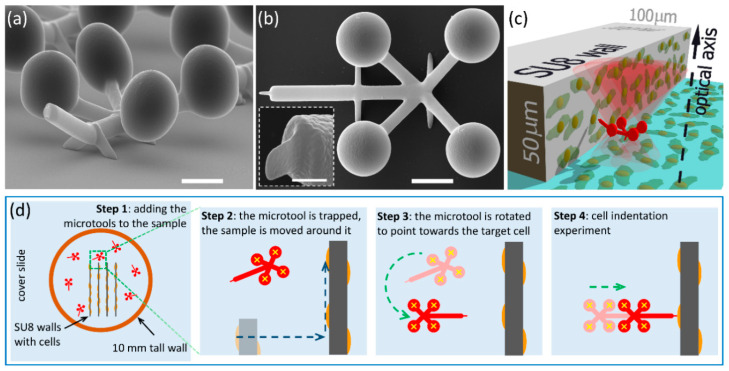
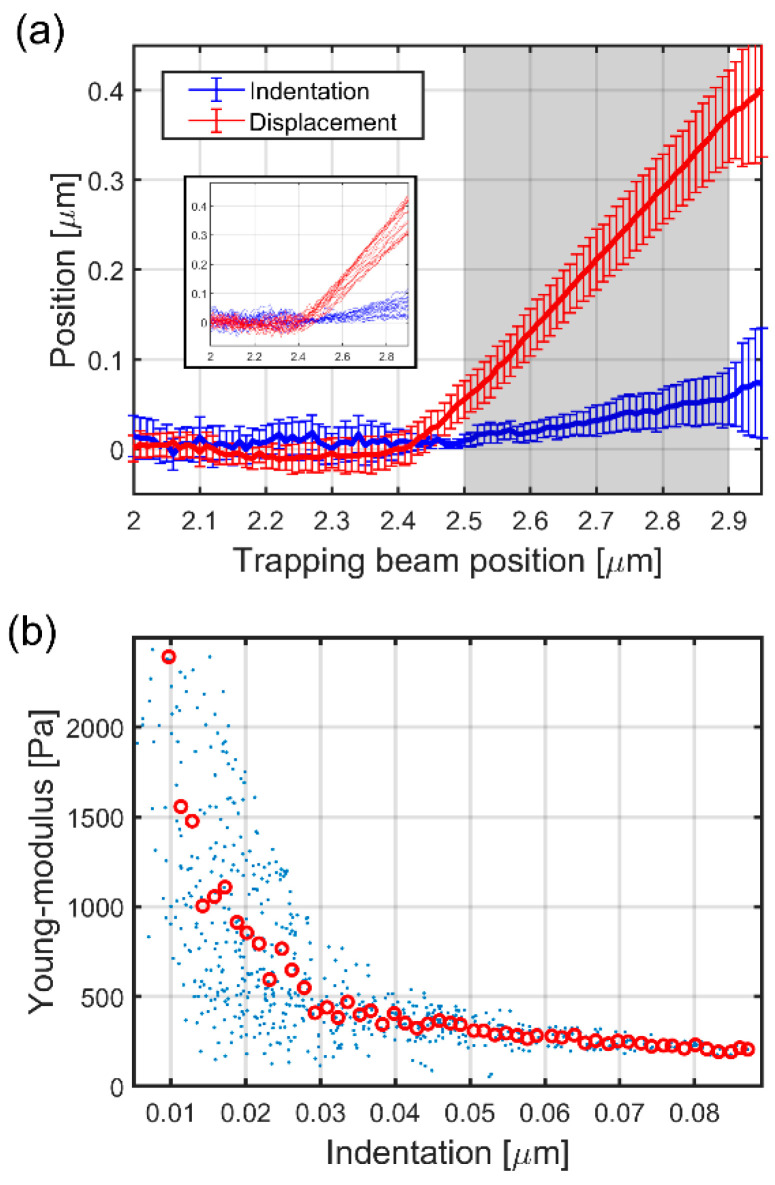
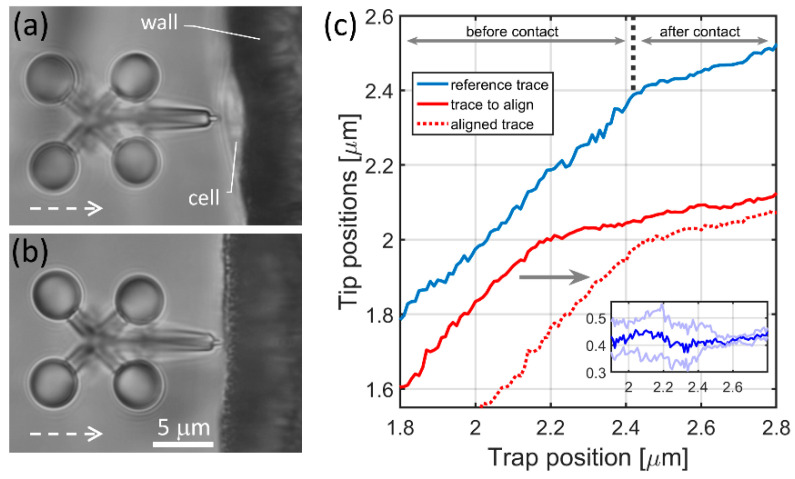
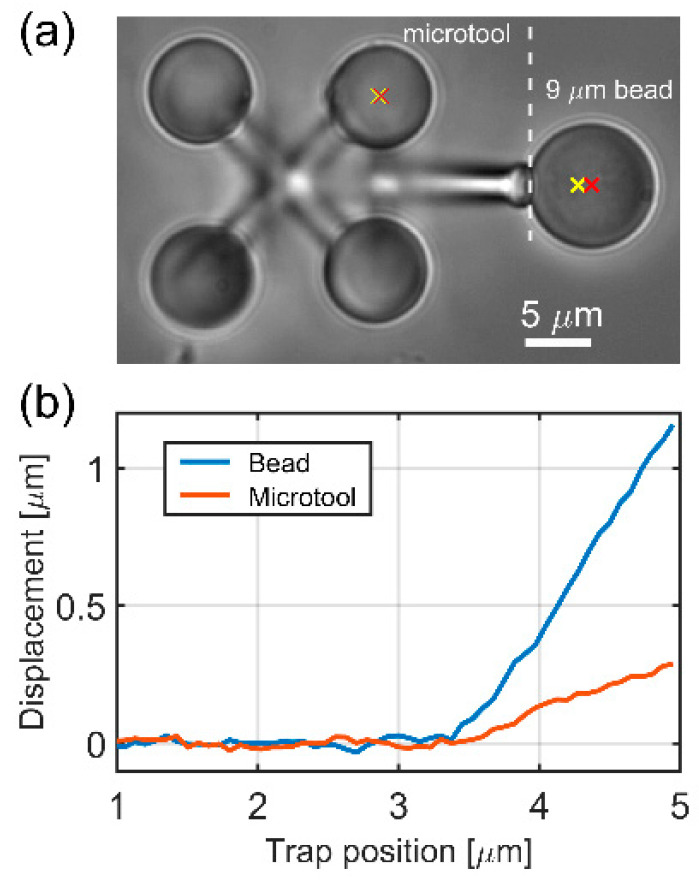
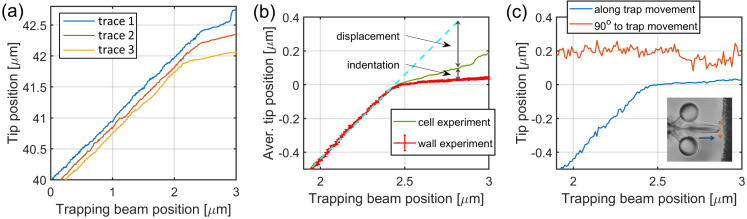
A cell elasticity measurement method is introduced that uses polymer microtools actuated by holographic optical tweezers. The microtools were prepared with two-photon polymerization. Their shape enables the approach of the cells in any lateral direction. In the presented case, endothelial cells grown on vertical polymer walls were probed by the tools in a lateral direction. The use of specially shaped microtools prevents the target cells from photodamage that may arise during optical trapping. The position of the tools was recorded simply with video microscopy and analyzed with image processing methods. We critically compare the resulting Young's modulus values to those in the literature obtained by other methods. The application of optical tweezers extends the force range available for cell indentations measurements down to the fN regime. Our approach demonstrates a feasible alternative to the usual vertical indentation experiments.
介绍了一种细胞弹性测量方法,该方法使用由全息光镊驱动的聚合物微工具。这些微工具通过双光子聚合制备。它们的形状使得能够从任何横向方向接近细胞。在本文所述的情况下,生长在垂直聚合物壁上的内皮细胞被这些工具从横向进行探测。使用特殊形状的微工具可防止目标细胞在光镊捕获过程中受到可能产生的光损伤。工具的位置通过视频显微镜简单记录,并使用图像处理方法进行分析。我们严格地将所得的杨氏模量值与文献中通过其他方法获得的值进行比较。光镊的应用将可用于细胞压痕测量的力范围扩展到了飞牛(fN)量级。我们的方法展示了一种不同于常规垂直压痕实验的可行替代方案。