Department of Internal Medicine, Chonnam National University Hwasun Hospital, Hwasun, Korea.
Department of Pathology, Chonnam National University Medical School, Gwangju, Korea.
Cancer Res Treat. 2021 Jan;53(1):93-103. doi: 10.4143/crt.2020.459. Epub 2020 Sep 21.
Osimertinib is a potent, irreversible third-generation epidermal growth factor receptor (EGFR) tyrosine kinase inhibitor for both EGFR-activating and T790M resistant mutation. The treatment efficacy of osimertinib was assessed in previously untreated patients with metastatic non-small cell lung carcinoma (NSCLC) harboring activating EGFR mutations in circulating tumor DNA (ctDNA) as well as tumor DNA.
Patients with activating EGFR mutations in their tumor DNA underwent screening with ctDNA analysis using Mutyper and Cobas v2 assays. Enrolled subjects received osimertinib 80 mg, once daily. Primary endpoint was objective response rate (ORR) and secondary endpoints were ctDNA test sensitivity, progression-free survival (PFS), duration of response (DoR), and safety.
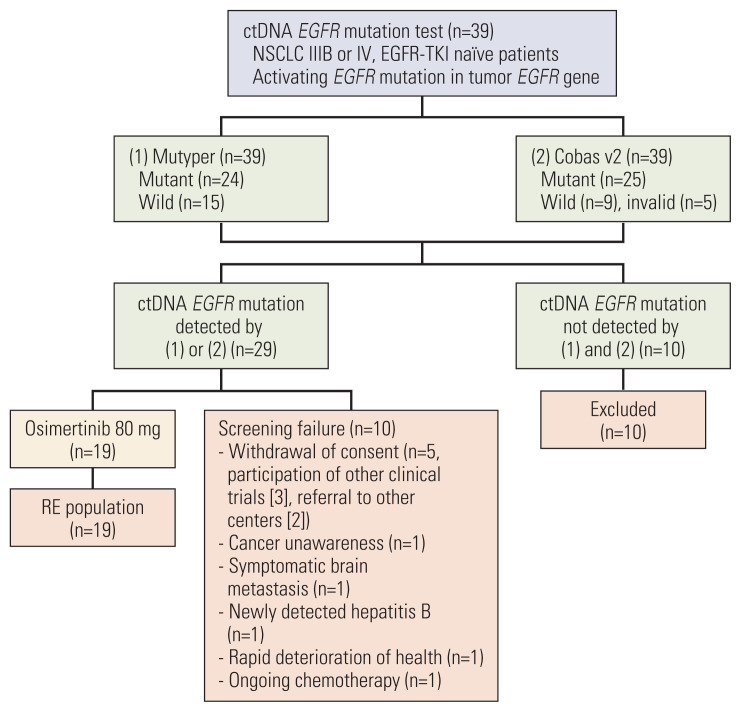
Among 39 screened patients, 29 were ctDNA positive for activating EGFR mutations and 19 were enrolled (ex19del, n=11; L858R/L861Q, n=7; G719A, n=1). Median age was 70 and most patients had brain metastases (15/19, 79%). ctDNA test sensitivity for activating EGFR mutations was 74% using both methods and 62% (Mutyper) or 64% (Cobas v2) for individual methods. ORR was 68% (13/19), median PFS was 11.1 months (95% confidence interval [CI], 0.0 to 26.7), and median DoR was 17.6 months (95% CI, 3.5 to 31.7). ORR and median PFS were significantly superior with ex19del (91%; 21.9 months; 95% CI, 5.5 to 38.3) than with L858R/L861Q (43%; 5.1 months; 95% CI, 2.3 to 7.9). One patient discontinued the drug because of drug-related interstitial pneumonitis.
Osimertinib had favorable efficacy in the first-line treatment of metastatic NSCLC harboring activating EGFR mutations in ctDNA as well as tumor DNA.
奥希替尼是一种强效、不可逆的第三代表皮生长因子受体(EGFR)酪氨酸激酶抑制剂,可同时针对 EGFR 激活和 T790M 耐药突变。奥希替尼在携带激活 EGFR 突变的转移性非小细胞肺癌(NSCLC)患者中的治疗效果,已在肿瘤 DNA(tumor DNA)和循环肿瘤 DNA(ctDNA)分析中进行了评估。
携带肿瘤 DNA 中激活 EGFR 突变的患者,采用 Mutyper 和 Cobas v2 检测进行 ctDNA 分析筛选。入组患者接受奥希替尼 80mg,每日一次。主要终点为客观缓解率(ORR),次要终点为 ctDNA 检测灵敏度、无进展生存期(PFS)、缓解持续时间(DoR)和安全性。
在 39 例筛选患者中,29 例 ctDNA 检测出激活 EGFR 突变,其中 19 例入组(外显子 19 缺失,n=11;L858R/L861Q,n=7;G719A,n=1)。中位年龄为 70 岁,大多数患者有脑转移(15/19,79%)。两种方法检测激活 EGFR 突变的 ctDNA 检测灵敏度均为 74%,两种方法单独检测灵敏度分别为 62%(Mutyper)和 64%(Cobas v2)。ORR 为 68%(19/29),中位 PFS 为 11.1 个月(95%CI,0.0 至 26.7),中位 DoR 为 17.6 个月(95%CI,3.5 至 31.7)。外显子 19 缺失(91%;21.9 个月;95%CI,5.5 至 38.3)与 L858R/L861Q(43%;5.1 个月;95%CI,2.3 至 7.9)相比,ORR 和中位 PFS 显著更优。1 例患者因药物相关性间质性肺炎而停药。
奥希替尼在携带 ctDNA 和肿瘤 DNA 中激活 EGFR 突变的转移性 NSCLC 患者的一线治疗中具有良好的疗效。