Institute of Cancer Research, Department of Medicine I, Comprehensive Cancer Center, Medical University of Vienna, Borschkegasse 8a, 1090, Vienna, Austria.
Karl Landsteiner Institute of Lung Research and Pulmonary Oncology, Department of Respiratory and Critical Care Medicine, Hospital North, Vienna, Austria.
Target Oncol. 2021 Jan;16(1):77-84. doi: 10.1007/s11523-020-00781-3. Epub 2020 Dec 3.
The allele frequency of epidermal growth factor receptor (EGFR) mutations could be a potential molecular biomarker for the outcome of osimertinib therapy.
The purpose of our study was to assess the clinical relevance of the allele frequency of EGFR mutations in plasma-based circulating tumor DNA (ctDNA) before starting osimertinib therapy in patients with advanced EGFR-mutated non-small cell lung cancer (NSCLC) who had progressed under treatment with EGFR tyrosine kinase inhibitors (TKIs).
We enrolled 141 patients with advanced EGFR T790M-positive NSCLC who underwent second-line osimertinib treatment. Plasma ctDNA was tested for EGFR-activating mutations (EGFR deletions in exon 19, L858R, L861Q, S768I) and T790M by means of droplet digital polymerase chain reaction (ddPCR).
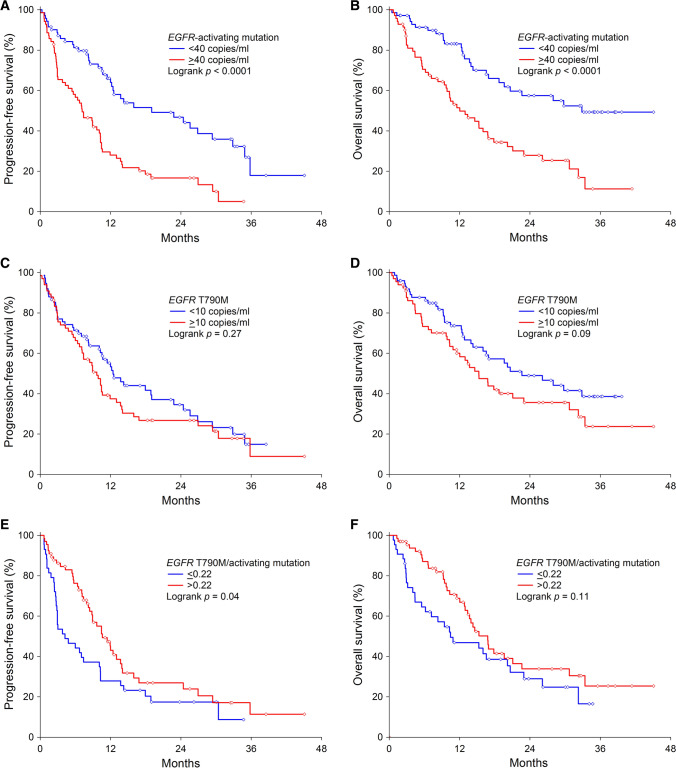
The allele frequency of EGFR-activating mutations in plasma ctDNA before osimertinib initiation ranged from 0 to 81,543 copies/ml and was independently associated with progression-free survival (PFS) and overall survival (OS) after adjusting for known clinicopathological risk factors (PFS: adjusted hazard ratio [HR] 1.26, 95% confidence interval [CI] 1.15-1.39, P < 0.0001; OS: adjusted HR 1.32, 95% CI 1.18-1.47, P < 0.0001). The allele frequency of T790M in plasma ctDNA before starting osimertinib therapy ranged from 0 to 38,092 copies/ml. Multivariate analyses showed that a higher T790M allele frequency was associated with a trend towards a shorter PFS (adjusted HR 1.19, 95% CI 0.99-1.42, P = 0.05) and a significantly shorter OS (adjusted HR 1.25, 95% CI 1.02-1.53, P = 0.03) of the patients.
A higher allele frequency of EGFR mutations, particularly EGFR-activating mutations, in plasma ctDNA is a poor prognostic marker. Further studies on the clinical utility of liquid biopsy are needed.
表皮生长因子受体(EGFR)突变的等位基因频率可能是奥希替尼治疗结果的潜在分子生物标志物。
我们的研究目的是评估在接受 EGFR 酪氨酸激酶抑制剂(TKI)治疗后进展的晚期 EGFR 突变型非小细胞肺癌(NSCLC)患者开始奥希替尼治疗前血浆循环肿瘤 DNA(ctDNA)中 EGFR 突变的等位基因频率的临床相关性。
我们纳入了 141 名接受二线奥希替尼治疗的晚期 EGFR T790M 阳性 NSCLC 患者。通过液滴数字聚合酶链反应(ddPCR)检测血浆 ctDNA 中的 EGFR 激活突变(外显子 19 缺失、L858R、L861Q、S768I)和 T790M。
奥希替尼起始前血浆 ctDNA 中 EGFR 激活突变的等位基因频率范围为 0 至 81,543 拷贝/ml,与无进展生存期(PFS)和总生存期(OS)独立相关,调整已知临床病理危险因素后(PFS:调整后的危险比[HR]1.26,95%置信区间[CI]1.15-1.39,P<0.0001;OS:调整后的 HR 1.32,95%CI 1.18-1.47,P<0.0001)。奥希替尼治疗前血浆 ctDNA 中 T790M 的等位基因频率范围为 0 至 38,092 拷贝/ml。多变量分析表明,较高的 T790M 等位基因频率与较短的 PFS (调整后的 HR 1.19,95%CI 0.99-1.42,P=0.05)和显著较短的 OS(调整后的 HR 1.25,95%CI 1.02-1.53,P=0.03)相关。
血浆 ctDNA 中 EGFR 突变(尤其是 EGFR 激活突变)的等位基因频率较高是预后不良的标志物。需要进一步研究液体活检的临床应用。