Interventional Neuroradiology, Beijing Tiantan Hospital, Beijing, China.
Neurosurgery, First Affiliated Hospital of Harbin Medical University, Harbin, China.
Stroke Vasc Neurol. 2021 Mar;6(1):95-102. doi: 10.1136/svn-2020-000391. Epub 2020 Sep 24.
Hyperperfusion (HP) is a devastating complication associated with carotid artery stenting (CAS) or endarterectomy. The efficacy and safety of staged angioplasty (SAP) in patients with CAS at high risk of HP remains unclear. We sought to determine whether SAP is superior to regular CAS in patients with high risk of HP.
A randomised, multicentre open-label clinical trial with blinded outcome assessment (STEP) was conducted. Patients with severe carotid stenosis at high risk of HP were randomly assigned (1:1) to the SAP or regular CAS group. The primary endpoint was hyperperfusion syndrome (HPS) and intracerebral haemorrhage (ICH) within 30 days after the procedure.
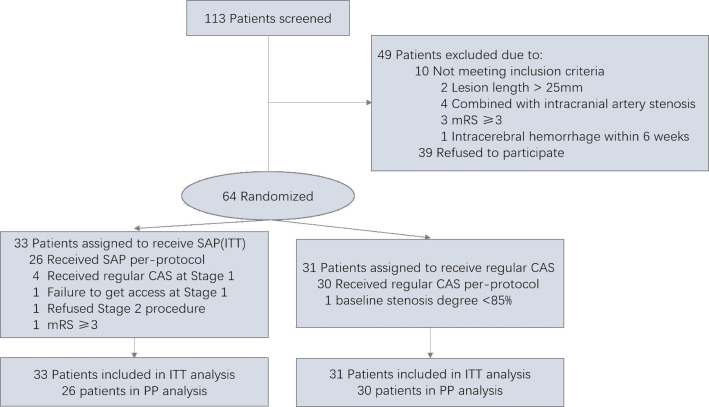
From November 2014 to January 2017, a total of 64 patients were enrolled in 11 centres. 33 patients were allocated to the SAP group and 31 to the regular CAS group. At 30 days, the rate of primary endpoint was 0.0% (0/33) in the SAP group and 9.7% (3/31) in the regular CAS group (absolute risk reduction (ARR), 9.7%; 95% CI -20.1% to 0.7%; p=0.11). As one of the secondary endpoints, the incidence of HP phenomenon (HPP) was lower in the SAP group than the regular CAS group (0.0% vs 22.6%, ARR,-22.6%; 95% CI -36.8% to -10.2%; p=0.04).
The rate of HPS and ICH was not significantly lower in SAP group; the extended secondary endpoint of HPP, however, significantly reduced, which suggested that SAP may be a safe and effective carotid revascularisation procedure to prevent HP.
NCT02224209.
高灌注(HP)是颈动脉支架置入术(CAS)或内膜切除术相关的一种破坏性并发症。对于有 HP 高风险的 CAS 患者,分期血管成形术(SAP)的疗效和安全性尚不清楚。我们旨在确定 SAP 是否优于 HP 高风险患者的常规 CAS。
采用随机、多中心、开放标签、盲法结局评估的临床试验(STEP)。将有 HP 高风险的严重颈动脉狭窄患者按 1:1 随机分配至 SAP 或常规 CAS 组。主要终点为术后 30 天内发生高灌注综合征(HPS)和颅内出血(ICH)。
2014 年 11 月至 2017 年 1 月,共有 64 例患者纳入 11 个中心。33 例患者被分配至 SAP 组,31 例患者被分配至常规 CAS 组。30 天时,SAP 组的主要终点发生率为 0.0%(0/33),常规 CAS 组为 9.7%(3/31)(绝对风险降低(ARR)9.7%;95%CI-20.1%0.7%;p=0.11)。作为次要终点之一,SAP 组的 HP 现象(HPP)发生率低于常规 CAS 组(0.0%比 22.6%,ARR-22.6%;95%CI-36.8%-10.2%;p=0.04)。
SAP 组的 HPS 和 ICH 发生率没有显著降低;然而,扩展的次要终点 HPP 显著减少,这表明 SAP 可能是一种安全有效的颈动脉血运重建术,可预防 HP。
NCT02224209。