Rheonova, domaine universitaire, 1270 rue de la piscine, 38400, Saint Martin d'Hères, France.
Service Hospitalo-Universitaire de Pneumologie et Physiologie, Pôle Thorax et Vaisseaux, Centre hospitalier universitaire de Grenoble-Alpes, Boulevard de la Chantourne, 38700, La Tronche, France.
Sci Rep. 2020 Sep 24;10(1):15685. doi: 10.1038/s41598-020-72672-6.
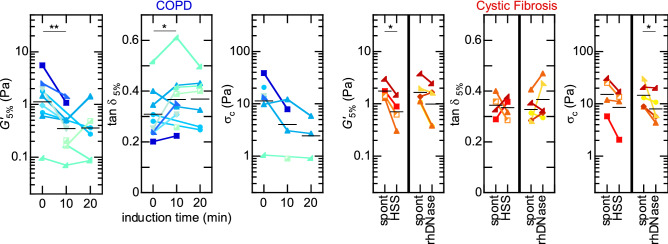
Bronchial diseases are characterised by the weak efficiency of mucus transport through the lower airways, leading in some cases to the muco-obstruction of bronchi. It has been hypothesised that this loss of clearance results from alterations in the mucus rheology, which are reflected in sputum samples collected from patients, making sputum rheology a possible biophysical marker of these diseases and their evolution. However, previous rheological studies have focused on quasi-static viscoelastic (linear storage and loss moduli) properties only, which are not representative of the mucus mobilisation within the respiratory tract. In this paper, we extend this approach further, by analysing both quasi-static and some dynamic (flow point) properties, to assess their usability and relative performance in characterising several chronic bronchial diseases (asthma, chronic obstructive pulmonary disease, and cystic fibrosis) and distinguishing them from healthy subjects. We demonstrate that pathologies influence substantially the linear and flow properties. Linear moduli are weakly condition-specific and even though the corresponding ranges overlap, distinct levels can be identified. This directly relates to the specific mucus structure in each case. In contrast, the flow point is found to strongly increase in muco-obstructive diseases, which may reflect the complete failure of mucociliary clearance causing episodic obstructions. These results suggest that the analysis of quasi-static and dynamic regimes in sputum rheology is in fact useful as these regimes provide complementary markers of chronic bronchial diseases.
支气管疾病的特征是下呼吸道内的黏液输送效率低下,在某些情况下会导致支气管黏液阻塞。据推测,这种清除能力的丧失是由于黏液流变学的改变所致,这些改变反映在从患者中收集的痰液样本中,使痰液流变学成为这些疾病及其演变的潜在生物物理标志物。然而,以前的流变学研究仅集中在准静态粘弹性(线性储能和损耗模量)特性上,这些特性不能代表呼吸道内的黏液移动性。在本文中,我们通过分析准静态和一些动态(流动点)特性进一步扩展了这种方法,以评估它们在表征几种慢性支气管疾病(哮喘、慢性阻塞性肺疾病和囊性纤维化)及其与健康受试者的区分方面的可用性和相对性能。我们证明了病理变化对线性和流动特性有很大影响。线性模量与条件的相关性较弱,尽管对应的范围重叠,但可以识别出不同的水平。这直接与每种情况下的特定黏液结构有关。相比之下,在黏液阻塞性疾病中发现流动点显著增加,这可能反映了黏液纤毛清除的完全失败,导致间歇性阻塞。这些结果表明,在痰液流变学中分析准静态和动态状态实际上是有用的,因为这些状态提供了慢性支气管疾病的补充标志物。