Niu Jianfang, Yan Taiqiang, Guo Wei, Wang Wei, Zhao Zhiqing, Ren Tingting, Huang Yi, Zhang Hongliang, Yu Yiyang, Liang Xin
Musculoskeletal Tumor Center, Peking University People's Hospital, Peking University, Beijing, China.
Beijing Key Laboratory of Musculoskeletal Tumor, Peking University People's Hospital, Beijing, China.
Front Oncol. 2020 Aug 21;10:1628. doi: 10.3389/fonc.2020.01628. eCollection 2020.
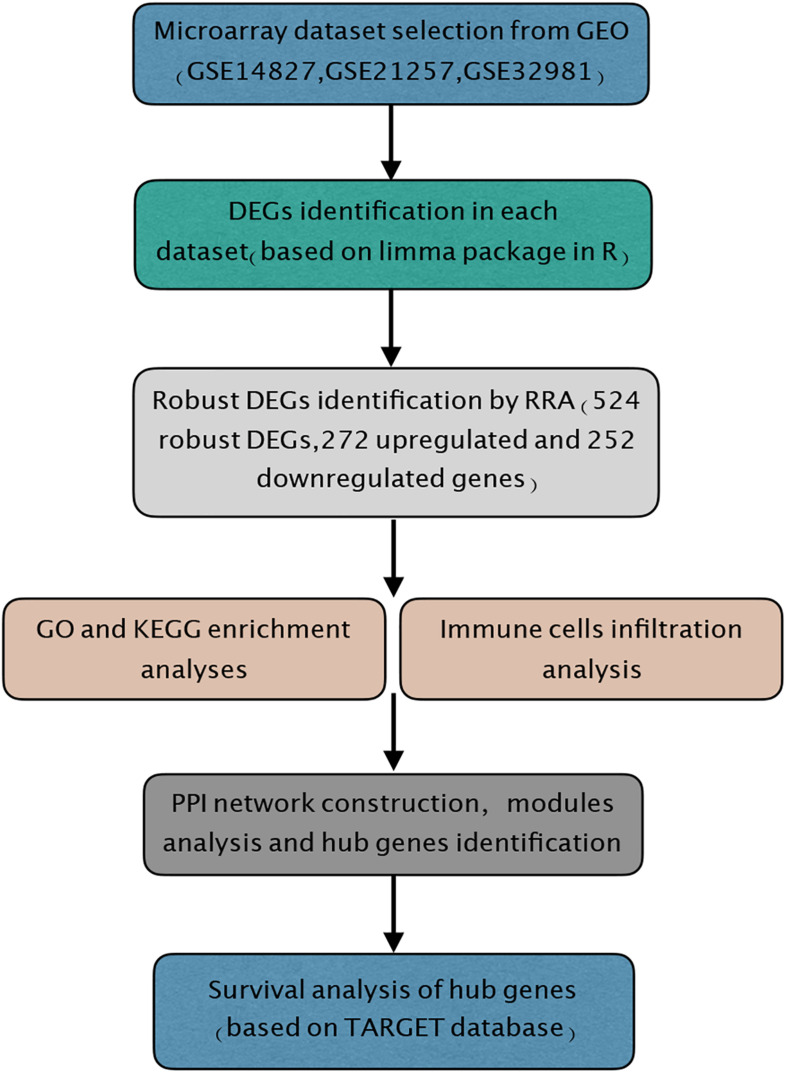
Osteosarcoma is one of the most aggressive malignant bone tumors worldwide. Although great advancements have been made in its treatment owing to the advent of neoadjuvant chemotherapy, the problem of lung metastasis is a major obstacle in the improvement of survival outcomes. Thus, the aim of the present study is to screen novel and key biomarkers, which may act as potential prognostic markers and therapeutic targets in osteosarcoma. We utilized the robust rank aggregation (RRA) method to integrate three osteosarcoma microarray datasets downloaded from the Gene Expression Omnibus (GEO) database, and we identified the robust differentially expressed genes (DEGs) between primary and metastatic osteosarcoma tissues. Gene Ontology (GO) and Kyoto Encyclopedia of Genes and Genomes (KEGG) enrichment analyses were performed to explore the functions of robust DEGs. The results of enrichment analysis showed that the robust DEGs were closely associated with osteosarcoma development and progression. Immune cell infiltration analysis was also conducted by CIBERSORT algorithm, and we found that macrophages are the most principal infiltrating immune cells in osteosarcoma, especially macrophages M0 and M2. Then, the protein-protein interaction network and key modules were constructed by Cytoscape, and 10 hub genes were selected by plugin cytoHubba from the whole network. The survival analysis of hub genes was also carried out based on the Therapeutically Applicable Research to Generate Effective Treatments (TARGET) database. The integrated bioinformatics analysis was utilized to provide new insight into osteosarcoma development and metastasis and identified , , , and as potential biomarkers for prognosis of osteosarcoma.
骨肉瘤是全球最具侵袭性的恶性骨肿瘤之一。尽管由于新辅助化疗的出现,其治疗取得了巨大进展,但肺转移问题仍是改善生存结局的主要障碍。因此,本研究的目的是筛选新的关键生物标志物,这些标志物可能作为骨肉瘤潜在的预后标志物和治疗靶点。我们利用稳健秩聚合(RRA)方法整合从基因表达综合数据库(GEO)下载的三个骨肉瘤微阵列数据集,并鉴定原发性和转移性骨肉瘤组织之间的稳健差异表达基因(DEG)。进行基因本体(GO)和京都基因与基因组百科全书(KEGG)富集分析以探索稳健DEG的功能。富集分析结果表明,稳健DEG与骨肉瘤的发生和进展密切相关。还通过CIBERSORT算法进行免疫细胞浸润分析,我们发现巨噬细胞是骨肉瘤中最主要的浸润免疫细胞,尤其是M0和M2巨噬细胞。然后,用Cytoscape构建蛋白质-蛋白质相互作用网络和关键模块,并从整个网络中通过插件cytoHubba选择10个枢纽基因。还基于治疗应用研究生成有效治疗方法(TARGET)数据库对枢纽基因进行生存分析。综合生物信息学分析为骨肉瘤的发生和转移提供了新的见解,并鉴定出 、 、 和 作为骨肉瘤预后的潜在生物标志物。