Department of Epidemiology College of Public Health Harbin Medical University Harbin Heilongjiang Province P.R. China.
Department of Community Health Sciences University of Calgary Alberta Canada.
J Am Heart Assoc. 2020 Oct 20;9(19):e016804. doi: 10.1161/JAHA.120.016804. Epub 2020 Sep 25.
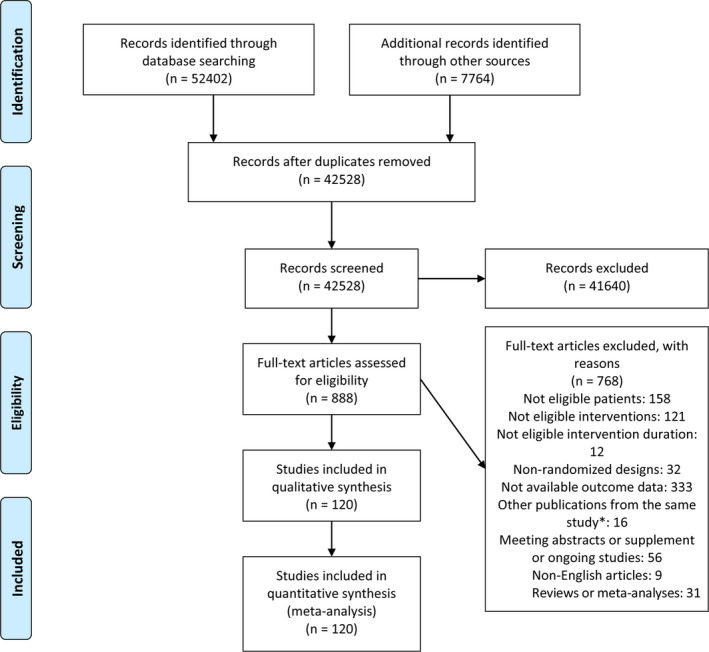
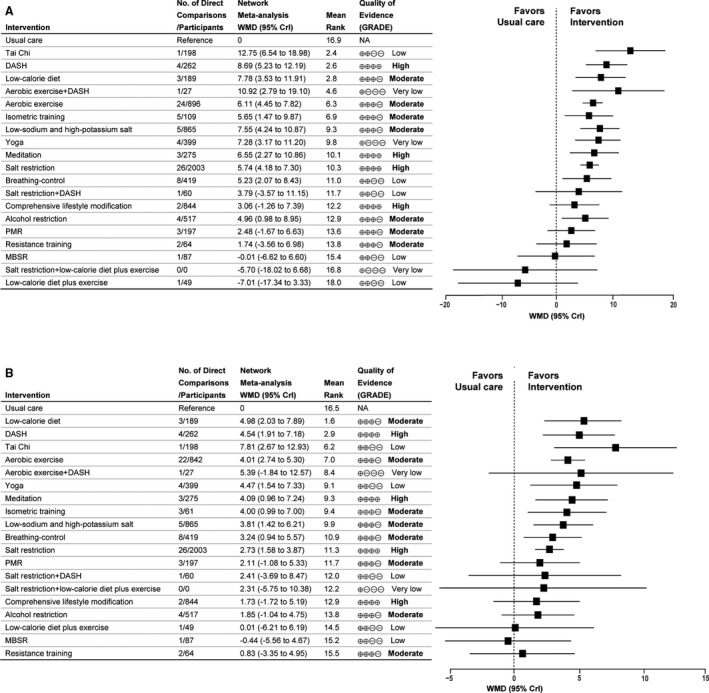
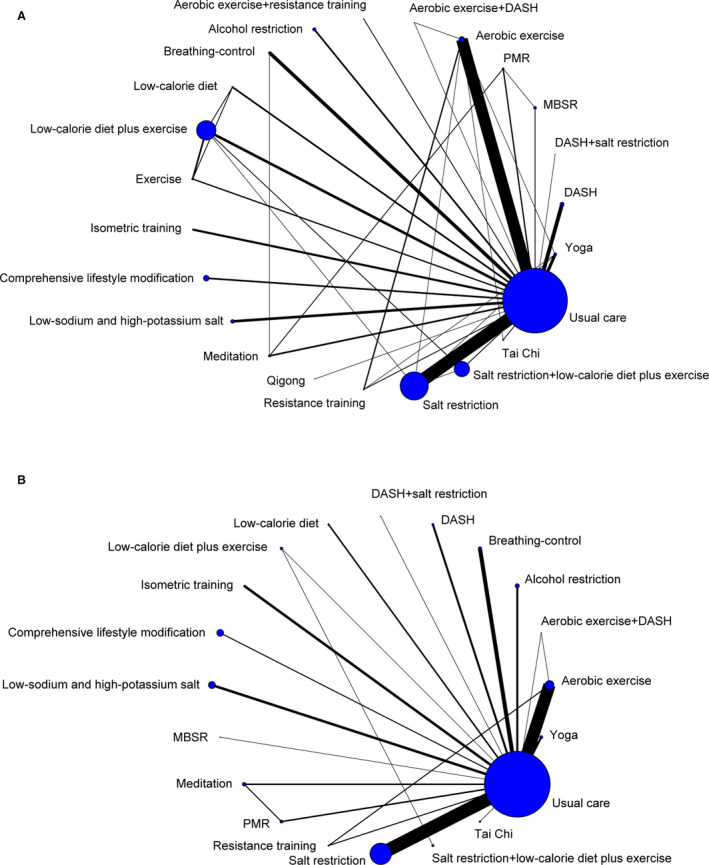
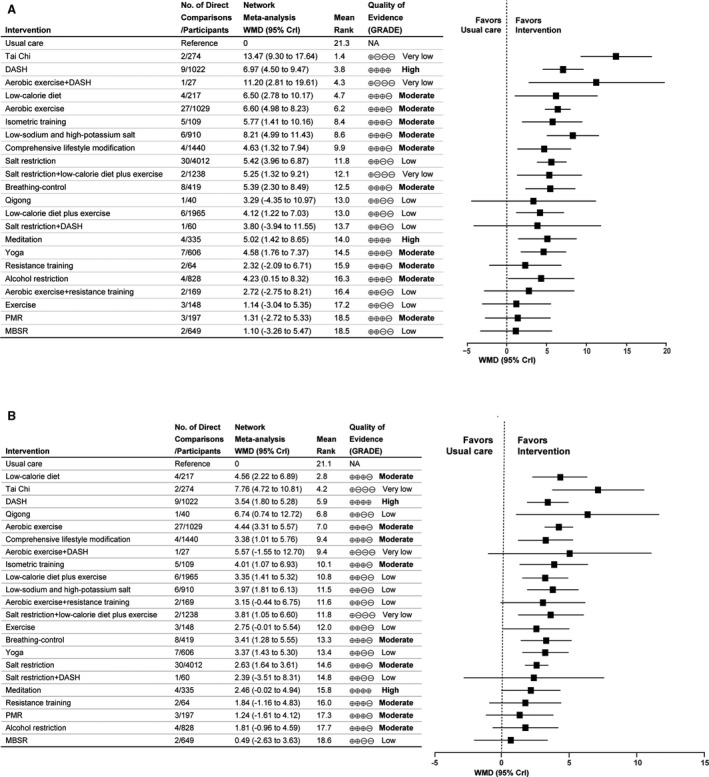
Background Nonpharmacologic interventions that modify lifestyle can lower blood pressure (BP) and have been assessed in numerous randomized controlled trials and pairwise meta-analyses. It is still unclear which intervention would be most efficacious. Methods and Results Bayesian network meta-analyses were performed to estimate the comparative effectiveness of different interventions for lowering BP. From 60 166 potentially relevant articles, 120 eligible articles (14 923 participants) with a median follow-up of 12 weeks, assessing 22 nonpharmacologic interventions, were included. According to the surface under the cumulative ranking probabilities and Grading of Recommendations Assessment, Development and Evaluation (GRADE) quality of evidence, for adults with prehypertension to established hypertension, high-quality evidence indicated that the Dietary Approach to Stop Hypertension (DASH) was superior to usual care and all other nonpharmacologic interventions in lowering systolic BP (weighted mean difference, 6.97 mm Hg; 95% credible interval, 4.50-9.47) and diastolic BP (weighted mean difference, 3.54 mm Hg; 95% credible interval, 1.80-5.28). Compared with usual care, moderate- to high-quality evidence indicated that aerobic exercise, isometric training, low-sodium and high-potassium salt, comprehensive lifestyle modification, breathing-control, and meditation could lower systolic BP and diastolic BP. For patients with hypertension, moderate- to high-quality evidence suggested that the interventions listed (except comprehensive lifestyle modification) were associated with greater systolic BP and diastolic BP reduction than usual care; salt restriction was also effective in lowering both systolic BP and diastolic BP. Among overweight and obese participants, low-calorie diet and low-calorie diet plus exercise could lower more BP than exercise. Conclusions DASH might be the most effective intervention in lowering BP for adults with prehypertension to established hypertension. Aerobic exercise, isometric training, low-sodium and high-potassium salt, comprehensive lifestyle modification, salt restriction, breathing-control, meditation and low-calorie diet also have obvious effects on BP reduction.
改变生活方式的非药物干预措施可以降低血压(BP),并已在许多随机对照试验和成对荟萃分析中进行了评估。目前仍不清楚哪种干预措施最有效。
进行贝叶斯网络荟萃分析,以估计不同干预措施降低 BP 的相对有效性。从 60166 篇潜在相关文章中,纳入了 120 篇符合条件的文章(14923 名参与者,中位随访时间为 12 周),评估了 22 种非药物干预措施。根据累积排序概率曲线下面积和推荐评估、制定与评估(GRADE)证据质量分级,对于高血压前期至确诊高血压的成年人,高质量证据表明,膳食干预防治高血压(DASH)饮食优于常规护理和所有其他非药物干预措施,可更有效降低收缩压(加权均数差,6.97mmHg;95%可信区间,4.50-9.47)和舒张压(加权均数差,3.54mmHg;95%可信区间,1.80-5.28)。与常规护理相比,中至高质量证据表明,有氧运动、等长训练、低钠高钾盐、综合生活方式改变、呼吸控制和冥想可以降低收缩压和舒张压。对于高血压患者,中至高质量证据表明,除综合生活方式改变外,所列干预措施与常规护理相比,收缩压和舒张压降低更明显;盐限制也能有效降低收缩压和舒张压。在超重和肥胖参与者中,低热量饮食和低热量饮食加运动比运动更能降低血压。
对于高血压前期至确诊高血压的成年人,DASH 可能是降低血压最有效的干预措施。有氧运动、等长训练、低钠高钾盐、综合生活方式改变、盐限制、呼吸控制、冥想和低热量饮食也对降低血压有明显效果。