MacDonald Hayley V, Johnson Blair T, Huedo-Medina Tania B, Livingston Jill, Forsyth Kym C, Kraemer William J, Farinatti Paulo T V, Pescatello Linda S
Department of Kinesiology, The University of Alabama, Tuscaloosa, AL Department of Kinesiology, University of Connecticut, Storrs, CT Institute for Collaboration on Health, Intervention, and Policy (InCHIP), University of Connecticut, Storrs, CT
Department of Psychological Sciences, University of Connecticut, Storrs, CT Institute for Collaboration on Health, Intervention, and Policy (InCHIP), University of Connecticut, Storrs, CT.
J Am Heart Assoc. 2016 Sep 28;5(10):e003231. doi: 10.1161/JAHA.116.003231.
Aerobic exercise (AE) is recommended as first-line antihypertensive lifestyle therapy based on strong evidence showing that it lowers blood pressure (BP) 5 to 7 mm Hg among adults with hypertension. Because of weaker evidence showing that dynamic resistance training (RT) reduces BP 2 to 3 mm Hg among adults with hypertension, it is recommended as adjuvant lifestyle therapy to AE training. Yet, existing evidence suggests that dynamic RT can lower BP as much or more than AE.
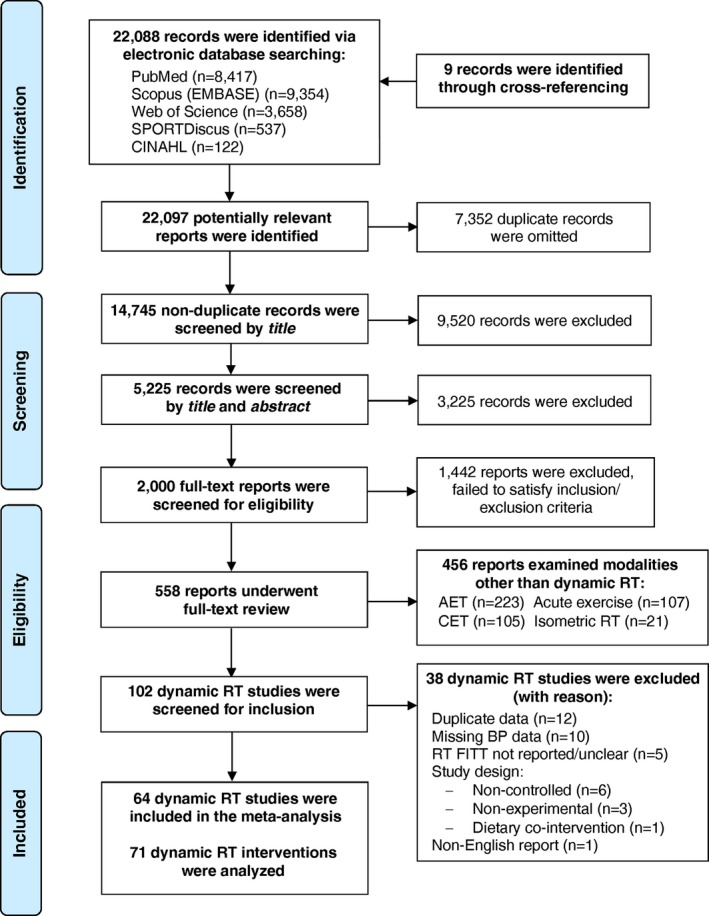
We meta-analyzed 64 controlled studies (71 interventions) to determine the efficacy of dynamic RT as stand-alone antihypertensive therapy. Participants (N=2344) were white (57%), middle-aged (47.2±19.0 years), and overweight (26.8±3.4 kg/m(2)) adults with prehypertension (126.7±10.3/76.8±8.7 mm Hg); 15% were on antihypertensive medication. Overall, moderate-intensity dynamic RT was performed 2.8±0.6 days/week for 14.4±7.9 weeks and elicited small-to-moderate reductions in systolic BP (SBP; d+=-0.31; 95% CIs, -0.43, -0.19; -3.0 mm Hg) and diastolic BP (DBP; d+=-0.30; 95% CIs, -0.38, -0.18; -2.1 mm Hg) compared to controls (Ps<0.001). Greater BP reductions occurred among samples with higher resting SBP/DBP: ≈6/5 mm Hg for hypertension, ≈3/3 mm Hg for prehypertension, and ≈0/1 mm Hg for normal BP (Ps<0.023). Furthermore, nonwhite samples with hypertension experienced BP reductions that were approximately twice the magnitude of those previously reported following AE training (-14.3 mm Hg [95% CIs, -19.0, -9.4]/-10.3 mm Hg [95% CIs, -14.5, -6.2]).
Our results indicate that for nonwhite adult samples with hypertension, dynamic RT may elicit BP reductions that are comparable to or greater than those reportedly achieved with AE training. Dynamic RT should be further investigated as a viable stand-alone therapeutic exercise option for adult populations with high BP.
有氧运动(AE)被推荐作为一线抗高血压生活方式疗法,因为有力证据表明,它可使高血压成年人的血压(BP)降低5至7毫米汞柱。由于证据显示动态抗阻训练(RT)在高血压成年人中使血压降低2至3毫米汞柱的力度较弱,所以它被推荐作为AE训练的辅助生活方式疗法。然而,现有证据表明,动态RT降低血压的幅度与AE相当或更大。
我们对64项对照研究(71项干预措施)进行了荟萃分析,以确定动态RT作为独立抗高血压疗法的疗效。参与者(N = 2344)为白人(57%)、中年(47.2±19.0岁)、超重(26.8±3.4千克/米²)的高血压前期成年人(收缩压/舒张压为126.7±10.3/76.8±8.7毫米汞柱);15%的人正在服用抗高血压药物。总体而言,中等强度动态RT每周进行2.8±0.6天,共14.4±7.9周,与对照组相比,收缩压(SBP)出现了小到中等程度的降低(d+=-0.31;95%可信区间为-0.43至-0.19;降低3.0毫米汞柱),舒张压(DBP)也出现了类似降低(d+=-0.30;95%可信区间为-0.38至-0.18;降低2.1毫米汞柱)(P<0.001)。静息SBP/DBP较高的样本血压降低幅度更大:高血压患者约降低6/5毫米汞柱,高血压前期患者约降低3/3毫米汞柱,血压正常者约降低0/1毫米汞柱(P<0.023)。此外,患有高血压的非白人样本的血压降低幅度约为先前报道的AE训练后降低幅度的两倍(-14.3毫米汞柱[95%可信区间为-19.0至-9.4]/-10.3毫米汞柱[95%可信区间为-14.5至-6.2])。
我们的结果表明,对于患有高血压的非白人成年样本,动态RT引起的血压降低幅度可能与AE训练相当或更大。动态RT应作为高血压成年人群可行的独立治疗性运动选择进行进一步研究。