Department of Histology and Embryology, University of Medical Sciences, Swiecicki Street 6, 60-781 Poznań, Poland.
Int J Mol Sci. 2020 Sep 23;21(19):6995. doi: 10.3390/ijms21196995.
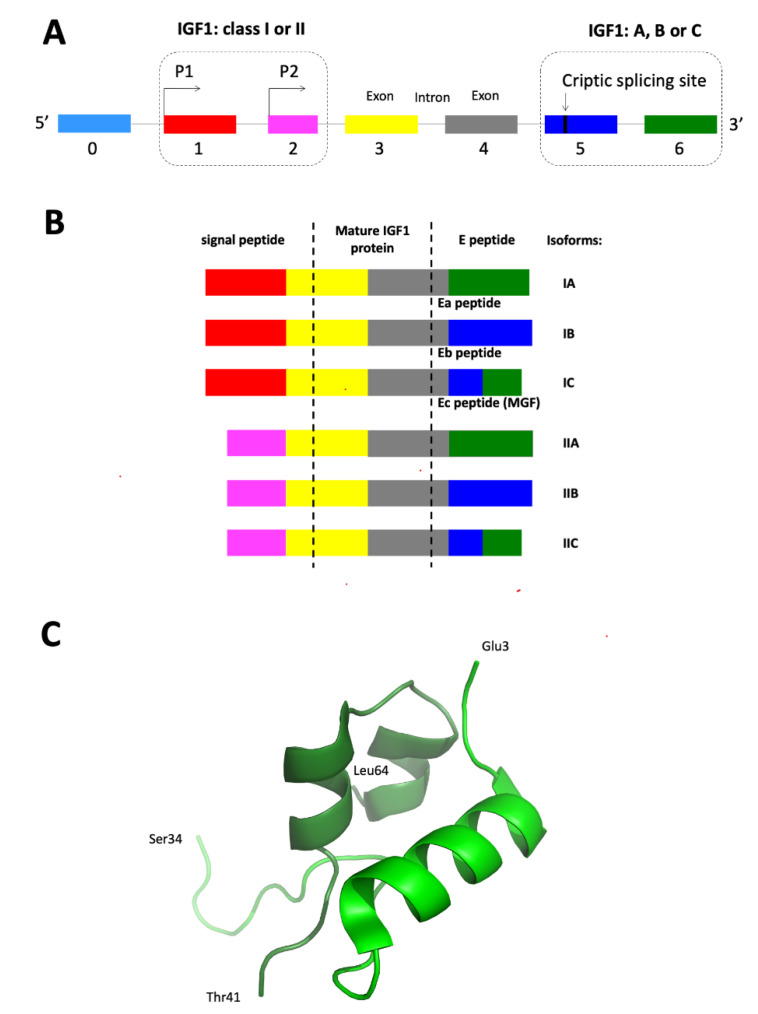
Insulin-like growth factor 1 (IGF1) is a key regulator of tissue growth and development that is also implicated in the initiation and progression of various cancers. The human IGF1 gene contains six exons and five long introns, the transcription of which is controlled by two promoters (P1 and P2). Alternate promoter usage, as well as alternative splicing (AS) of results in the expression of six various variants (isoforms) of mRNA, i.e., IA, IB, IC, IIA, IIB, and IIC. A mature 70-kDa IGF1 protein is coded only by exons 3 and 4, while exons 5 and 6 are alternatively spliced code for the three C-terminal E peptides: Ea (exon 6), Eb (exon 5), and Ec (fragments of exons 5 and 6). The most abundant of those transcripts is IGF1Ea, followed by IGF1Eb and IGF1Ec (also known as mechano-growth factor, MGF). The presence of different IGF1 transcripts suggests tissue-specific auto- and/or paracrine action, as well as separate regulation of both of these gene promoters. In physiology, the role of different IGF1 mRNA isoforms and pro-peptides is best recognized in skeletal muscle tissue. Their functions include the development and regeneration of muscles, as well as maintenance of proper muscle mass. In turn, in nervous tissue, a neuroprotective function of short peptides, produced as a result of IGF1 expression and characterized by significant blood-brain barrier penetrance, has been described and could be a potential therapeutic target. When it comes to the regulation of carcinogenesis, the potential biological role of different var iants of IGF1 mRNAs and pro-peptides is also intensively studied. This review highlights the role of IGF1 isoform expression (mRNAs, proteins) in physiology and different types of human tumors (e.g., breast cancer, cervical cancer, colorectal cancer, osteosarcoma, prostate and thyroid cancers), as well as mechanisms of IGF1 spliced variants involvement in tumor biology.
胰岛素样生长因子 1(IGF1)是一种组织生长和发育的关键调节剂,也与各种癌症的发生和发展有关。人类 IGF1 基因包含六个外显子和五个长内含子,其转录由两个启动子(P1 和 P2)控制。交替启动子的使用以及选择性剪接(AS)导致表达六种不同的信使 RNA 变体(同种型),即 IA、IB、IC、IIA、IIB 和 IIC。只有外显子 3 和 4 编码成熟的 70kDa IGF1 蛋白,而外显子 5 和 6 则选择性剪接编码三个 C 端 E 肽:Ea(外显子 6)、Eb(外显子 5)和 Ec(外显子 5 和 6 的片段)。这些转录本中最丰富的是 IGF1Ea,其次是 IGF1Eb 和 IGF1Ec(也称为机械生长因子,MGF)。不同 IGF1 转录本的存在表明存在组织特异性自分泌和/或旁分泌作用,以及这两个基因启动子的单独调节。在生理学中,不同 IGF1 mRNA 同种型和前肽的作用在骨骼肌组织中得到了最好的认识。它们的功能包括肌肉的发育和再生,以及适当的肌肉质量的维持。反过来,在神经组织中,已经描述了 IGF1 表达产生的短肽的神经保护功能,其特征是具有显著的血脑屏障通透性,并且可能是一个潜在的治疗靶点。当涉及到致癌作用的调节时,不同 IGF1 mRNA 变体和前肽的潜在生物学作用也在被深入研究。本综述强调了 IGF1 同种型表达(mRNA、蛋白质)在生理学和不同类型人类肿瘤(例如乳腺癌、宫颈癌、结直肠癌、骨肉瘤、前列腺癌和甲状腺癌)中的作用,以及 IGF1 剪接变体参与肿瘤生物学的机制。