Blood Service for Vienna, Lower Austria and Burgenland, Austrian Red Cross, Vienna, Austria.
Center for Virology, Medical University of Vienna, Vienna, Austria.
Transfusion. 2021 Jan;61(1):12-16. doi: 10.1111/trf.16119. Epub 2020 Oct 14.
Transfusion of severe acute respiratory syndrome coronavirus 2 (SARS-CoV-2) convalescent plasma is a promising treatment for severe coronavirus disease 2019 (COVID-19) cases, with success of the intervention based on neutralizing antibody content. Measurement by serologic correlates without biocontainment needs as well as an understanding of donor characteristics that may allow for targeting of more potent donors would greatly facilitate effective collection.
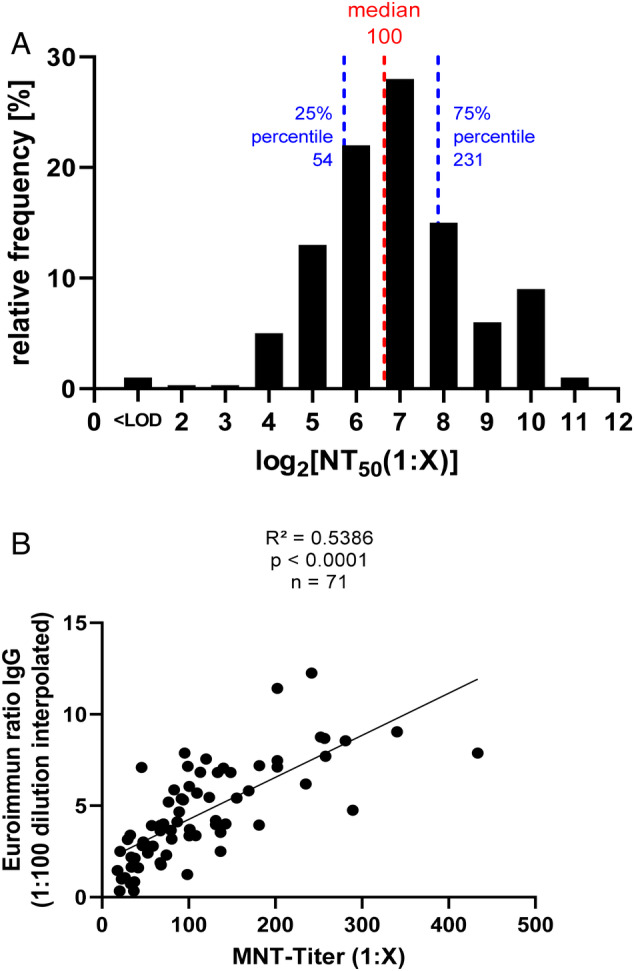
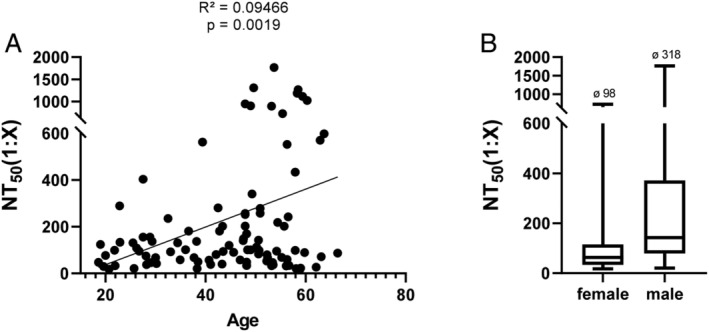
One hundred convalescent plasma units were characterized for functionally active SARS-CoV-2 neutralizing antibodies, as well as for SARS-CoV-2 binding antibodies, with the intention to establish a correlation between the functionally more relevant neutralization assay and the more accessible enzyme-linked immunosorbent assay (ELISA). Donor demographics such as COVID-19 severity, age, and sex were correlated with antibody titers.
A mean neutralization titer 50% of 230 (range, <8-1765) was seen for the 100 convalescent plasma units, with highly significant (P < .0001) yet quantitatively limited (R = 0.2830) correlation with results of the ELISA. Exclusion of units with particularly high titers (>500) from analysis improved correlation (R = 0.5386). A tendency of higher-titer plasma units from donors with increased disease severity, of advanced age, and of male sex was seen, yet the functional relevance of this difference is questionable.
The ELISA-based correlation to neutralization titer enabled a threshold proposal that could be used to eliminate lower-titer units from the clinical supply for COVID-19 treatment. Disease severity may be associated with the development of higher titers of neutralizing antibodies, although larger case numbers will be needed for additional confirmation.
输注严重急性呼吸综合征冠状病毒 2(SARS-CoV-2)恢复期血浆是治疗严重 2019 年冠状病毒病(COVID-19)的一种有前途的方法,干预的成功基于中和抗体含量。通过不需要生物控制的血清学相关性测量以及了解可能允许针对更有效供体的供体特征,将极大地促进有效的采集。
对 100 个恢复期血浆单位进行了功能性 SARS-CoV-2 中和抗体以及 SARS-CoV-2 结合抗体的特征分析,目的是建立功能相关性更强的中和测定法与更易获得的酶联免疫吸附测定法(ELISA)之间的相关性。将 COVID-19 严重程度、年龄和性别等供体特征与抗体滴度相关联。
100 个恢复期血浆单位的平均中和滴度为 50%,范围为<8-1765,与 ELISA 的结果具有高度显著(P < .0001)但数量有限的相关性(R = 0.2830)。从分析中排除具有特别高滴度(>500)的单位可提高相关性(R = 0.5386)。来自疾病严重程度增加、年龄较大和男性供体的高滴度血浆单位有增加的趋势,但这种差异的功能相关性值得怀疑。
基于 ELISA 的与中和滴度的相关性使我们能够提出一个阈值建议,该建议可用于从 COVID-19 治疗的临床供应中消除低滴度单位。疾病严重程度可能与中和抗体滴度的升高有关,但需要更多的病例数进行进一步确认。