National Microbiology Services, NHS Blood and Transplant, London, UK.
Statistics and Clinical Studies, NHS Blood and Transplant, Bristol, UK.
Transfus Med. 2021 Jun;31(3):167-175. doi: 10.1111/tme.12746. Epub 2020 Dec 17.
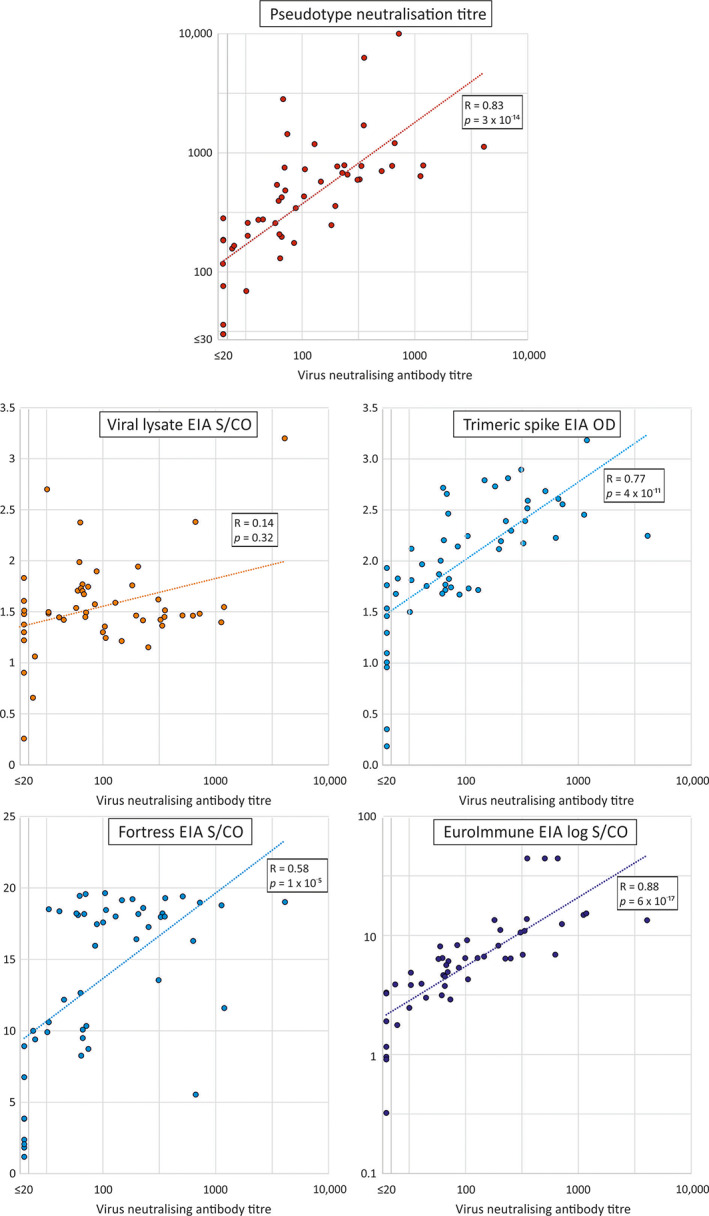
The lack of approved specific therapeutic agents to treat coronavirus disease (COVID-19) associated with severe acute respiratory syndrome coronavirus 2 (SARS-CoV-2) infection has led to the rapid implementation of convalescent plasma therapy (CPT) trials in many countries, including the United Kingdom. Effective CPT is likely to require high titres of neutralising antibody (nAb) in convalescent donations. Understanding the relationship between functional neutralising antibodies and antibody levels to specific SARS-CoV-2 proteins in scalable assays will be crucial for the success of a large-scale collection. We assessed whether neutralising antibody titres correlated with reactivity in a range of enzyme-linked immunosorbent assays (ELISA) targeting the spike (S) protein, the main target for human immune response.
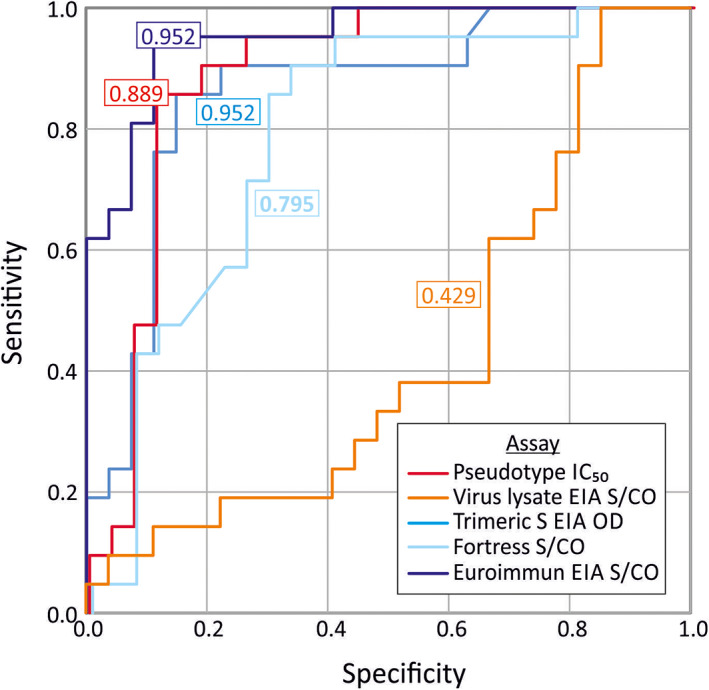
Blood samples were collected from 52 individuals with a previous laboratory-confirmed SARS-CoV-2 infection. These were assayed for SARS-CoV-2 nAbs by microneutralisation and pseudo-type assays and for antibodies by four different ELISAs. Receiver operating characteristic (ROC) analysis was used to further identify sensitivity and specificity of selected assays to identify samples containing high nAb levels.
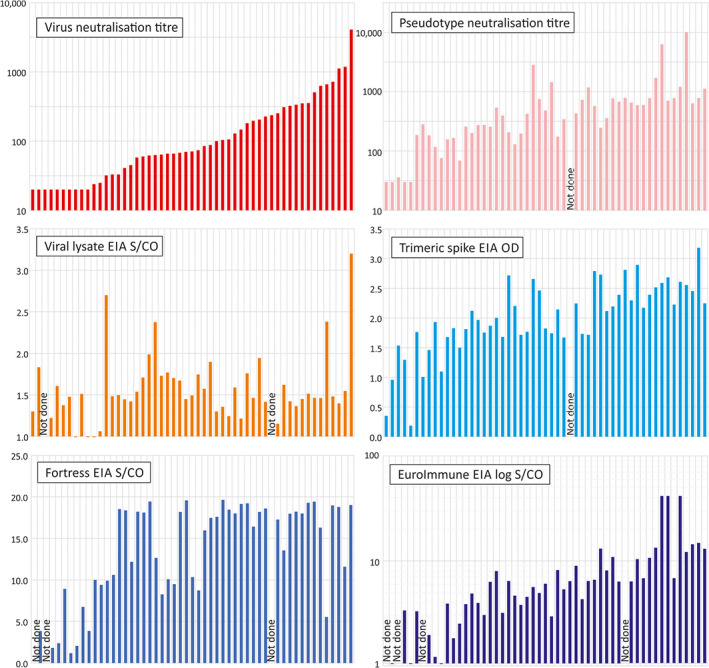
All samples contained SARS-CoV-2 antibodies, whereas neutralising antibody titres of greater than 1:20 were detected in 43 samples (83% of those tested) and >1:100 in 22 samples (42%). The best correlations were observed with EUROimmun immunoglobulin G (IgG) reactivity (Spearman Rho correlation coefficient 0.88; p < 0.001). Based on ROC analysis, EUROimmun would detect 60% of samples with titres of >1:100 with 100% specificity using a reactivity index of 9.1 (13/22).
Robust associations between nAb titres and reactivity in several ELISA-based antibody tests demonstrate their possible utility for scaled-up production of convalescent plasma containing potentially therapeutic levels of anti-SARS-CoV-2 nAbs.
由于缺乏针对严重急性呼吸综合征冠状病毒 2(SARS-CoV-2)感染的冠状病毒病(COVID-19)的批准的特定治疗药物,导致包括英国在内的许多国家迅速实施恢复期血浆疗法(CPT)试验。有效的 CPT 可能需要恢复期供体中具有高滴度的中和抗体(nAb)。在可扩展的测定中,了解功能性中和抗体与针对 SARS-CoV-2 蛋白的抗体水平之间的关系对于大规模采集的成功至关重要。我们评估了中和抗体滴度是否与针对刺突(S)蛋白的一系列酶联免疫吸附测定(ELISA)的反应性相关,S 蛋白是人类免疫反应的主要靶标。
从 52 名先前经实验室确诊的 SARS-CoV-2 感染患者中采集血液样本。通过微量中和和假型测定法对这些样本进行 SARS-CoV-2 nAb 检测,并通过四种不同的 ELISA 进行抗体检测。使用受试者工作特征(ROC)分析进一步确定选定测定法的灵敏度和特异性,以鉴定含有高 nAb 水平的样本。
所有样本均含有 SARS-CoV-2 抗体,而在 43 份样本(检测样本的 83%)中检测到中和抗体滴度大于 1:20,在 22 份样本(42%)中检测到大于 1:100。与 EUROimmun 免疫球蛋白 G(IgG)反应性观察到最佳相关性(Spearman Rho 相关系数 0.88;p<0.001)。根据 ROC 分析,使用反应性指数 9.1(22 个样本中的 13 个),EUROimmun 将以 100%特异性检测到 60%具有 >1:100 滴度的样本。
中和抗体滴度与几种基于 ELISA 的抗体检测的反应性之间存在稳健的关联,表明它们可能有助于大规模生产含有潜在治疗水平抗 SARS-CoV-2 nAb 的恢复期血浆。