Khalili Farhad, Najafi Behzad, Mansour-Ghanaei Fariborz, Yousefi Mahmood, Abdollahzad Hadi, Motlagh Ali
Department of Health Economics, School of Management and Medical Informatics, Tabriz University of Medical Sciences, Tabriz, Iran.
Iranian Center of Excellence in Health Management, School of Management and Medical Informatics, Tabriz University of Medical Sciences, Tabriz, Iran.
Risk Manag Healthc Policy. 2020 Sep 10;13:1499-1512. doi: 10.2147/RMHP.S262171. eCollection 2020.
Colorectal cancer (CRC) is a significant health problem with an increasing incidence worldwide. Screening is one of the ways, in which cases and deaths of CRC can be prevented. The objective of this systematic review was to evaluate the cost-effectiveness of the different CRC screening techniques and to specify the efficient technique from a cost-effectiveness perspective.
The economic studies of CRC screening in general populations (average risk), aged 50 years and above were reviewed. Two reviewers independently reviewed the titles, abstracts, and full-texts of the studies in five databases: Cochrane, Embase, Scopus, Web of Science and PubMed. The disagreements between reviewers were resolved through the authors' consensus. The main outcome measures in this systematic review were the incremental cost-effectiveness ratio (ICER) of screening versus no-screening and then in comparison with other screening techniques. The ICER is defined by the difference in cost between two possible interventions, divided by the difference in their effect.
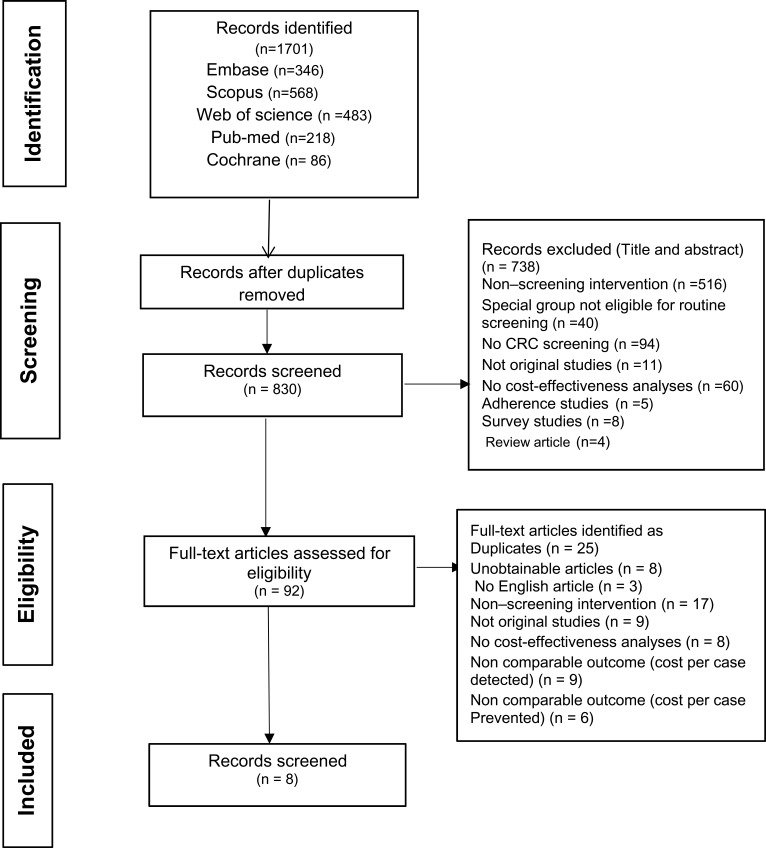
Eight studies were identified and retained for the final analysis. In this study, when screening techniques were compared to no-screening, all CRC screening techniques showed to be cost-effective. The lowest ICER calculated was $PPP -16265/quality-adjusted life-year (QALY) (the negative ICERs were between purchasing power parity in US dollar ($PPP) -16265/QALY to $PPP -1988/QALY, whereas the positive ICERs were between $PPP 1257/QALY to $PPP 55987/QALY). For studies comparing various screening techniques, there was great heterogeneity in terms of the structures of the analyses, leading to diverse conclusions about their incremental cost-effectiveness.
All CRC screening techniques were cost-effective, compared with the no-screening methods. The cost-effectiveness of the various screening techniques mainly was dependent on the context-specific parameters and highly affected by the framework of the cost-effectiveness analysis. In order to make the studies comparable, it is important to adopt a reference-based methodology for economic evaluation studies.
结直肠癌(CRC)是一个严重的健康问题,在全球范围内发病率不断上升。筛查是预防结直肠癌病例和死亡的方法之一。本系统评价的目的是评估不同结直肠癌筛查技术的成本效益,并从成本效益角度确定有效的技术。
对50岁及以上普通人群(平均风险)进行结直肠癌筛查的经济学研究进行了综述。两名评审员独立评审了五个数据库(Cochrane、Embase、Scopus、Web of Science和PubMed)中研究的标题、摘要和全文。评审员之间的分歧通过作者协商解决。本系统评价的主要结局指标是筛查与不筛查的增量成本效益比(ICER),然后与其他筛查技术进行比较。ICER定义为两种可能干预措施之间的成本差异除以其效果差异。
确定了八项研究并保留用于最终分析。在本研究中,当将筛查技术与不筛查进行比较时,所有结直肠癌筛查技术均显示具有成本效益。计算出的最低ICER为16265美元购买力平价/质量调整生命年(QALY)(负ICER在16265美元购买力平价/QALY至1988美元购买力平价/QALY之间,而正ICER在1257美元购买力平价/QALY至55987美元购买力平价/QALY之间)。对于比较各种筛查技术的研究,分析结构存在很大异质性,导致其增量成本效益的结论各不相同。
与不筛查方法相比,所有结直肠癌筛查技术均具有成本效益。各种筛查技术的成本效益主要取决于特定背景参数,并受到成本效益分析框架的高度影响。为了使研究具有可比性,采用基于参考的方法进行经济评估研究很重要。