McLoughlin Steven, Spillane Charles, Claffey Noel, Smith Paul E, O'Rourke Tommy, Diskin Michael G, Waters Sinéad M
Animal and Bioscience Research Department, Animal and Grassland Research and Innovation Centre, Teagasc, Athenry, Ireland.
Genetics and Biotechnology Laboratory, Plant and AgriBiosciences Research Centre (PABC), Ryan Institute, National University of Ireland Galway, Galway, Ireland.
Front Microbiol. 2020 Aug 25;11:1981. doi: 10.3389/fmicb.2020.01981. eCollection 2020.
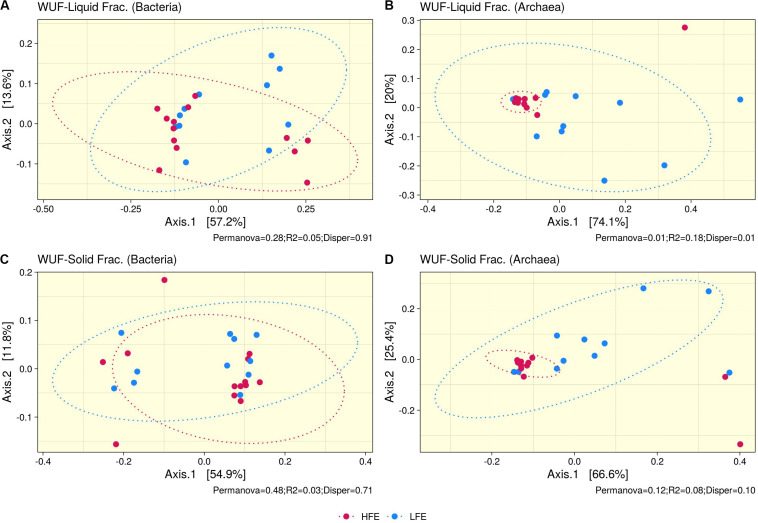
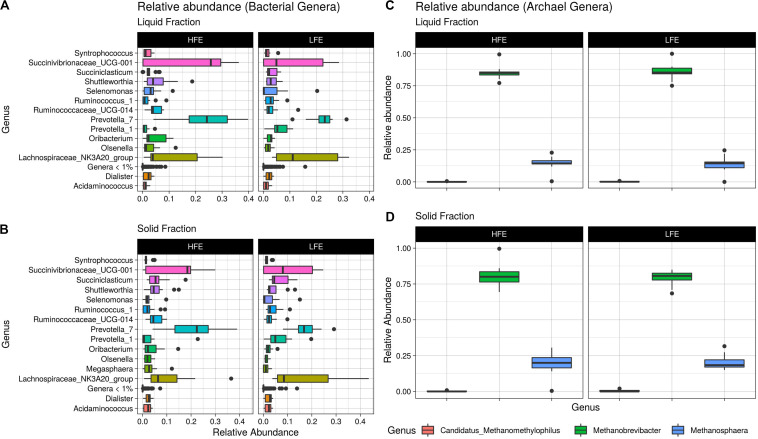
Rumen microbiome composition and functionality is linked to animal feed efficiency, particularly for bovine ruminants. To investigate this in sheep, we compared rumen bacterial and archaeal populations (and predicted metabolic processes) of sheep divergent for the feed efficiency trait feed conversion ratio (FCR). In our study 50 Texel cross Scottish Blackface (TXSB) ram lambs were selected from an original cohort of 200 lambs. From these, 26 were further selected for experimentation based on their extreme FCR (High Feed Efficiency, HFE = 13; Low Feed Efficiency, LFE = 13). Animals were fed a 95% concentrate diet over 36 days. 16S rRNA amplicon sequencing was used to investigate the rumen bacterial and archaeal communities in the liquid and solid rumen fractions of sheep divergent for FCR. Weighted UniFrac distances separated HFE and LFE archaea communities from the liquid rumen fraction (Permanova, < 0.05), with greater variation observed for the LFE cohort (Permdisp, < 0.05). LFE animals exhibited greater Shannon and Simpson diversity indices, which was significant for the liquid rumen fraction ( < 0.05). (in liquid and solid fractions) and (liquid fraction) were differentially abundant, and increased in the LFE cohort ( < 0.05), while (liquid fraction) was increased in the HFE cohort ( < 0.05). This suggests that methanogenic archaea may be responsible for a potential loss of energy for the LFE cohort. Bacterial community composition (Permanova, 0.1) and diversity ( > 0.1) was not affected by the FCR phenotype. Only the genus was differentially abundant between HFE and LFE cohorts. Although no major compositional shifts of bacterial populations were identified amongst the feed efficient cohorts ( > 0.05), correlation analysis identified putative drivers of feed efficiency with (liquid, = -0.53; solid, = -0.56) and (solid, = -0.40) exhibiting significant negative association with FCR ( < 0.05). and showed significant positive correlations with ADG. Major cellulolytic bacteria (liquid, = 0.43) and (liquid, = 0.41; solid, = 41) correlated positively with FCR ( < 0.05). Our study provides evidence that feed efficiency in sheep is likely influenced by compositional changes to the archaeal community, and abundance changes of specific bacteria, rather than major overall shifts within the rumen microbiome.
瘤胃微生物群的组成和功能与动物饲料效率相关,尤其是对于反刍动物而言。为了在绵羊中研究这一点,我们比较了饲料效率性状饲料转化率(FCR)存在差异的绵羊的瘤胃细菌和古菌种群(以及预测的代谢过程)。在我们的研究中,从最初的200只羔羊群体中挑选出50只特克塞尔杂交苏格兰黑脸(TXSB)公羔羊。其中,根据其极端FCR(高饲料效率,HFE = 13只;低饲料效率,LFE = 13只)进一步挑选出26只用于实验。动物在36天内喂食95%的浓缩饲料。使用16S rRNA扩增子测序来研究FCR存在差异的绵羊瘤胃液相和固相部分中的瘤胃细菌和古菌群落。加权UniFrac距离将液相瘤胃部分的HFE和LFE古菌群落分开(PERMANOVA,<0.05),LFE组观察到更大的变异(PERMDISP,<0.05)。LFE动物表现出更高的香农和辛普森多样性指数,这在液相瘤胃部分中具有显著性(<0.05)。(在液相和固相部分)和(液相部分)丰度存在差异,并且在LFE组中增加(<0.05),而(液相部分)在HFE组中增加(<0.05)。这表明产甲烷古菌可能是LFE组能量潜在损失的原因。细菌群落组成(PERMANOVA,0.1)和多样性(>0.1)不受FCR表型的影响。只有属在HFE和LFE组之间丰度存在差异。尽管在饲料高效组中未发现细菌种群的主要组成变化(>0.05),但相关性分析确定了饲料效率的推定驱动因素,(液相,=-0.53;固相,=-0.56)和(固相,=-0.40)与FCR呈显著负相关(<0.05)。和与平均日增重呈显著正相关。主要纤维素分解细菌(液相,=0.43)和(液相,=0.41;固相,=41)与FCR呈正相关(<0.05)。我们的研究提供了证据,表明绵羊的饲料效率可能受古菌群落组成变化以及特定细菌丰度变化的影响,而不是瘤胃微生物群的主要总体变化。