Suzhou Institute of Systems Medicine, Suzhou, China.
Center for Systems Medicine, Institute of Basic Medical Sciences, Chinese Academy of Medical Sciences and Peking Union Medical College, Beijing, China.
Front Immunol. 2020 Aug 27;11:1834. doi: 10.3389/fimmu.2020.01834. eCollection 2020.
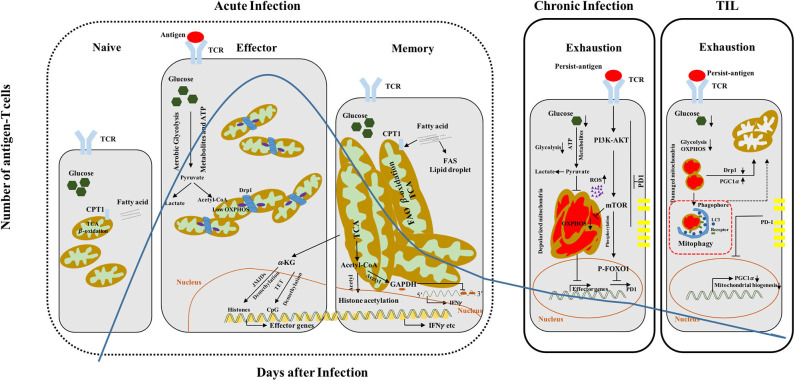
Memory T cells persist for long term to mediate robust recall response upon rechallenging with previous encountered pathogens. The memory T cell pool is highly heterogeneous based on distinct phenotypic, functional, and locational properties, and contains discrete subsets, which contribute to diverse immune responses. In this mini-review, we will briefly discuss the distinct subsets of memory T cells and then focus on mitochondria-related metabolic and epigenetic regulations of CD8 T cell memory formation. In particular, we discuss many aspects of mitochondrial quality control systems (biogenesis, dynamics, etc.) in regulating CD8 T cell fate decision and antitumor immunity. Importantly, targeting mitochondrial metabolism to boost T cell memory formation and metabolic fitness might represent an attractive strategy to improve cancer immunotherapy including CAR-T therapy.
记忆 T 细胞长期存在,在再次遇到以前遇到过的病原体时,能介导强大的回忆反应。记忆 T 细胞库根据不同的表型、功能和位置特性高度异质,并包含不同的亚群,这些亚群有助于产生不同的免疫反应。在这篇小综述中,我们将简要讨论记忆 T 细胞的不同亚群,然后重点讨论 CD8 T 细胞记忆形成的线粒体相关代谢和表观遗传调控。特别是,我们讨论了线粒体质量控制系统(生物发生、动力学等)在调节 CD8 T 细胞命运决定和抗肿瘤免疫中的许多方面。重要的是,靶向线粒体代谢以促进 T 细胞记忆形成和代谢适应性可能是改善癌症免疫疗法(包括 CAR-T 疗法)的一种有吸引力的策略。