Department of Life, Health and Environmental Sciences, University of L'Aquila, L'Aquila, Italy.
Front Immunol. 2020 Sep 2;11:2132. doi: 10.3389/fimmu.2020.02132. eCollection 2020.
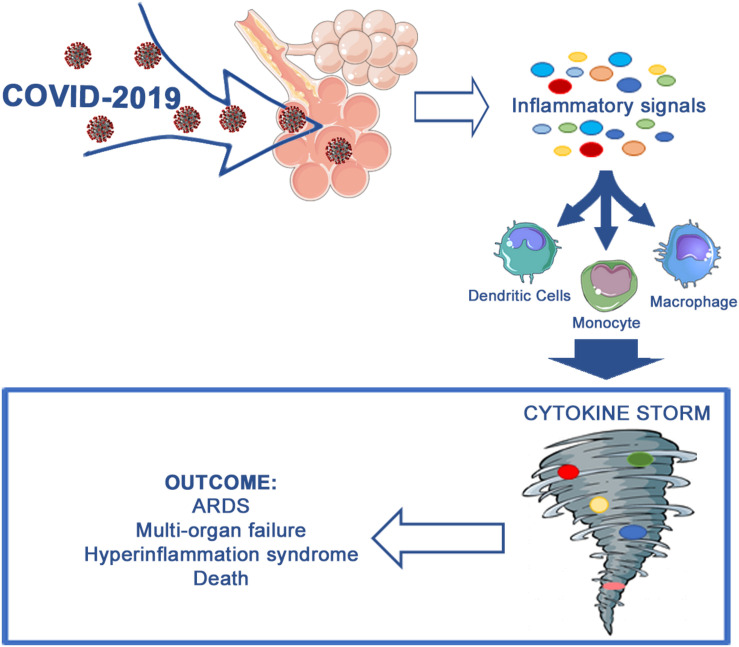
In December 2019, a novel coronavirus, COVID-19, was discovered to be the causal agent of a severe respiratory infection named SARS-CoV-2, and it has since been recognized worldwide as a pandemic. There are still numerous doubts concerning its pathogenesis and particularly the underlying causes of the various clinical courses, ranging from severe manifestations to asymptomatic forms, including acute respiratory distress syndrome. The major factor responsible for acute respiratory distress syndrome is the so-called "cytokine storm," which is an aberrant response from the host immune system that induces an exaggerated release of proinflammatory cytokines/chemokines. In this review, we will discuss the role of cytokine storm in COVID-19 and potential treatments with which counteract this aberrant response, which may be valuable in the clinical translation.
2019 年 12 月,一种新型冠状病毒(COVID-19)被发现是一种严重呼吸道感染的病原体,被命名为 SARS-CoV-2,自此已被全球公认为一种大流行疾病。其发病机制,尤其是各种临床表现的潜在病因,包括急性呼吸窘迫综合征,仍存在许多疑问。急性呼吸窘迫综合征的主要致病因素是所谓的“细胞因子风暴”,这是一种宿主免疫系统的异常反应,导致促炎细胞因子/趋化因子的过度释放。在这篇综述中,我们将讨论细胞因子风暴在 COVID-19 中的作用以及潜在的治疗方法,以对抗这种异常反应,这可能在临床转化中具有重要价值。