Kwon Hyeokjin, Kim Jun Won, Park Mina, Kim Jin Woo, Kim Minseo, Suh Sang Hyun, Chang Yoon Soo, Ahn Sung Jun, Lee Jong-Min
Department of Biomedical Engineering, Hanyang University, Seoul, South Korea.
Department of Radiation Oncology, Gangnam Severance Hospital, Yonsei University, College of Medicine, Seoul, South Korea.
Front Oncol. 2020 Aug 28;10:1664. doi: 10.3389/fonc.2020.01664. eCollection 2020.
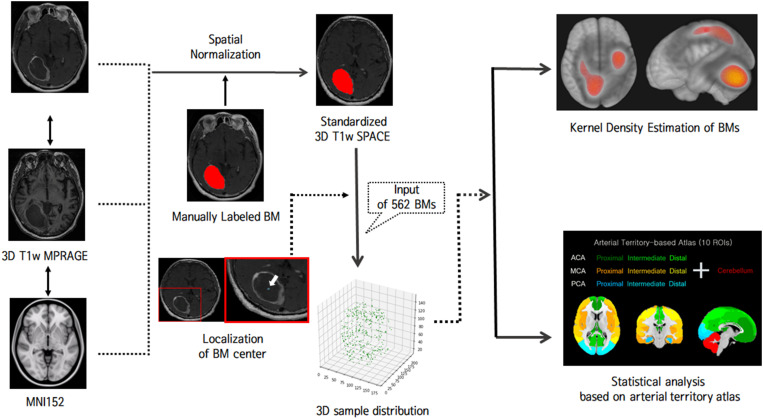
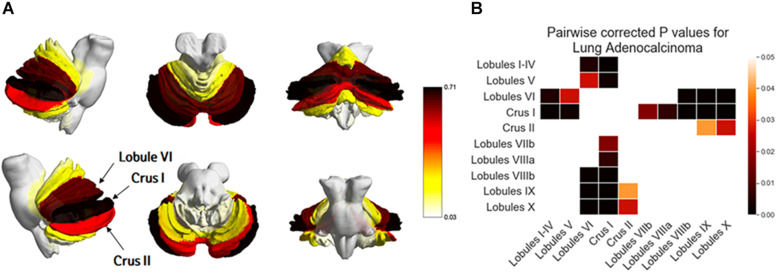
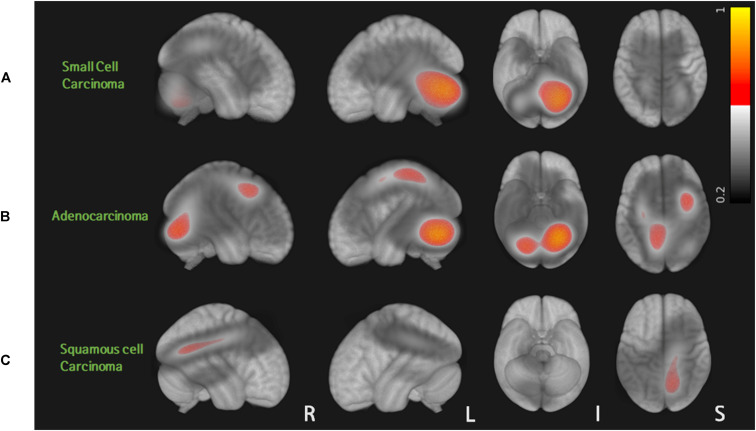
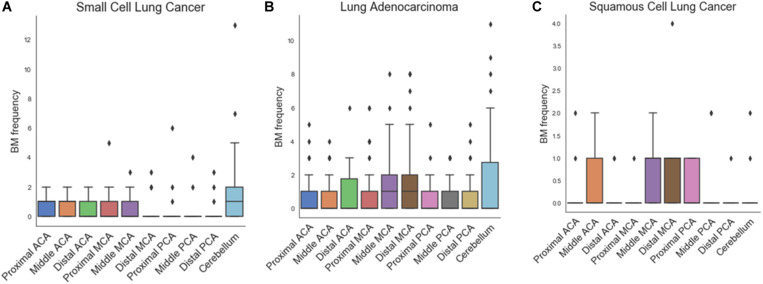
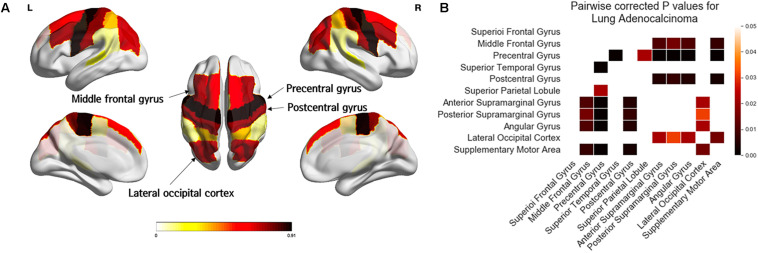
Although whole-brain radiation therapy (WBRT) is the mainstay of treatment for brain metastases (BMs), the concept of saving eloquent cortical lesions has been promoted. If BMs from lung cancer are spatially biased to certain regions, this approach can be justified more. We evaluated whether BMs from lung cancer show a preference for certain brain regions and if their distribution pattern differs according to the histologic subtype of the primary lung cancer. In this retrospective study, 562 BMs in 80 patients were analyzed (107 BMs from small cell carcinoma, 432 from adenocarcinoma, and 23 from squamous cell carcinoma). Kernel density estimation was performed to investigate whether BM spatial patterns differed among lung cancer subtypes. Further, we explored more detailed subregions where BMs from adenocarcinomas occur frequently using one-way analysis of variance. Finally, we divided our cohort into those with fewer (≤10) and more (>10) BMs and evaluated whether this biased pattern was maintained across limited and extensive stages. For small cell carcinoma, BMs were biased to the cerebellum, but this did not reach statistical significance. For adenocarcinoma, BMs were found more frequently near the distal middle cerebral artery (MCA) territory and cerebellum than in other arterial territories ( < 0.01). The precentral and postcentral gyri were the most significant subregions within the distal anterior cerebral artery (ACA) and MCA territories ( < 0.01). Crus I and Lobule VI were significant regions within the cerebellum ( < 0.01). Regardless of the number of BMs, the affinity to the distal MCA territory and cerebellum was maintained. The present data confirm that BMs from lung adenocarcinoma may preferentially involve the distal MCA territory and cerebellum.
尽管全脑放射治疗(WBRT)是脑转移瘤(BMs)治疗的主要手段,但保留功能区皮质病灶的理念已得到推广。如果肺癌脑转移瘤在空间上偏向某些区域,这种方法就更有合理性。我们评估了肺癌脑转移瘤是否对某些脑区有偏好,以及它们的分布模式是否因原发性肺癌的组织学亚型而异。在这项回顾性研究中,分析了80例患者的562个脑转移瘤(107个来自小细胞癌,432个来自腺癌,23个来自鳞状细胞癌)。进行核密度估计以研究肺癌亚型之间脑转移瘤的空间模式是否不同。此外,我们使用单因素方差分析探索了腺癌脑转移瘤频繁发生的更详细的亚区域。最后,我们将队列分为脑转移瘤较少(≤10个)和较多(>10个)的两组,并评估这种偏向模式在局限期和广泛期是否保持。对于小细胞癌,脑转移瘤偏向小脑,但未达到统计学意义。对于腺癌,在大脑中动脉(MCA)远端区域和小脑附近发现的脑转移瘤比在其他动脉区域更频繁(<0.01)。中央前回和中央后回是大脑前动脉(ACA)和MCA远端区域内最显著的亚区域(<0.01)。小脑的Ⅰ脚和Ⅵ小叶是显著区域(<0.01)。无论脑转移瘤的数量如何,对MCA远端区域和小脑的亲和力都保持不变。目前的数据证实,肺腺癌脑转移瘤可能优先累及MCA远端区域和小脑。