Renewable Resources and Enabling Sciences Center, National Renewable Energy Laboratory, Golden, CO 80401.
Centre for Enzyme Innovation, School of Biological Sciences, Institute of Biological and Biomedical Sciences, University of Portsmouth, Portsmouth PO1 2DY, United Kingdom.
Proc Natl Acad Sci U S A. 2020 Oct 13;117(41):25476-25485. doi: 10.1073/pnas.2006753117. Epub 2020 Sep 28.
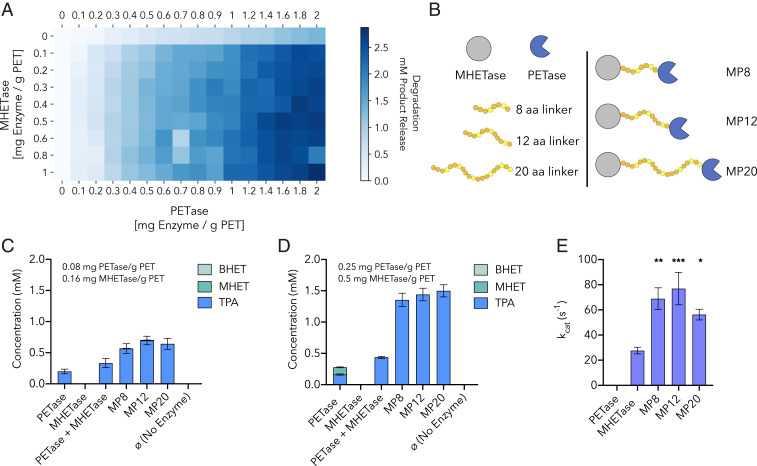
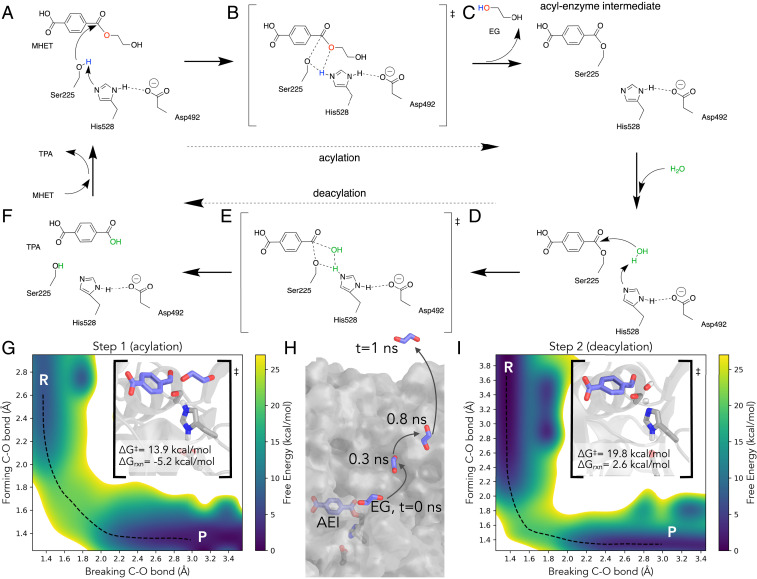
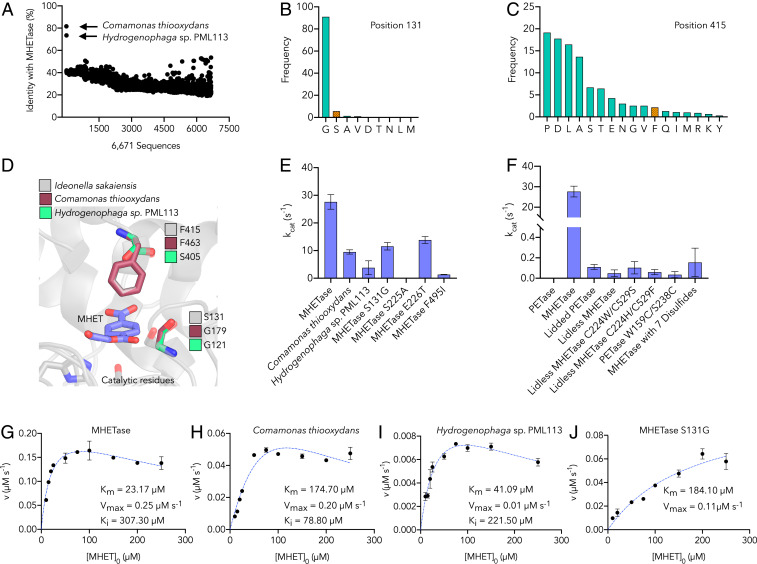
Plastics pollution represents a global environmental crisis. In response, microbes are evolving the capacity to utilize synthetic polymers as carbon and energy sources. Recently, was reported to secrete a two-enzyme system to deconstruct polyethylene terephthalate (PET) to its constituent monomers. Specifically, the PETase depolymerizes PET, liberating soluble products, including mono(2-hydroxyethyl) terephthalate (MHET), which is cleaved to terephthalic acid and ethylene glycol by MHETase. Here, we report a 1.6 Å resolution MHETase structure, illustrating that the MHETase core domain is similar to PETase, capped by a lid domain. Simulations of the catalytic itinerary predict that MHETase follows the canonical two-step serine hydrolase mechanism. Bioinformatics analysis suggests that MHETase evolved from ferulic acid esterases, and two homologous enzymes are shown to exhibit MHET turnover. Analysis of the two homologous enzymes and the MHETase S131G mutant demonstrates the importance of this residue for accommodation of MHET in the active site. We also demonstrate that the MHETase lid is crucial for hydrolysis of MHET and, furthermore, that MHETase does not turnover mono(2-hydroxyethyl)-furanoate or mono(2-hydroxyethyl)-isophthalate. A highly synergistic relationship between PETase and MHETase was observed for the conversion of amorphous PET film to monomers across all nonzero MHETase concentrations tested. Finally, we compare the performance of MHETase:PETase chimeric proteins of varying linker lengths, which all exhibit improved PET and MHET turnover relative to the free enzymes. Together, these results offer insights into the two-enzyme PET depolymerization system and will inform future efforts in the biological deconstruction and upcycling of mixed plastics.
塑料污染是一场全球性的环境危机。为应对这一问题,微生物进化出了利用合成聚合物作为碳源和能源的能力。最近,有研究报道称,一种微生物能够分泌出两种酶系统,将聚对苯二甲酸乙二醇酯(PET)分解为其组成单体。具体来说,该酶系统中的 PETase 可将 PET 解聚,释放出可溶产物,包括单(2-羟乙基)对苯二甲酸酯(MHET),MHETase 可将 MHET 进一步水解为对苯二甲酸和乙二醇。在此,我们报道了一个分辨率为 1.6Å 的 MHETase 结构,该结构表明,MHETase 的核心结构域与 PETase 相似,顶部由一个盖子结构域覆盖。催化途径的模拟预测,MHETase 遵循典型的两步丝氨酸水解酶机制。生物信息学分析表明,MHETase 可能是从阿魏酸酯酶进化而来的,有两个同源酶被证明能够催化 MHET 的转化。对这两个同源酶和 MHETase S131G 突变体的分析表明,该残基对 MHET 在活性位点的结合非常重要。我们还证明了 MHETase 的盖子对 MHET 的水解至关重要,此外,MHETase 不能催化 MHET 呋喃酸酯或 MHET 间苯二甲酸酯的转化。在测试的所有非零 MHETase 浓度下,观察到 PETase 和 MHETase 之间对无定形 PET 薄膜转化为单体具有高度协同作用。最后,我们比较了不同长度连接子的 MHETase:PETase 嵌合蛋白的性能,所有嵌合蛋白都表现出相对于游离酶更好的 PET 和 MHET 转化效率。总之,这些结果为研究这两种酶的 PET 解聚系统提供了新的见解,并将为混合塑料的生物解构和升级循环利用提供指导。