Negishi Takahito, Furubayashi Nobuki, Takamatsu Dai, Ieiri Kousuke, Nishiyama Naotaka, Kitamura Hiroshi, Nakamura Motonobu
Department of Urology, National Hospital Organization Kyushu Cancer Center, Fukuoka 811-1395, Japan.
Department of Urology, Graduate School of Medicine and Pharmaceutical Sciences for Research University of Toyama, Toyama 930-0194, Japan.
Oncol Lett. 2020 Nov;20(5):267. doi: 10.3892/ol.2020.12130. Epub 2020 Sep 21.
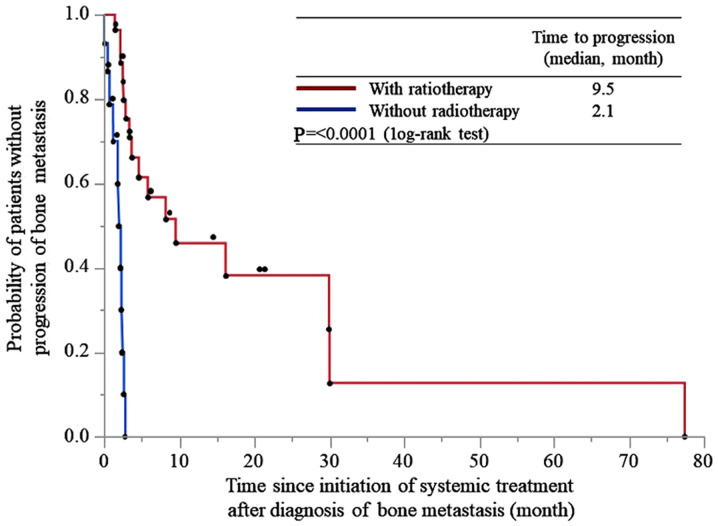
Enlarged bone metastasis from renal cell carcinoma (RCC) can cause skeletal-related events, and thus treatment to inhibit the growth of bone metastases is often required. Although radiotherapy for RCC bone metastases can achieve a certain degree of local control, evidence is lacking regarding the effects of systemic therapy to improve bone metastasis. The present study aimed to assess the treatment efficacy of targeted therapy and immune checkpoint inhibitors, and to determine whether systemic therapy without radiotherapy can shrink bone metastases of RCC. The present study retrospectively reviewed 44 patients with RCC with bone metastases treated via systemic therapy, including targeted therapy or immune checkpoint inhibitors. Patients were divided into two groups: Those who underwent systemic therapy with radiotherapy for bone lesions (n=29); and those who underwent systemic therapy without radiotherapy for bone lesions (n=15). The radiographical efficacy of systemic therapy and the time to progression of bone metastases were compared between groups. The overall response rate of systemic therapy with radiotherapy was 44%, and in total, 13 patients demonstrated a partial response. Only one patient (6%) had a partial response among those who were treated via systemic therapy without radiotherapy. The time to progression of bone metastasis was 9.5 and 2.1 months in patients treated with and without radiotherapy, respectively (P<0.0001). Collectively, the present results suggested that targeted therapy or immune checkpoint inhibitors without radiotherapy had only a slight effect on bone metastasis control.
肾细胞癌(RCC)引起的骨转移增大可导致骨相关事件,因此通常需要进行抑制骨转移生长的治疗。尽管RCC骨转移的放射治疗可实现一定程度的局部控制,但关于全身治疗改善骨转移效果的证据尚缺。本研究旨在评估靶向治疗和免疫检查点抑制剂的治疗效果,并确定不进行放射治疗的全身治疗是否可使RCC骨转移缩小。本研究回顾性分析了44例接受全身治疗(包括靶向治疗或免疫检查点抑制剂)的RCC骨转移患者。患者分为两组:接受骨病变放射治疗的全身治疗患者(n = 29);以及未接受骨病变放射治疗的全身治疗患者(n = 15)。比较两组全身治疗的影像学疗效和骨转移进展时间。接受放射治疗的全身治疗的总缓解率为44%,共有13例患者表现出部分缓解。在未接受放射治疗的全身治疗患者中,只有1例患者(6%)有部分缓解。接受和未接受放射治疗的患者骨转移进展时间分别为9.5个月和2.1个月(P < 0.0001)。总体而言,目前的结果表明,不进行放射治疗的靶向治疗或免疫检查点抑制剂对骨转移控制的效果甚微。