Faculty of Veterinary Medicine, Ludwig-Maximilians-Universität Munich (LMU), Schoenleutnerstr. 8, 85764, Oberschleissheim, Germany.
National Reference Laboratory for Mycotoxins, Department Safety in the Food Chain, BfR - German Federal Institute for Risk Assessment, Max-Dohrn-Straße 8-10, 10589, Berlin, Germany.
Mycotoxin Res. 2021 Feb;37(1):11-21. doi: 10.1007/s12550-020-00411-x. Epub 2020 Sep 29.
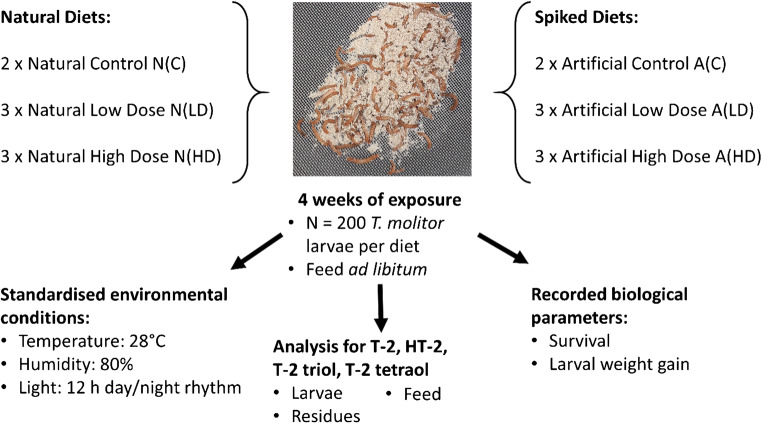
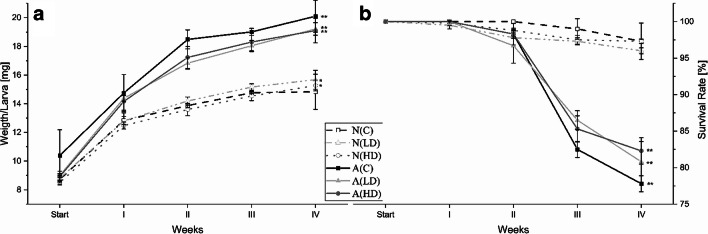
Within the European Union (EU), edible insects need to be approved as "Novel Food" according to Regulation (EU) 2015/2283 and must comply with the requirements of European food law with regard to microbiological and chemical food safety. Substrates used for feeding insects are susceptible to the growth of Fusarium spp. and consequently to contamination with trichothecene mycotoxins. Therefore, the current study aimed to investigate the influence of T-2 and HT-2 toxins on the larval life cycle of yellow mealworm (Tenebrio molitor (L.)) and to study the transfer of T-2, HT-2, T-2 triol and T-2 tetraol in the larvae. In a 4-week feeding study, T. molitor larvae were kept either on naturally (oat flakes moulded with Fusarium sporotrichioides) or artificially contaminated oat flakes, each at two levels (approximately 100 and 250 μg/kg total T-2 and HT-2). Weight gain and survival rates were monitored, and mycotoxins in the feeding substrates, larvae and residues were determined using LC-MS/MS. Larval development varied between the diets and was 44% higher for larvae fed artificially contaminated diets. However, the artificially contaminated diets had a 16% lower survival rate. No trichothecenes were detected in the surviving larvae after harvest, but T-2 and HT-2 were found both in the dead larvae and in the residues of naturally and artificially contaminated diets.
在欧盟(EU)内部,食用昆虫需要根据法规(EU)2015/2283 被批准为“新型食品”,并且必须符合欧洲食品安全法规关于微生物和化学食品安全的要求。用于饲养昆虫的基质容易受到镰刀菌属的生长影响,因此会受到单端孢霉烯族真菌毒素的污染。因此,本研究旨在调查 T-2 和 HT-2 毒素对黄粉虫(Tenebrio molitor (L.))幼虫生命周期的影响,并研究 T-2、HT-2、T-2 三醇和 T-2 四醇在幼虫体内的转移情况。在为期 4 周的饲养研究中,将 T. molitor 幼虫分别饲养在自然(用镰刀菌属 sporotrichioides 模制的燕麦片)或人工污染的燕麦片上,每种情况设两个水平(总 T-2 和 HT-2 约为 100 和 250 μg/kg)。监测体重增加和存活率,并使用 LC-MS/MS 测定饲料、幼虫和残留物中的真菌毒素。幼虫的发育因饮食而异,人工污染饮食的幼虫发育率高 44%。然而,人工污染饮食的存活率低 16%。收获后,在存活的幼虫中未检测到任何单端孢霉烯,但在死亡的幼虫和自然及人工污染饮食的残留物中均发现了 T-2 和 HT-2。