IRCCS Istituto Ortopedico Galeazzi, Milan, Italy.
ISICO (Italian Scientific Spine Institute), Milan, Italy; NEPSI (Neuropsicologia e Psicoterapia), Milan, Italy.
Arch Phys Med Rehabil. 2021 Jan;102(1):155-158. doi: 10.1016/j.apmr.2020.09.376. Epub 2020 Sep 28.
To report the cognitive features of patients with severe coronavirus disease 2019 (COVID-19) entering the postacute phase, to understand whether COVID-19 acute respiratory distress syndrome itself could result in long-term cognitive deficits, and to determine whether neuropsychological treatment after the acute stage might represent a specific rehabilitation need.
Case series.
Rehabilitation hospital.
We assessed the general cognitive functioning through tablet-supported video calls in 9 of 12 consecutive patients (N=9) admitted to the hospital at least 30 days earlier for acute respiratory distress syndrome due to COVID-19. Three patients were excluded based on the exclusion criteria. None of the patients presented cognitive symptoms before hospitalization.
General cognitive functioning, measured using the Mini-Mental State Examination (MMSE) test.
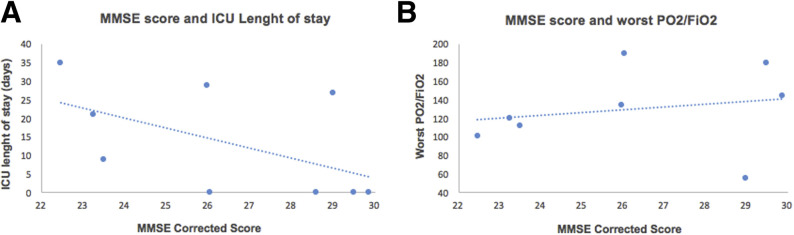
A general cognitive decay was observed in 3 patients (33.3%) who had a pathologic score on the MMSE, with a specific decline in attention, memory, language, and praxis abilities. The cognitive malfunctioning appears to be linearly associated with the length of stay (in d) in the intensive care unit (ICU). The longer the amount of time spent in the ICU, the lower the MMSE score, indicating a lower global cognitive functioning.
Our results indicate that some patients with COVID-19 might also benefit from neuropsychological rehabilitation, given their possible global cognitive decay. The link between neuropsychological functioning and the length of stay in the ICU suggests that neurocognitive rehabilitative treatments should be directed explicitly toward patients who treated in the ICU, rather than toward every patient who experienced acute respiratory distress syndrome owing to COVID-19. However, given the limitation of a case series study, those hypotheses should be tested with future studies with larger samples and a longer follow-up period.
报告进入后急性期的严重 2019 冠状病毒病(COVID-19)患者的认知特征,了解 COVID-19 急性呼吸窘迫综合征本身是否会导致长期认知缺陷,并确定急性阶段后的神经心理治疗是否代表特定的康复需求。
病例系列。
康复医院。
我们通过平板电脑支持的视频通话评估了 12 名连续入院的患者中的 9 名(N=9)的一般认知功能,这些患者至少在 30 天前因 COVID-19 急性呼吸窘迫综合征入院。根据排除标准,有 3 名患者被排除在外。在住院前,没有患者出现认知症状。
使用简易精神状态检查(MMSE)测试测量的一般认知功能。
3 名患者(33.3%)的 MMSE 得分异常,存在注意力、记忆力、语言和动作能力的特定下降,表明存在一般认知衰退。认知功能障碍似乎与在重症监护病房(ICU)的停留时间(以天计)呈线性相关。在 ICU 停留的时间越长,MMSE 得分越低,表明整体认知功能越低。
我们的结果表明,一些 COVID-19 患者可能也受益于神经心理康复,因为他们可能存在整体认知衰退。神经心理功能与 ICU 停留时间之间的联系表明,神经认知康复治疗应该明确针对在 ICU 接受治疗的患者,而不是针对每个因 COVID-19 而发生急性呼吸窘迫综合征的患者。然而,鉴于病例系列研究的局限性,这些假设应该通过未来具有更大样本量和更长随访期的研究进行检验。