Department of Hematology, Comprehensive Human Biosciences, and.
Department of Hematology, Faculty of Medicine, University of Tsukuba, Tsukuba, Japan.
Blood. 2020 Dec 24;136(26):3018-3032. doi: 10.1182/blood.2020006513.
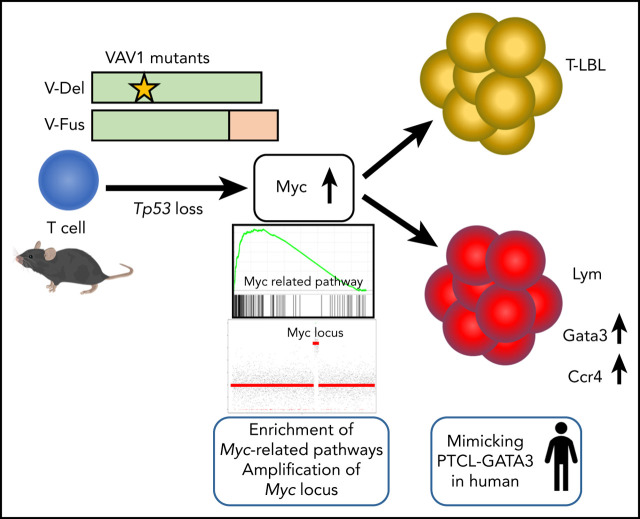
Activating mutations in the Vav guanine nucleotide exchange factor 1 (VAV1) gene are reported in various subtypes of mature T-cell neoplasms (TCNs). However, oncogenic activities associated with VAV1 mutations in TCNs remain unclear. To define them, we established transgenic mice expressing VAV1 mutants cloned from human TCNs. Although we observed no tumors in these mice for up to a year, tumors did develop in comparably aged mice on a p53-null background (p53-/-VAV1-Tg), and p53-/-VAV1-Tg mice died with shorter latencies than did p53-null (p53-/-) mice. Notably, various TCNs with tendency of maturation developed in p53-/-VAV1-Tg mice, whereas p53-/- mice exhibited only immature TCNs. Mature TCNs in p53-/-VAV1-Tg mice mimicked a subtype of human peripheral T-cell lymphoma (PTCL-GATA3) and exhibited features of type 2 T helper (Th2) cells. Phenotypes seen following transplantation of either p53-/-VAV1 or p53-/- tumor cells into nude mice were comparable, indicating cell-autonomous tumor-initiating capacity. Whole-transcriptome analysis showed enrichment of multiple Myc-related pathways in TCNs from p53-/-VAV1-Tg mice relative to p53-/- or wild-type T cells. Remarkably, amplification of the Myc locus was found recurrently in TCNs of p53-/-VAV1-Tg mice. Finally, treatment of nude mice transplanted with p53-/-VAV1-Tg tumor cells with JQ1, a bromodomain inhibitor that targets the Myc pathway, prolonged survival of mice. We conclude that VAV1 mutations function in malignant transformation of T cells in vivo and that VAV1-mutant-expressing mice could provide an efficient tool for screening new therapeutic targets in TCNs harboring these mutations.
Vav 鸟嘌呤核苷酸交换因子 1(VAV1)基因的激活突变已在各种成熟 T 细胞肿瘤(TCN)中报道。然而,与 TCN 中 VAV1 突变相关的致癌活性尚不清楚。为了确定这些活性,我们建立了表达从人类 TCN 克隆的 VAV1 突变体的转基因小鼠。尽管在这些小鼠中观察了长达一年的时间没有肿瘤,但在 p53 缺失背景下(p53-/-VAV1-Tg)的年龄相当的小鼠中确实会发展出肿瘤,并且 p53-/-VAV1-Tg 小鼠的死亡潜伏期比 p53 缺失(p53-/-)小鼠短。值得注意的是,p53-/-VAV1-Tg 小鼠中出现了各种具有成熟趋势的 TCN,而 p53-/-小鼠仅表现出不成熟的 TCN。p53-/-VAV1-Tg 小鼠中的成熟 TCN模拟了人类外周 T 细胞淋巴瘤(PTCL-GATA3)的一种亚型,并表现出 2 型辅助性 T 细胞(Th2)的特征。将 p53-/-VAV1 或 p53-/-肿瘤细胞移植到裸鼠中后观察到的表型相当,表明细胞自主的肿瘤起始能力。全转录组分析表明,与 p53-/-或野生型 T 细胞相比,p53-/-VAV1-Tg 小鼠中的 TCN 中多个 Myc 相关途径富集。值得注意的是,在 p53-/-VAV1-Tg 小鼠的 TCN 中反复发现 Myc 基因座的扩增。最后,用溴结构域抑制剂 JQ1 治疗移植有 p53-/-VAV1-Tg 肿瘤细胞的裸鼠,可延长小鼠的存活时间。我们得出结论,VAV1 突变在体内 T 细胞恶性转化中起作用,并且表达 VAV1 突变体的小鼠可以为筛选携带这些突变的 TCN 中的新治疗靶点提供有效工具。