Olomouc University Social Health Institute, Palacky University in Olomouc, 711 11 Olomouc, Czech Republic.
Graduate School Kosice Institute for Society and Health, Pavel Jozef Safarik University in Kosice, 040 11 Kosice, Slovakia.
Int J Environ Res Public Health. 2020 Sep 27;17(19):7066. doi: 10.3390/ijerph17197066.
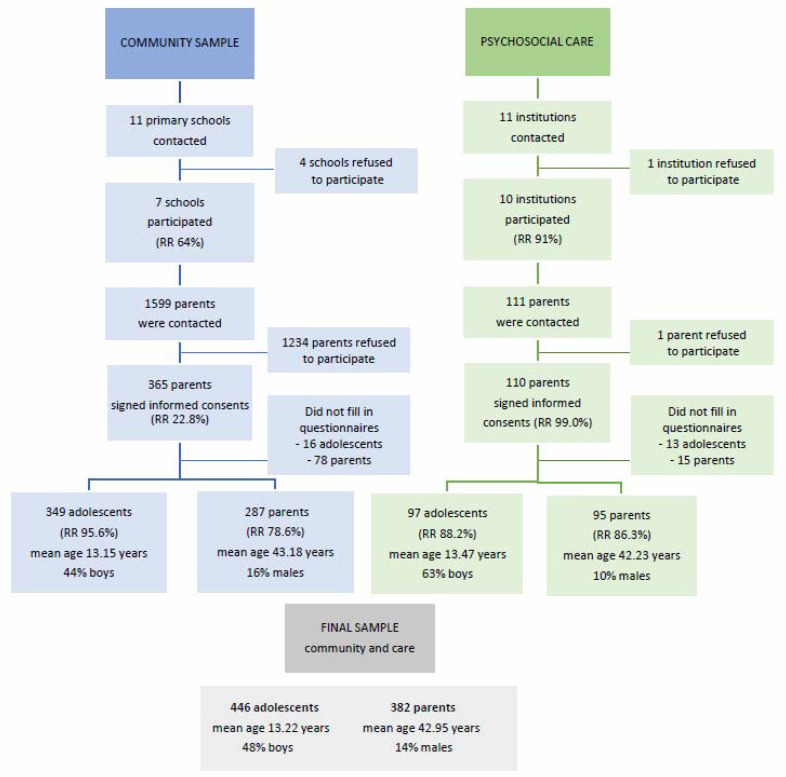
Care for adolescents with emotional and behavioral problems (EBP) is frequently unequally distributed. Parents may play a role in the access to this care. Therefore, the aim was to explore the association between parental characteristics and their adolescent's enrollment in psychosocial care. We used data from the Care4Youth cohort study. Our sample consisted of 446 adolescents (mean age 13.22 years, 48% boys) and 382 parents (mean age 42.95 years, 14% males). EBP combined with enrollment created four groups: 1, no EBP/no care; 2, no EBP/care; 3, EBP/no care; 4, EBP/care. We assessed differences in parental characteristics among the groups. Group 2 had a significantly lower socioeconomic position ( < 0.01), more psychological distress ( < 0.001), poorer supervision ( < 0.001) and lower family social support ( < 0.05) than Group 1. Group 4 had a significantly lower socioeconomic position ( < 0.01) and poorer supervision ( < 0.001) than Group 1. Group 3 had significantly poorer supervision ( < 0.001) than Group 4. The poor supervision in Group 3 requires attention, as these adolescents receive no care. The quality of parental supervision should be addressed generally, e.g., by providing better parenting support and more parental training.
关注患有情绪和行为问题的青少年(EBP)的服务常常分配不均。父母可能在获得这些服务方面发挥作用。因此,本研究旨在探讨父母特征与青少年接受心理社会护理之间的关联。我们使用了 Care4Youth 队列研究的数据。我们的样本包括 446 名青少年(平均年龄 13.22 岁,48%为男性)和 382 名父母(平均年龄 42.95 岁,14%为男性)。将 EBP 与入组相结合,创建了四个组:1. 无 EBP/无护理;2. 无 EBP/护理;3. EBP/无护理;4. EBP/护理。我们评估了各组之间父母特征的差异。与组 1 相比,组 2 的社会经济地位显著较低(<0.01),心理困扰更严重(<0.001),监督较差(<0.001),家庭社会支持较低(<0.05)。与组 1 相比,组 4 的社会经济地位显著较低(<0.01),监督较差(<0.001)。与组 4 相比,组 3 的监督明显较差(<0.001)。组 3 中较差的监督需要引起关注,因为这些青少年没有接受护理。一般来说,应该关注父母监督的质量,例如,提供更好的育儿支持和更多的父母培训。