Szymański Tomasz, Kempa Marcelina, Giersig Michael, Dalibor Rybka Jakub
Center for Advanced Technology, Adam Mickiewicz University, Uniwersytetu Poznańskiego 10 Street, 61-614 Poznan, Poland.
Faculty of Chemistry, Adam Mickiewicz University, Uniwersytetu Poznańskiego 8 Street, 61-614 Poznan, Poland.
Materials (Basel). 2020 Sep 25;13(19):4270. doi: 10.3390/ma13194270.
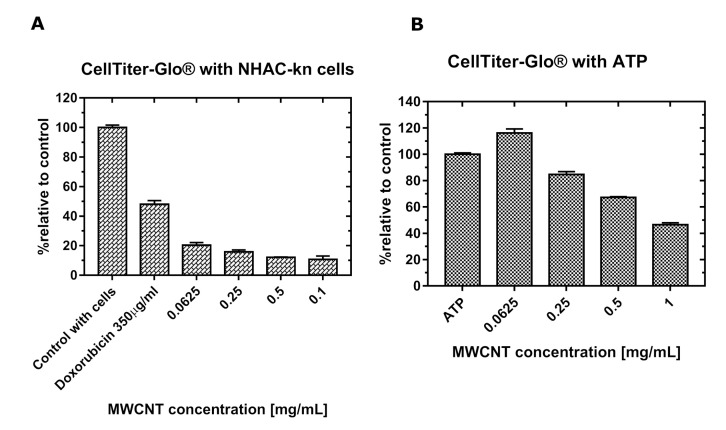
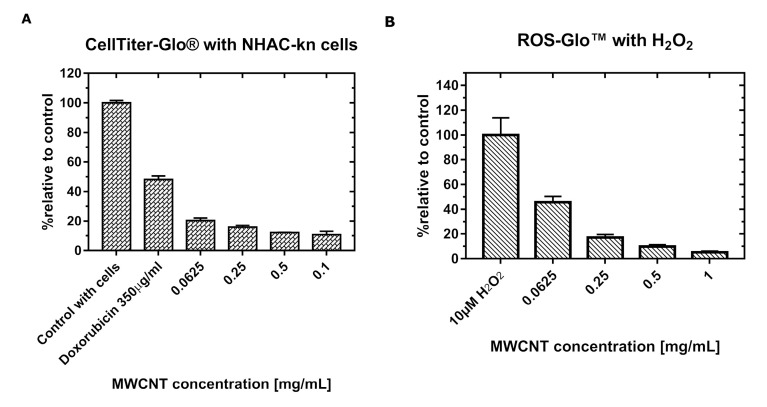
Carbon nanotubes (CNTs) are one of the most promising nanomaterials synthesized to date. Thanks to their unique mechanical, electronic, and optical properties, they have found a wide application in electronics in the production of biosensors and nanocomposites. The functionalization of multiwalled carbon nanotubes (MWCNTs) is aimed at making them biocompatible by adding hydrophilic groups on their surface, increasing their solubility and thus rendering them applicable in the regenerative medicine. So far, there is conflicting information about carbon nanotubes in biological systems. This paper investigates the effect of functionalized, oxidized, multiwalled carbon nanotubes (MWCNT-Ox) on the cytotoxicity of normal human articular chondrocytes (NHAC-kn cell line). Since absorbance-based and fluorescence-based assays were shown to interfere with carbon nanotubes, luminescence-based tests were carried out, as they work on a different method of detection and provide advantages over the mentioned ones. Cell viability and reactive oxygen species (ROS) tests were carried out. The cell viability assay showed that with the increasing MWCNTs concentration, the number of viable chondrocytes was significantly decreasing. Exposure to MWCNT-Ox indicated oxidative stress in the lowest investigated concentration with a decreased amount of ROS with higher concentrations. However, control experiments with adenosine triphosphate (ATP) and HO-molecules that are detected by the assays-showed that carbon nanotubes interfere directly with measurement, thus rendering the results unreliable. To understand the exact interference mechanisms, further studies must be taken. In conclusion, this study shows that luminescence-based tests yield erroneous results, confirming that in vitro experiments in the literature concerning carbon nanotubes should be analyzed with caution.
碳纳米管(CNTs)是迄今为止合成的最有前途的纳米材料之一。由于其独特的机械、电子和光学性能,它们已在电子产品、生物传感器和纳米复合材料的生产中得到广泛应用。多壁碳纳米管(MWCNTs)的功能化旨在通过在其表面添加亲水性基团使其具有生物相容性,增加其溶解度,从而使其适用于再生医学。到目前为止,关于生物系统中碳纳米管的信息相互矛盾。本文研究了功能化氧化多壁碳纳米管(MWCNT-Ox)对正常人关节软骨细胞(NHAC-kn细胞系)细胞毒性的影响。由于基于吸光度和荧光的检测方法已被证明会干扰碳纳米管,因此进行了基于发光的测试,因为它们采用不同的检测方法,比上述方法具有优势。进行了细胞活力和活性氧(ROS)测试。细胞活力测定表明,随着MWCNTs浓度的增加,存活软骨细胞的数量显著减少。暴露于MWCNT-Ox表明,在研究的最低浓度下存在氧化应激,而在较高浓度下ROS含量降低。然而,用三磷酸腺苷(ATP)和检测方法检测的HO分子进行的对照实验表明,碳纳米管直接干扰测量,从而使结果不可靠。为了了解确切的干扰机制,必须进行进一步的研究。总之,本研究表明基于发光的测试会产生错误结果,证实了文献中关于碳纳米管的体外实验应谨慎分析。