Mieloch Adam Aron, Richter Magdalena, Trzeciak Tomasz, Giersig Michael, Rybka Jakub Dalibor
Center for Advanced Technology, Adam Mickiewicz University in Poznan, Uniwersytetu Poznańskiego 10 Street, 61-614 Poznan, Poland.
Faculty of Chemistry, Adam Mickiewicz University in Poznan, Uniwersytetu Poznańskiego 8 Street, 61-614 Poznan, Poland.
J Clin Med. 2019 Nov 3;8(11):1865. doi: 10.3390/jcm8111865.
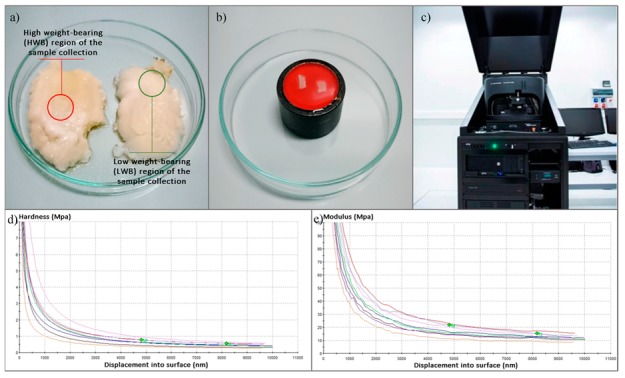
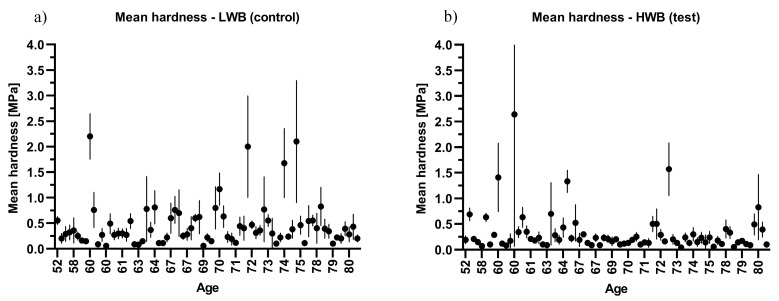
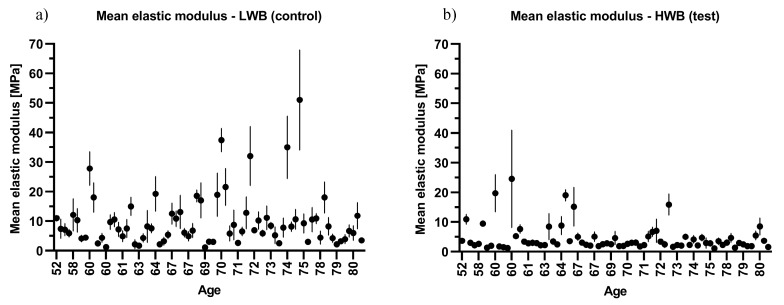
The nanoindentation method was applied to determine the elastic modulus and hardness of knee articular cartilage. Cartilage samples from both high weight bearing (HWB) and low weight bearing (LWB) femoral condyles were collected from patients diagnosed with osteoarthritis (OA). The mean elastic modulus of HWB cartilage was 4.46 ± 4.44 MPa in comparison to that of the LWB region (9.81 ± 8.88 MPa, < 0.001). Similarly, the hardness was significantly lower in HWB tissue (0.317 ± 0.397 MPa) than in LWB cartilage (0.455 ± 0.434 MPa, < 0.001). When adjusted to patients' ages, the mean elastic modulus and hardness were both significantly lower in the age group over 70 years ( < 0.001). A statistically significant difference in mechanical parameters was also found in grade 3 and 4 OA. This study provides an insight into the nanomechanical properties of the knee articular cartilage and provides a starting point for personalized cartilage grafts that are compatible with the mechanical properties of the native tissue.
采用纳米压痕法测定膝关节软骨的弹性模量和硬度。从诊断为骨关节炎(OA)的患者中收集高负重(HWB)和低负重(LWB)股骨髁的软骨样本。HWB软骨的平均弹性模量为4.46±4.44MPa,而LWB区域的平均弹性模量为9.81±8.88MPa(P<0.001)。同样,HWB组织的硬度(0.317±0.397MPa)显著低于LWB软骨(0.455±0.434MPa,P<0.001)。调整患者年龄后,70岁以上年龄组的平均弹性模量和硬度均显著降低(P<0.001)。在3级和4级OA中也发现了力学参数的统计学显著差异。本研究深入了解了膝关节软骨的纳米力学性能,并为与天然组织力学性能相匹配的个性化软骨移植提供了一个起点。