Griffin Darren K, Kretschmer Rafael, Srikulnath Kornsorn, Singchat Worapong, O'Connor Rebecca E, Romanov Michael N
School of Biosciences, University of Kent, Canterbury, CT2 7NJ, UK.
Faculty of Science, Animal Genomics and Bioresource Research Unit (AGB Research Unit), Kasetsart University, Chatuchak, Bangkok, 10900, Thailand.
Mol Cytogenet. 2024 Oct 31;17(1):24. doi: 10.1186/s13039-024-00696-y.
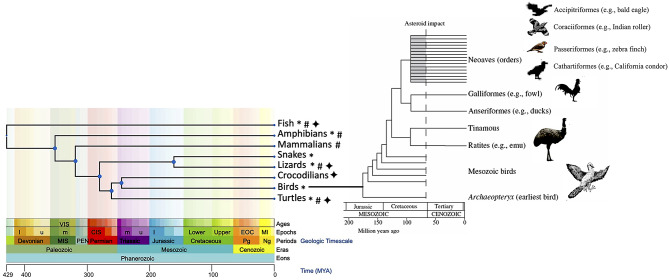
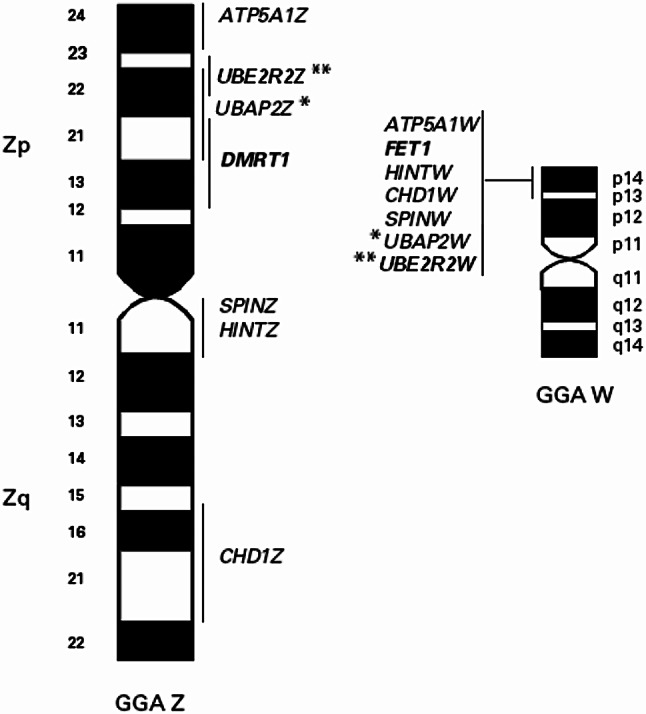
In last 100 years or so, much information has been accumulated on avian karyology, genetics, physiology, biochemistry and evolution. The chicken genome project generated genomic resources used in comparative studies, elucidating fundamental evolutionary processes, much of it funded by the economic importance of domestic fowl (which are also excellent model species in many areas). Studying karyotypes and whole genome sequences revealed population processes, evolutionary biology, and genome function, uncovering the role of repetitive sequences, transposable elements and gene family expansion. Knowledge of the function of many genes and non-expressed or identified regulatory components is however still lacking. Birds (Aves) are diverse, have striking adaptations for flight, migration and survival and inhabit all continents most islands. They also have a unique karyotype with ~ 10 macrochromosomes and ~ 30 microchromosomes that are smaller than other reptiles. Classified into Palaeognathae and Neognathae they are evolutionarily close, and a subset of reptiles. Here we overview avian molecular cytogenetics with reptilian comparisons, shedding light on their karyotypes and genome structure features. We consider avian evolution, then avian (followed by reptilian) karyotypes and genomic features. We consider synteny disruptions, centromere repositioning, and repetitive elements before turning to comparative avian and reptilian genomics. In this context, we review comparative cytogenetics and genome mapping in birds as well as Z- and W-chromosomes and sex determination. Finally, we give examples of pivotal research areas in avian and reptilian cytogenomics, particularly physical mapping and map integration of sex chromosomal genes, comparative genomics of chicken, turkey and zebra finch, California condor cytogenomics as well as some peculiar cytogenetic and evolutionary examples. We conclude that comparative molecular studies and improving resources continually contribute to new approaches in population biology, developmental biology, physiology, disease ecology, systematics, evolution and phylogenetic systematics orientation. This also produces genetic mapping information for chromosomes active in rearrangements during the course of evolution. Further insights into mutation, selection and adaptation of vertebrate genomes will benefit from these studies including physical and online resources for the further elaboration of comparative genomics approaches for many fundamental biological questions.
在过去约100年里,关于鸟类的核型学、遗传学、生理学、生物化学及进化方面已积累了大量信息。鸡基因组计划产生了用于比较研究的基因组资源,阐明了基本的进化过程,其中大部分资金来源于家禽的经济重要性(家禽在许多领域也是优秀的模式物种)。对核型和全基因组序列的研究揭示了种群过程、进化生物学及基因组功能,发现了重复序列、转座元件和基因家族扩张的作用。然而,许多基因以及未表达或未鉴定的调控元件的功能仍不清楚。鸟类(鸟纲)种类繁多,对飞行、迁徙和生存具有显著适应性,栖息于各大洲及多数岛屿。它们还拥有独特的核型,约有10条大染色体和约30条小染色体,这些小染色体比其他爬行动物的小。鸟类分为古颚类和今颚类,它们在进化上亲缘关系较近,是爬行动物的一个分支。在此,我们概述鸟类分子细胞遗传学并与爬行动物进行比较,以阐明它们的核型和基因组结构特征。我们先考虑鸟类进化,然后是鸟类(接着是爬行动物)的核型和基因组特征。在转向鸟类和爬行动物的比较基因组学之前,我们考虑同线性破坏、着丝粒重新定位和重复元件。在此背景下,我们回顾鸟类的比较细胞遗传学和基因组图谱以及Z和W染色体与性别决定。最后,我们给出鸟类和爬行动物细胞基因组学关键研究领域的例子,特别是性染色体基因的物理图谱绘制和图谱整合、鸡、火鸡和斑胸草雀的比较基因组学、加州兀鹰细胞基因组学以及一些特殊的细胞遗传学和进化实例。我们得出结论,比较分子研究和不断改进的资源持续推动种群生物学、发育生物学、生理学、疾病生态学、系统学、进化和系统发育系统学方向的新方法发展。这也为进化过程中发生重排的活跃染色体产生遗传图谱信息。对脊椎动物基因组的突变、选择和适应的进一步深入了解将受益于这些研究,包括用于进一步阐述许多基本生物学问题的比较基因组学方法的物理和在线资源。