Discipline of Public Health Medicine, School of Nursing and Public Health, University of KwaZulu-Natal, Durban, 4041, South Africa.
BMC Public Health. 2020 Sep 29;20(1):1466. doi: 10.1186/s12889-020-09561-0.
Lung cancer is the most diagnosed cancer worldwide. In low- and middle-income countries (LMICs), lung cancer is often diagnosed at a late stage due to poor knowledge and awareness of its signs and symptoms. Increasing lung cancer awareness is likely to reduce the diagnosis and treatment delays. The implementation of early palliative care has also been reported to improve a patient's quality of life, and even survival. The aim of this scoping review was to map evidence on lung cancer awareness and palliative care interventions implemented in sub-Saharan Africa (SSA) and other LMICs.
This scoping review was guided by Arksey and O'Malley's framework. Databases such as the EBSCOhost, PubMed, Science Direct, Google Scholar, World Health Organization (WHO) library and grey literature were used to perform systematic searches of relevant articles. The methodological quality assessment of included primary studies was assessed using the Mixed Method Appraisal Tool (MMAT). NVivo version 10 software was used to perform the thematic content analysis of the included studies.
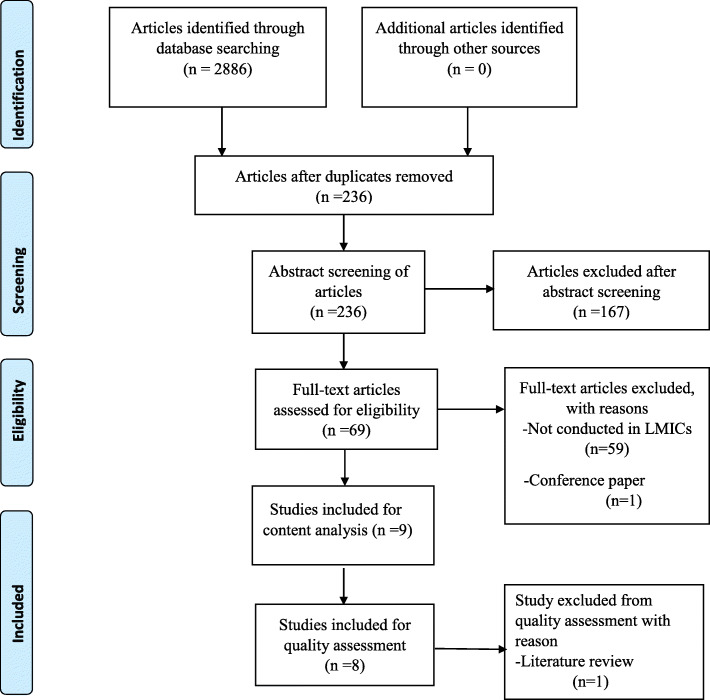
A total number of screened articles was 2886, with 236 meeting the eligibility criteria and 167 further excluded following abstract screening. Sixty-nine (69) articles qualified for full-article screening and 9 were selected for detailed data extraction and methodological quality assessment. Of the included nine studies, eight described at least one lung cancer warning signs and symptoms, while one described the effectiveness of palliative care for lung cancer. Eight articles recognized the level of lung cancer knowledge, risk factors awareness of warning signs and symptoms in LMICs, mostly Africa and Asia.
Most of the participants were aware of tobacco use as the major risk factor for lung cancer but lacked knowledge on the other pre-disposing risk factors. Evidence on palliative care is scarce, therefore, awareness interventions packaged with evidence on the value of timely access to palliative care services in improving the quality of life of the lung cancer patients and their families, are required.
肺癌是全球最常见的癌症。在低收入和中等收入国家(LMICs),由于对肺癌的体征和症状缺乏了解和认识,肺癌往往在晚期才被诊断出来。提高肺癌的认知度可能会减少诊断和治疗的延迟。据报道,实施早期姑息治疗也可以提高患者的生活质量,甚至延长其生存时间。本范围综述的目的是绘制在撒哈拉以南非洲(SSA)和其他 LMICs 中实施的肺癌意识和姑息治疗干预措施的证据图谱。
本范围综述以 Arksey 和 O'Malley 的框架为指导。使用 EBSCOhost、PubMed、Science Direct、Google Scholar、世界卫生组织(WHO)图书馆和灰色文献等数据库对相关文章进行系统检索。使用混合方法评估工具(MMAT)评估纳入的原始研究的方法学质量。使用 NVivo 版本 10 软件对纳入研究进行主题内容分析。
共筛选出 2886 篇文章,其中 236 篇符合纳入标准,167 篇在摘要筛选后被进一步排除。69 篇文章通过全文筛选,9 篇文章被选中进行详细的全文筛选和方法学质量评估。在纳入的九项研究中,有八项描述了至少一种肺癌预警症状,而一项描述了姑息治疗对肺癌的有效性。八项研究都认识到了 LMICs 对肺癌知识、风险因素意识和预警症状的水平,主要在非洲和亚洲。
大多数参与者都意识到吸烟是肺癌的主要危险因素,但缺乏其他易患因素的知识。姑息治疗方面的证据很少,因此需要实施意识干预措施,并提供有关及时获得姑息治疗服务对提高肺癌患者及其家属生活质量的价值的证据。