Center for the Promotion of Health in the New England Workplace (CPH-NEW), Lowell, MA, USA.
Department of Biomedical Engineering, University of Massachusetts Lowell, 1 University Avenue, Lowell, MA, 01854, USA.
BMC Public Health. 2020 Sep 29;20(1):1463. doi: 10.1186/s12889-020-09551-2.
Healthcare facilities are notorious for occupational health and safety problems. Multi-level interventions are needed to address interacting exposures and their overlapping origins in work organization features. Worker participation in problem identification and resolution is essential. This study evaluates the CPH-NEW Healthy Workplace Participatory Program (HWPP), a Total Worker Health® protocol to develop effective employee teams for worker safety, health, and wellbeing.
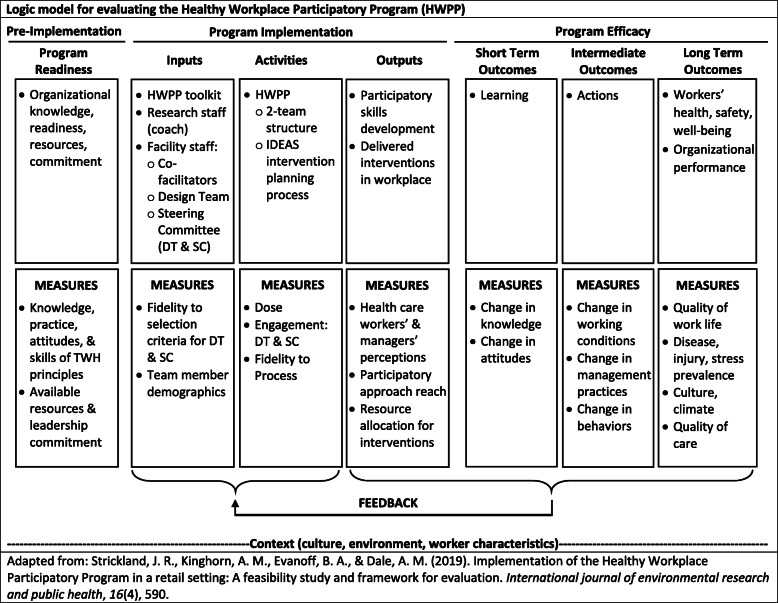
Six public sector, unionized healthcare facilities are enrolled, in three pairs, matched by agency. The unit of intervention is a workplace health and safety committee, adapted here to a joint labor-management "Design Team" (DT). The DT conducts root cause analyses, prioritizes problems, identifies feasible interventions in light of the constraints and needs of the specific setting, makes business-case presentations to facility leadership, and assists in evaluation. Following a stepped-wedge (cross-over) design, one site in each pair is randomly assigned to "immediate intervention" status, receiving the full coached intervention at baseline; in the "lagged intervention" site, coaching begins about half-way through the study. Program effectiveness and cost-effectiveness outcomes are assessed at both organizational (e.g., workers' compensation claim and absenteeism rates, perceived management support of safety) and individual levels (e.g., self-rated health, sleep quality, leisure-time exercise). Targeted pre-post analyses will also examine specific outcomes appropriate to the topics selected for intervention. Process evaluation outcomes include fidelity of the HWPP intervention, extent of individual DT member activity, expansion of committee scope to include employee well-being, program obstacles and opportunities in each setting, and sustainability (within the available time frame).
This study aims for a quantitative evaluation of the HWPP over a time period long enough to accomplish multiple intervention cycles in each facility. The design seeks to achieve comparable study engagement and data quality between groups. We will also assess whether the HWPP might be further improved to meet the needs of U.S. public sector healthcare institutions. Potential challenges include difficulty in pooling data across study sites if Design Teams select different intervention topics, and follow-up periods too short for change to be observed.
ClinicalTrials.gov NCT04251429 (retrospectively registered January 29, 2020), protocol version 1.
医疗机构在职业健康和安全方面存在问题。需要采取多层次的干预措施来解决相互作用的暴露问题及其在工作组织特征中的重叠来源。工人参与问题的识别和解决是至关重要的。本研究评估了 CPH-NEW 健康工作场所参与计划(HWPP),这是一种全面工人健康协议,旨在为工人安全、健康和福利培养有效的员工团队。
六家公共部门、工会化的医疗机构被招募,分为三组,按机构匹配。干预的单位是一个工作场所健康和安全委员会,在这里改编为一个联合劳资“设计团队”(DT)。DT 进行根本原因分析,确定问题的优先级,根据特定环境的限制和需求确定可行的干预措施,向设施领导层提出商业案例演示,并协助评估。采用阶梯式(交叉)设计,每对中的一个站点被随机分配到“立即干预”状态,在基线时接受完整的辅导干预;在“延迟干预”站点中,辅导从研究的一半左右开始。在组织层面(例如,工人的赔偿要求和旷工率、管理层对安全的支持程度)和个人层面(例如,自我评估的健康、睡眠质量、休闲时间的锻炼)评估计划的有效性和成本效益结果。有针对性的前后分析还将检查针对干预主题选择的具体结果。过程评估结果包括 HWPP 干预的保真度、个人 DT 成员活动的程度、委员会范围扩大到包括员工福利、每个环境中的计划障碍和机会以及可持续性(在可用时间框架内)。
本研究旨在对 HWPP 在足够长的时间内进行定量评估,以在每个设施中完成多个干预周期。该设计旨在实现两组之间的可比研究参与度和数据质量。我们还将评估 HWPP 是否可以进一步改进以满足美国公共部门医疗机构的需求。潜在的挑战包括如果设计团队选择不同的干预主题,那么在研究站点之间汇总数据会有困难,以及随访时间太短,无法观察到变化。
ClinicalTrials.gov NCT04251429(2020 年 1 月 29 日回顾性注册),方案版本 1。