Division of Endocrinology and Metabolism, Department of Internal Medicine, Seoul St. Mary's Hospital, College of Medicine, The Catholic University of Korea, #222 Banpo-daero, Seocho-gu, Seoul, 06591, South Korea.
Department of Statistics and Actuarial Science, Soongsil University, Seoul, 06978, South Korea.
Cardiovasc Diabetol. 2020 Sep 29;19(1):153. doi: 10.1186/s12933-020-01129-x.
Metabolic syndrome (MetS) status changes over time, but few studies have investigated the relationship between the extent or duration of exposure to MetS and the risk of cardiovascular disease (CVD). We investigated the cumulative effects of MetS and its components on the risk of myocardial infarction (MI) and stroke.
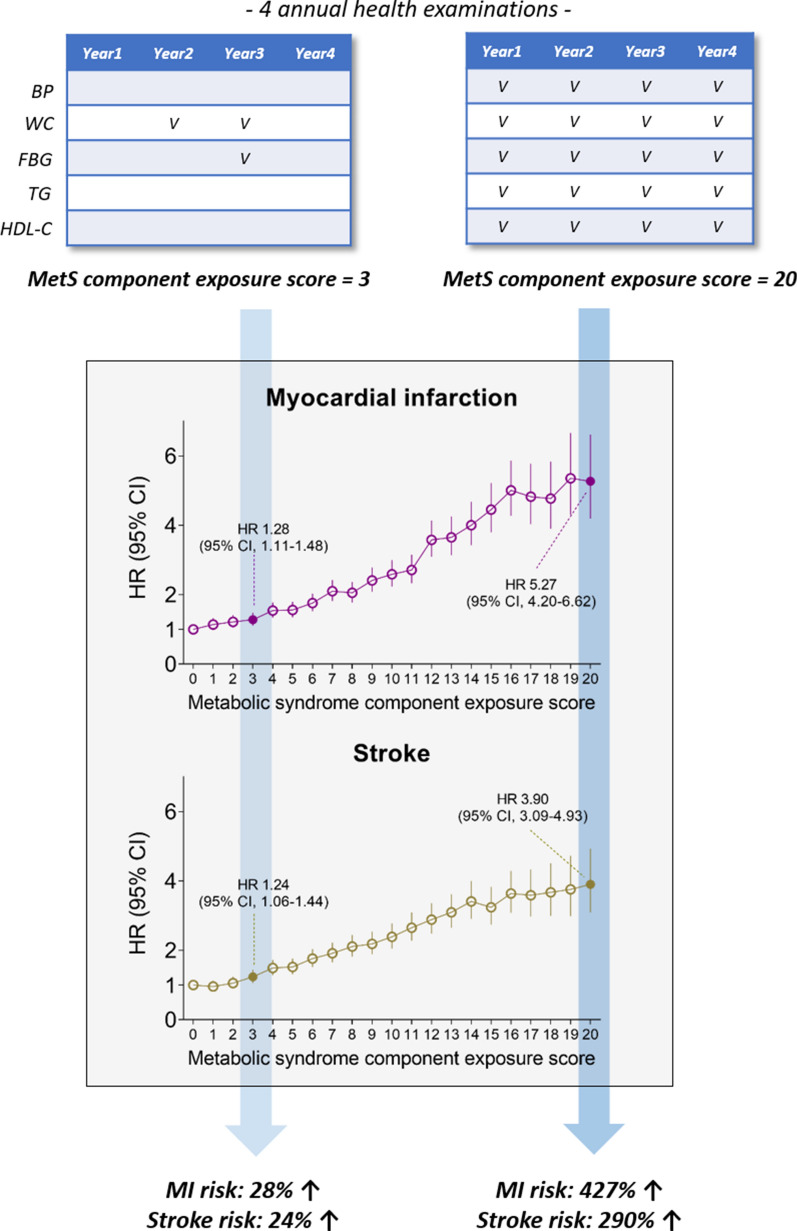
From the Korean National Health Insurance database, 2,644,851 people who received annual health examinations from 2010 to 2013 were recruited. Exposure-weighted scores for MetS during this 4-year period were calculated in two ways: cumulative number of MetS diagnoses (MetS exposure score, range: 0-4) and the composite of its five components (MetS component exposure score, range: 0-20). The multivariable Cox proportional-hazards model was used to assess CVD risk according to the exposure-weighted scores for MetS.
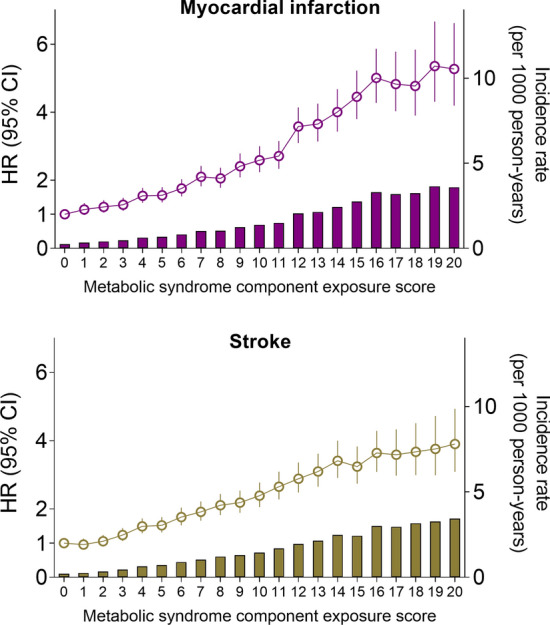
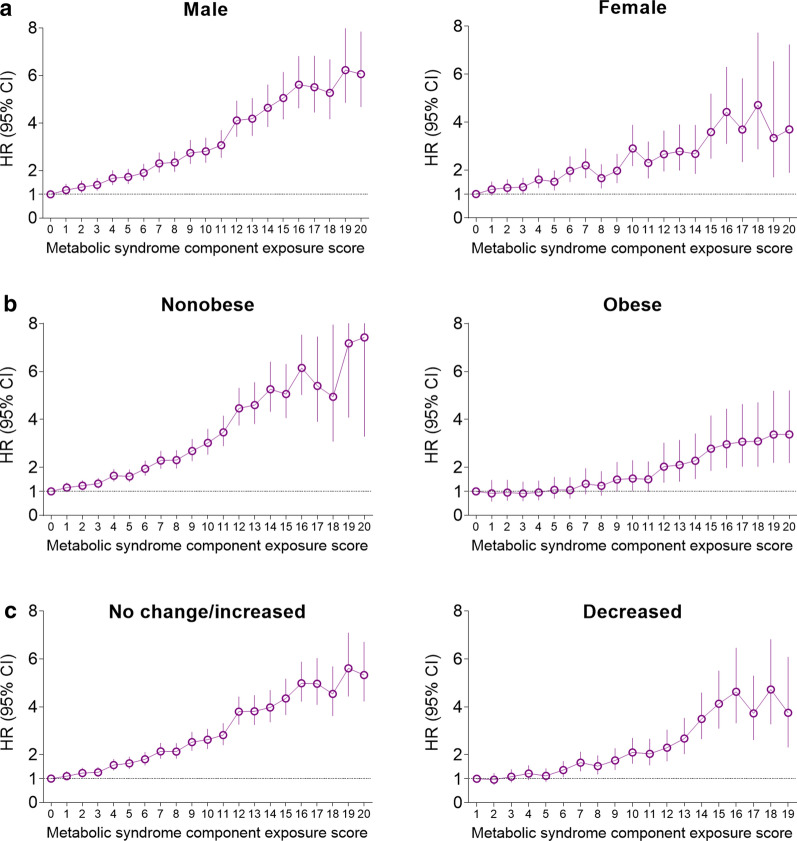
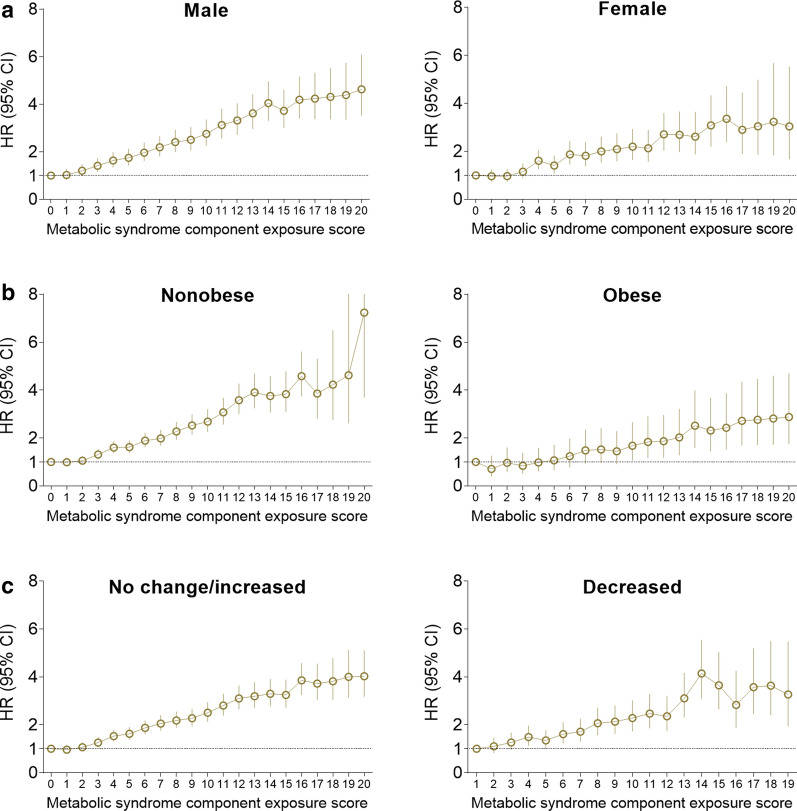
MetS was identified at least once in 37.6% and persistent MetS in 8.2% of subjects. During the follow-up (median, 4.4 years), 10,522 cases of MI (0.4%) and 10,524 cases of stoke (0.4%) occurred. The risk of MI and stroke increased gradually with increasing exposure scores of MetS and its components (each P for trend < 0.0001). The hazard ratio [(HR) (95% CI)] of MI and stroke were 5.27 (4.20-6.62) and 3.90 (3.09-4.93), respectively, in those with a score of 20 compared with those with a MetS component exposure score of 0. People fulfilling only two MetS components out of 20 already had 22% increased risk of MI, and those with three MetS components had 24% increased risk of stroke. These associations were consistent in the subgroup and sensitivity analyses.
A dose-response relationship between the cumulative exposure to metabolic disturbances and incident MI or stroke was evident. Even minimal exposure to MetS components was sufficient to increase the risk of CVD significantly, highlighting the importance of intensive risk management for the prevention of CVD.
代谢综合征(MetS)的状态随时间而变化,但很少有研究调查代谢综合征的暴露程度或持续时间与心血管疾病(CVD)风险之间的关系。我们研究了代谢综合征及其成分对心肌梗死(MI)和中风风险的累积影响。
从韩国国家健康保险数据库中招募了 2644851 名在 2010 年至 2013 年期间接受年度健康检查的人。在这 4 年期间,通过两种方法计算代谢综合征的暴露加权分数:代谢综合征诊断的累积次数(代谢综合征暴露评分,范围:0-4)和其五个成分的综合(代谢综合征成分暴露评分,范围:0-20)。使用多变量 Cox 比例风险模型根据代谢综合征的暴露加权评分评估 CVD 风险。
在研究对象中,至少有一次被诊断出代谢综合征的比例为 37.6%,持续性代谢综合征的比例为 8.2%。在随访期间(中位数,4.4 年),发生了 10522 例 MI(0.4%)和 10524 例中风(0.4%)。随着代谢综合征及其成分的暴露评分增加,MI 和中风的风险逐渐增加(每个趋势 P<0.0001)。与代谢综合征成分暴露评分为 0 的人相比,评分为 20 的人的 MI 和中风的风险比分别为 5.27(4.20-6.62)和 3.90(3.09-4.93)。仅满足 20 个成分中的两个代谢综合征的人,MI 的风险增加 22%,而有三个代谢综合征成分的人,中风的风险增加 24%。这些关联在亚组和敏感性分析中是一致的。
代谢紊乱的累积暴露与 MI 或中风的发生之间存在剂量反应关系。即使是对代谢综合征成分的最低限度暴露也足以显著增加 CVD 的风险,这突出了强化风险管理对预防 CVD 的重要性。