Lima Maria, Siokas Vasileios, Aloizou Athina-Maria, Liampas Ioannis, Mentis Alexios-Fotios A, Tsouris Zisis, Papadimitriou Anastasios, Mitsias Panayiotis D, Tsatsakis Aristidis, Bogdanos Dimitrios P, Baloyannis Stavros J, Dardiotis Efthimios
Department of Neurology, Laboratory of Neurogenetics, University of Thessaly, University Hospital of Larissa, Larissa, Greece.
Public Health Laboratories, Hellenic Pasteur Institute, Athens, Greece.
Curr Treat Options Neurol. 2020;22(11):37. doi: 10.1007/s11940-020-00647-z. Epub 2020 Sep 25.
To describe the possible neuroinvasion pathways of Severe Acute Respiratory Syndrome-related Coronavirus-2 (SARS-CoV-2), the virus responsible for the Coronavirus disease-19 (Covid-19) pandemic.
We present data regarding the family of Coronaviruses (CoVs) and the central nervous system (CNS), and describe parallels between SARS-CoV-2 and other members of the family, which have been investigated in more depth and combine these findings with the recent advancements regarding SARS-CoV-2.
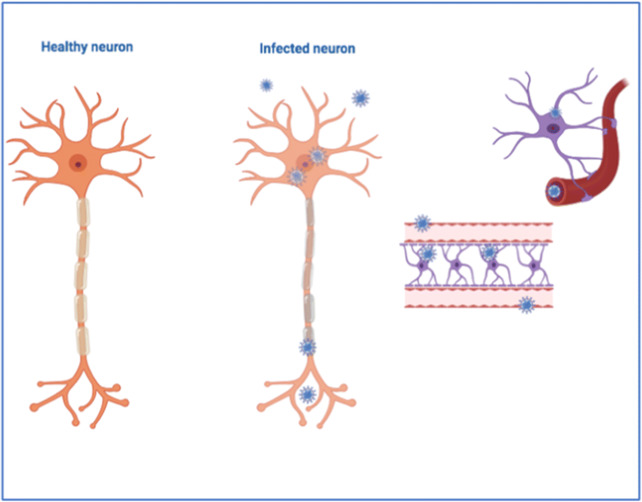
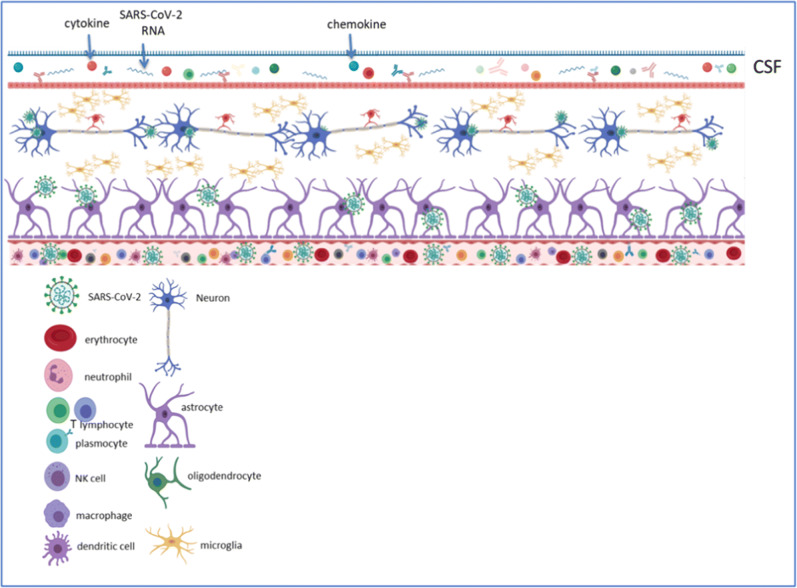
SARS-CoV-2 like other CoVs is neuroinvasive, neurotropic and neurovirulent. Two main pathways of CNS penetration seem to be the strongest candidates, the hematogenous and the neuronal. Τhe olfactory route in particular appears to play a significant role in neuroinvasion of coronaviruses and SARS-CoV-2, as well. However, existing data suggest that other routes, involving the nasal epithelium in general, lymphatic tissue and the CSF may also play roles in SARS-CoV-2 invasion into the CNS.
描述严重急性呼吸综合征相关冠状病毒2(SARS-CoV-2),即导致冠状病毒病19(Covid-19)大流行的病毒,可能的神经侵袭途径。
我们展示了关于冠状病毒(CoV)家族与中枢神经系统(CNS)的数据,并描述了SARS-CoV-2与该家族其他成员之间的相似之处,这些成员已得到更深入的研究,并将这些发现与SARS-CoV-2的最新进展相结合。
与其他CoV一样,SARS-CoV-2具有神经侵袭性、嗜神经性和神经毒性。中枢神经系统渗透的两条主要途径似乎是最有力的候选途径,即血行途径和神经途径。特别是嗅觉途径似乎在冠状病毒和SARS-CoV-2的神经侵袭中也起着重要作用。然而,现有数据表明,其他途径,包括一般的鼻上皮、淋巴组织和脑脊液,也可能在SARS-CoV-2侵入中枢神经系统中发挥作用。