Quer Giorgio, Freedman Ben, Steinhubl Steven R
Scripps Research Translational Institute, 3344 North Torrey Pines Court, Plaza Level, La Jolla, CA 92037, USA.
Heart Research Institute, Heart Rhythm and Stroke Group, 7 Eliza St Newtown, Sydney, NSW 2043, Australia.
Europace. 2020 Dec 23;22(12):1781-1787. doi: 10.1093/europace/euaa186.
Screening for asymptomatic atrial fibrillation (AF) could prevent strokes and save lives, but the AF burden of those detected can impact prognosis. New technologies enable continuous monitoring or intermittent electrocardiogram (ECG) snapshots, however, the relationship between AF detection rates and the burden of AF found with intermittent strategies is unknown. We simulated the likelihood of detecting AF using real-world 2-week continuous ECG recordings and developed a generalizable model for AF detection strategies.
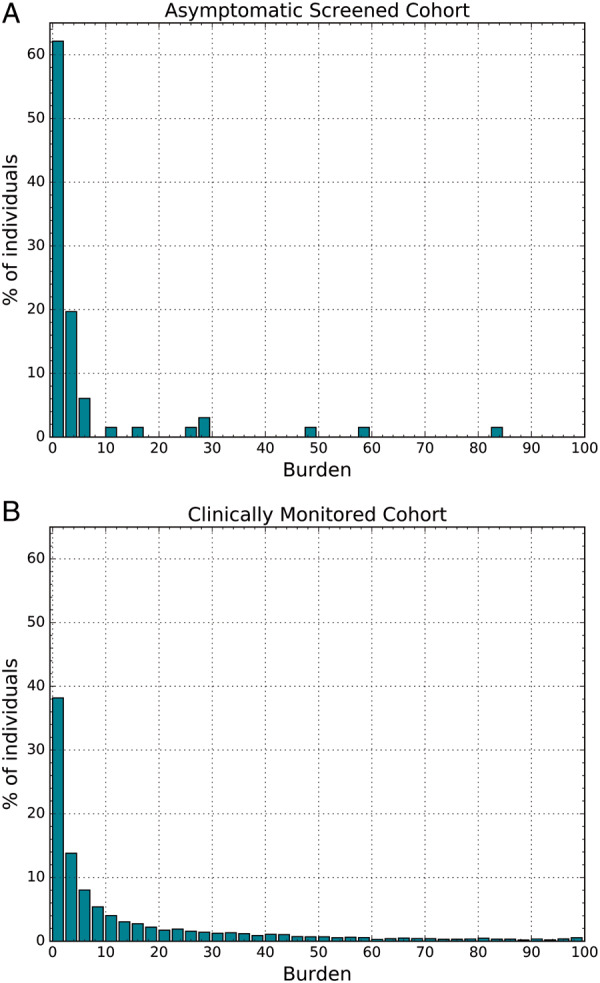
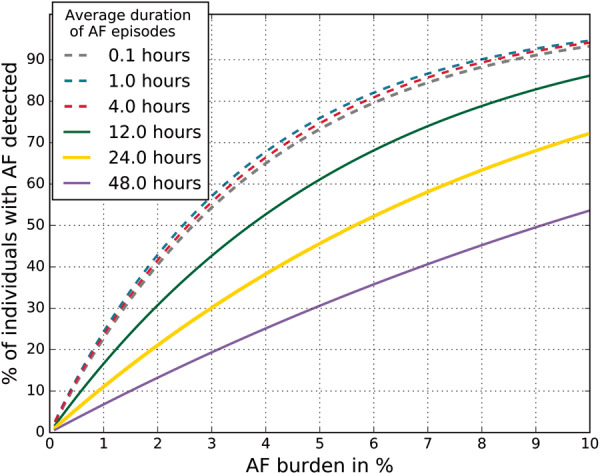
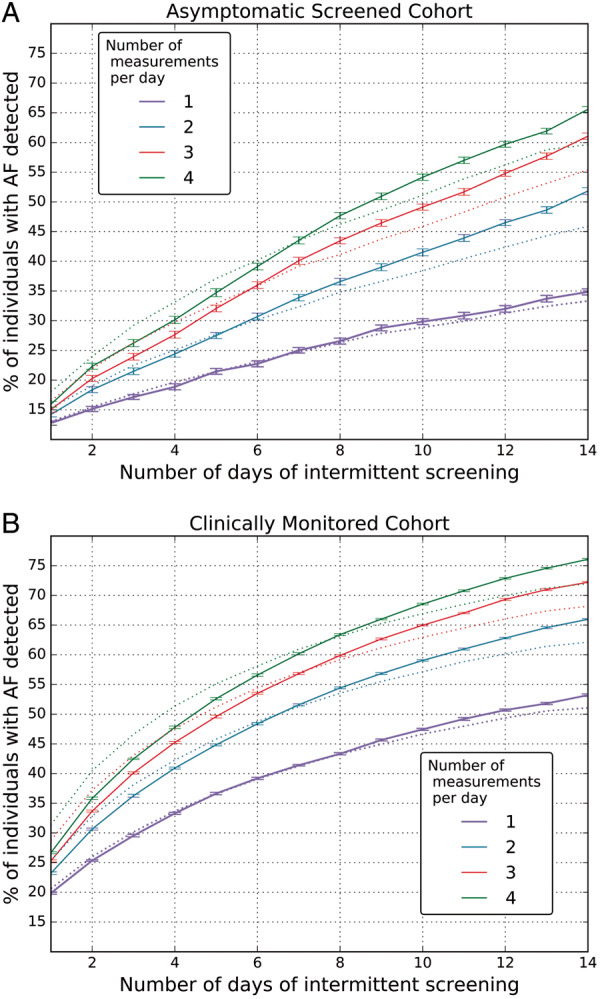
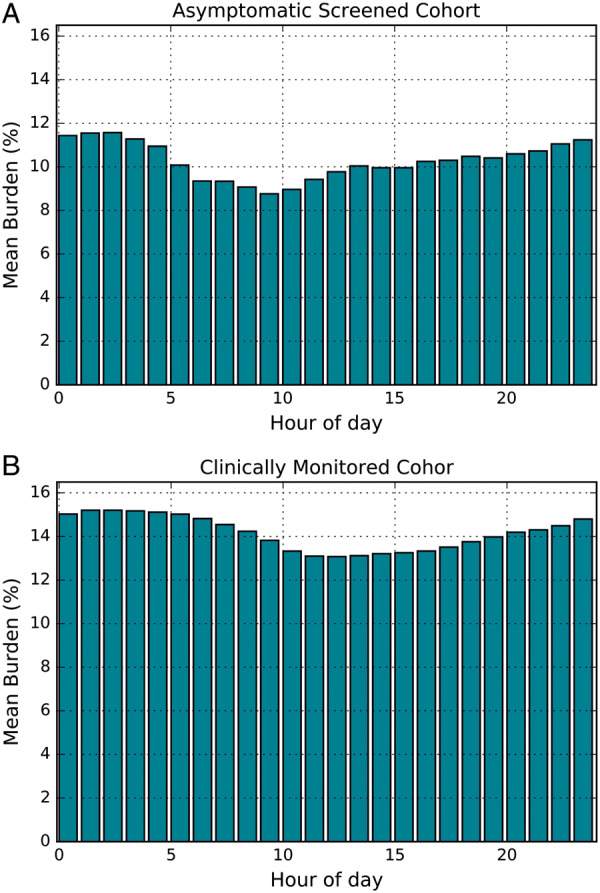
From 1738 asymptomatic screened individuals, ECG data of 69 individuals (mean age 76.3, median burden 1.9%) with new AF found during 14 days continuous monitoring were used to simulate 30 seconds ECG snapshots one to four times daily for 14 days. Based on this simulation, 35-66% of individuals with AF would be detected using intermittent screening. Twice-daily snapshots for 2 weeks missed 48% of those detected by continuous monitoring, but mean burden was 0.68% vs. 4% in those detected (P < 0.001). In a cohort of 6235 patients (mean age 69.2, median burden 4.6%) with paroxysmal AF during clinically indicated monitoring, simulated detection rates were 53-76%. The Markovian model of AF detection using mean episode duration and mean burden simulated actual AF detection with ≤9% error across the range of screening frequencies and durations.
Using twice-daily ECG snapshots over 2 weeks would detect only half of individuals discovered to have AF by continuous recordings, but AF burden of those missed was low. A model predicting AF detection, validated using real-world data, could assist development of optimized AF screening programmes.
筛查无症状性心房颤动(AF)可预防中风并挽救生命,但检测出的AF负荷会影响预后。新技术可实现连续监测或间歇性心电图(ECG)快照,然而,AF检测率与间歇性策略所发现的AF负荷之间的关系尚不清楚。我们使用真实世界的2周连续ECG记录模拟了检测AF的可能性,并开发了一种可推广的AF检测策略模型。
从1738名无症状筛查个体中,选取了69名(平均年龄76.3岁,中位负荷1.9%)在14天连续监测期间发现新发AF的个体的ECG数据,用于模拟每天1至4次、每次30秒的ECG快照,持续14天。基于此模拟,使用间歇性筛查可检测出35%-66%的AF个体。连续2周每天两次快照会遗漏48%通过连续监测检测出的个体,但遗漏个体的平均负荷为0.68%,而检测出个体的平均负荷为4%(P<0.001)。在一组6235例(平均年龄69.2岁,中位负荷4.6%)在临床指征监测期间发生阵发性AF的患者中,模拟检测率为53%-76%。使用平均发作持续时间和平均负荷的AF检测马尔可夫模型在一系列筛查频率和持续时间范围内模拟实际AF检测,误差≤9%。
在2周内每天两次ECG快照只能检测出通过连续记录发现的AF个体的一半,但遗漏个体的AF负荷较低。一个使用真实世界数据验证的预测AF检测的模型可协助优化AF筛查方案的制定。