Dipartimento di Neuroscienze, Università di Padova, Padova, Italy.
Padua Neuroscience Center, Università di Padova, Padova, Italy.
Braz J Psychiatry. 2021 May-Jun;43(3):314-323. doi: 10.1590/1516-4446-2020-1099.
To grade the evidence about risk factors for eating disorders (anorexia nervosa, bulimia nervosa, and binge eating disorder) with an umbrella review approach.
This was a systematic review of observational studies on risk factors for eating disorders published in PubMed/PsycInfo/Embase until December 11th, 2019. We recalculated random-effect meta-analyses, heterogeneity, small-study effect, excess significance bias and 95% prediction intervals, grading significant evidence (p < 0.05) from convincing to weak according to established criteria. Quality was assessed with the Assessment of Multiple Systematic Reviews 2 (AMSTAR-2) tool.
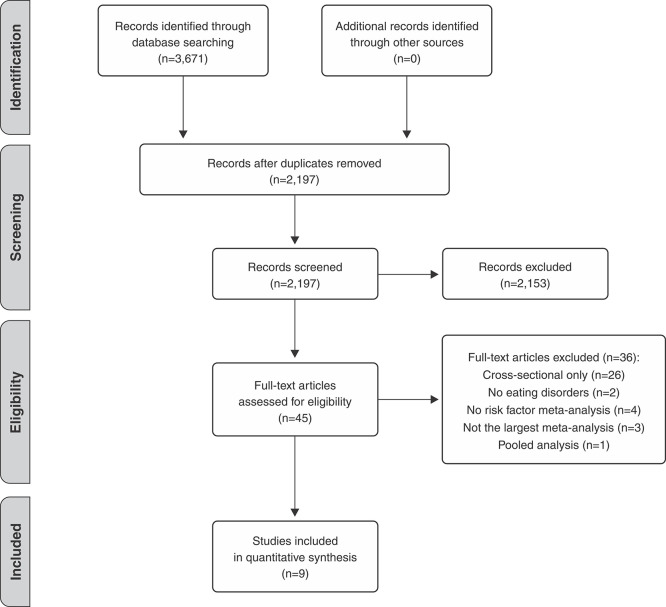
Of 2,197 meta-analyses, nine were included, providing evidence on 50 risk factors, 29,272 subjects with eating disorders, and 1,679,385 controls. Although no association was supported by convincing evidence, highly suggestive evidence supported the association between childhood sexual abuse and bulimia nervosa (k = 29, 1,103 cases with eating disorders, 8,496 controls, OR, 2.73, 95%CI 1.96-3.79, p = 2.1 x 10⁻⁹, AMSTAR-2 moderate quality) and between appearance-related teasing victimization and any eating disorder (k = 10, 1,341 cases with eating disorders, 3,295 controls, OR 2.91, 95%CI 2.05-4.12, p = 1.8x10⁻⁹, AMSTAR-2 moderate quality). Suggestive, weak, or no evidence supported 11, 29, and 8 associations, respectively.
The most credible evidence indicates that early traumatic and stressful events are risk factors for eating disorders. Larger collaborative prospective cohort studies are needed to identify risk factors for eating disorders, particularly anorexia nervosa.
采用伞式综述方法对饮食障碍(神经性厌食症、神经性贪食症和暴食障碍)的危险因素进行证据评估。
这是一项对截至 2019 年 12 月 11 日在 PubMed/PsycInfo/Embase 上发表的有关饮食障碍危险因素的观察性研究的系统综述。我们重新计算了随机效应荟萃分析、异质性、小样本效应、过度显著性偏差和 95%预测区间,并根据既定标准将有意义的证据(p<0.05)从可信到弱进行分级。使用 AMSTAR-2 工具评估质量。
从 2197 项荟萃分析中,纳入了 9 项研究,提供了 50 个危险因素的证据,涉及 29272 名饮食障碍患者和 1679385 名对照者。虽然没有证据支持强烈关联,但高度提示性证据支持童年性虐待与神经性贪食症之间的关联(k=29,1103 例饮食障碍患者,8496 例对照者,OR 2.73,95%CI 1.96-3.79,p=2.1x10⁻⁹,AMSTAR-2 中等质量)和与外貌相关的嘲笑受害与任何饮食障碍之间的关联(k=10,1341 例饮食障碍患者,3295 例对照者,OR 2.91,95%CI 2.05-4.12,p=1.8x10⁻⁹,AMSTAR-2 中等质量)。提示性、弱证据或无证据分别支持 11、29 和 8 个关联。
最可信的证据表明,早期的创伤和应激事件是饮食障碍的危险因素。需要开展更大规模的合作前瞻性队列研究来确定饮食障碍的危险因素,尤其是神经性厌食症。