Laboratorio de Neuroinmunología, Fundación Ciencia & Vida, Av. Zañartu 1482, 7780272 Ñuñoa, Santiago, Chile.
Universidad San Sebastián, 7510156 Providencia, Santiago, Chile.
Semin Immunopathol. 2020 Dec;42(6):681-696. doi: 10.1007/s00281-020-00819-8. Epub 2020 Sep 30.
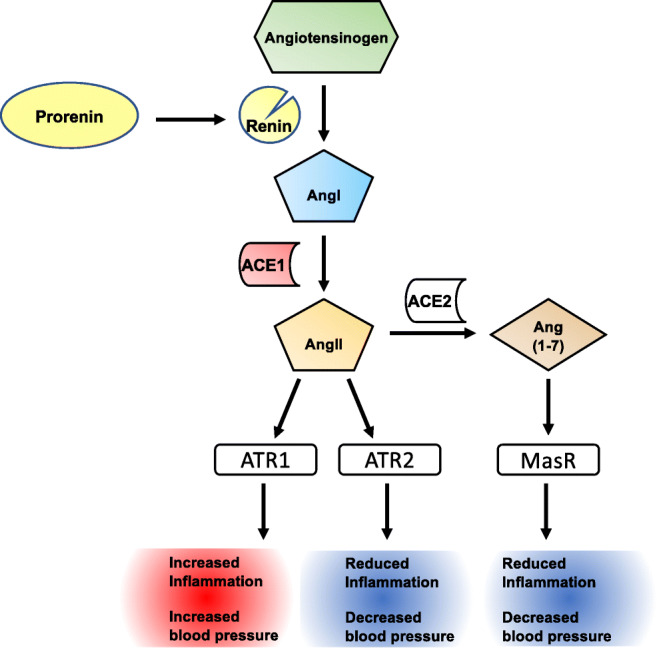
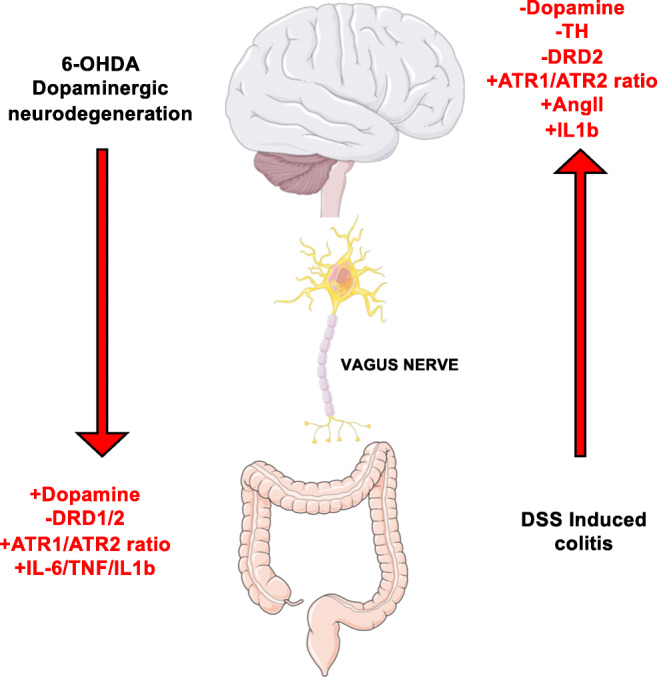
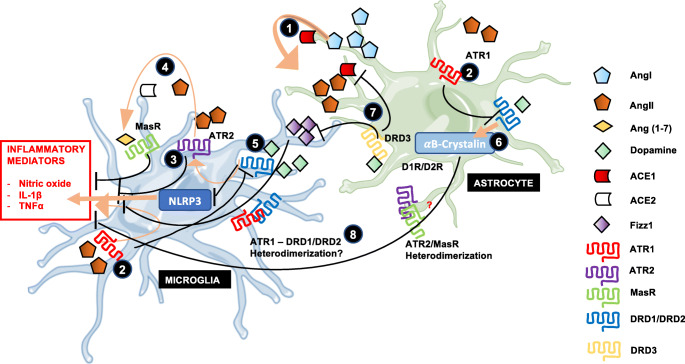
The renin-angiotensin system (RAS) is a fundamental regulator of blood pressure and has emerged as an important player in the control of inflammatory processes. Accordingly, imbalance on RAS components either systemically or locally might trigger the development of inflammatory disorders by affecting immune cells. At the same time, alterations in the dopaminergic system have been consistently involved in the physiopathology of inflammatory disorders. Accordingly, the interaction between the RAS and the dopaminergic system has been studied in the context of inflammation of the central nervous system (CNS), kidney, and intestine, where they exert antagonistic actions in the regulation of the immune system. In this review, we summarized, integrated, and discussed the cross talk of the dopaminergic system and the RAS in the regulation of inflammatory pathologies, including neurodegenerative disorders, such as Parkinson's disease. We analyzed the molecular mechanisms underlying the interaction between both systems in the CNS and in systemic pathologies. Moreover, we also analyzed the impact of the commensal microbiota in the regulation of RAS and dopaminergic system and how it is involved in inflammatory disorders. Furthermore, we summarized the therapeutic approaches that have yielded positive results in preclinical or clinical studies regarding the use of drugs targeting the RAS and dopaminergic system for the treatment of inflammatory conditions. Further understanding of the molecular and cellular regulation of the RAS-dopaminergic cross talk should allow the formulation of new therapies consisting of novel drugs and/or repurposing already existing drugs, alone or in combination, for the treatment of inflammatory disorders.
肾素-血管紧张素系统(RAS)是血压的基本调节者,并且已成为控制炎症过程的重要参与者。因此,无论是系统性还是局部性的 RAS 成分失衡都可能通过影响免疫细胞引发炎症性疾病的发展。同时,多巴胺能系统的改变一直与炎症性疾病的病理生理学有关。因此,在中枢神经系统(CNS)、肾脏和肠道的炎症背景下,已经研究了 RAS 和多巴胺能系统之间的相互作用,它们在免疫系统的调节中发挥拮抗作用。在这篇综述中,我们总结、整合和讨论了多巴胺能系统和 RAS 在调节炎症性疾病(包括神经退行性疾病,如帕金森病)中的相互作用。我们分析了这两个系统在中枢神经系统和系统性疾病中的相互作用的分子机制。此外,我们还分析了共生微生物群在 RAS 和多巴胺能系统调节中的作用以及它如何参与炎症性疾病。此外,我们总结了在使用靶向 RAS 和多巴胺能系统的药物治疗炎症性疾病的临床前或临床研究中取得积极结果的治疗方法。进一步了解 RAS-多巴胺能相互作用的分子和细胞调节,应该可以制定出新的治疗方法,包括单独或联合使用新型药物和/或重新利用现有药物,用于治疗炎症性疾病。