Labandeira-García Jose L, Garrido-Gil Pablo, Rodriguez-Pallares Jannette, Valenzuela Rita, Borrajo Ana, Rodríguez-Perez Ana I
Laboratory of Neuroanatomy and Experimental Neurology, Department of Morphological Sciences, CIMUS, Faculty of Medicine, University of Santiago de Compostela Santiago de Compostela, Spain ; Networking Research Center on Neurodegenerative Diseases (CIBERNED) Madrid, Spain.
Front Neuroanat. 2014 Jul 8;8:67. doi: 10.3389/fnana.2014.00067. eCollection 2014.
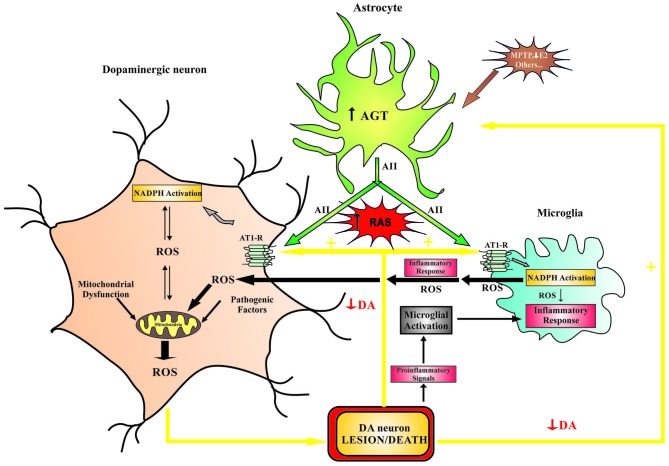
Although the renin-angiotensin system (RAS) was classically considered as a circulating system that regulates blood pressure, many tissues are now known to have a local RAS. Angiotensin, via type 1 receptors, is a major activator of the NADPH-oxidase complex, which mediates several key events in oxidative stress (OS) and inflammatory processes involved in the pathogenesis of major aging-related diseases. Several studies have demonstrated the presence of RAS components in the basal ganglia, and particularly in the nigrostriatal system. In the nigrostriatal system, RAS hyperactivation, via NADPH-oxidase complex activation, exacerbates OS and the microglial inflammatory response and contributes to progression of dopaminergic degeneration, which is inhibited by angiotensin receptor blockers and angiotensin converting enzyme (ACE) inhibitors. Several factors may induce an increase in RAS activity in the dopaminergic system. A decrease in dopaminergic activity induces compensatory upregulation of local RAS function in both dopaminergic neurons and glia. In addition to its role as an essential neurotransmitter, dopamine may also modulate microglial inflammatory responses and neuronal OS via RAS. Important counterregulatory interactions between angiotensin and dopamine have also been observed in several peripheral tissues. Neurotoxins and proinflammatory factors may also act on astrocytes to induce an increase in RAS activity, either independently of or before the loss of dopamine. Consistent with a major role of RAS in dopaminergic vulnerability, increased RAS activity has been observed in the nigra of animal models of aging, menopause and chronic cerebral hypoperfusion, which also showed higher dopaminergic vulnerability. Manipulation of the brain RAS may constitute an effective neuroprotective strategy against dopaminergic vulnerability and progression of Parkinson's disease.
尽管肾素-血管紧张素系统(RAS)传统上被认为是一个调节血压的循环系统,但现在已知许多组织都有局部RAS。血管紧张素通过1型受体,是NADPH氧化酶复合物的主要激活剂,该复合物介导氧化应激(OS)和主要衰老相关疾病发病机制中涉及的炎症过程中的几个关键事件。多项研究已证明基底神经节中存在RAS成分,尤其是黑质纹状体系统。在黑质纹状体系统中,RAS的过度激活通过NADPH氧化酶复合物的激活,加剧了OS和小胶质细胞炎症反应,并促进多巴胺能变性的进展,而血管紧张素受体阻滞剂和血管紧张素转换酶(ACE)抑制剂可抑制这种进展。几种因素可能导致多巴胺能系统中RAS活性增加。多巴胺能活性降低会诱导多巴胺能神经元和神经胶质细胞中局部RAS功能的代偿性上调。除了作为一种重要的神经递质外,多巴胺还可能通过RAS调节小胶质细胞炎症反应和神经元OS。在几个外周组织中也观察到了血管紧张素和多巴胺之间重要的反向调节相互作用。神经毒素和促炎因子也可能作用于星形胶质细胞,以诱导RAS活性增加,这可能独立于多巴胺丧失或在多巴胺丧失之前发生。与RAS在多巴胺能易损性中的主要作用一致,在衰老、更年期和慢性脑灌注不足动物模型的黑质中观察到RAS活性增加,这些模型也表现出更高的多巴胺能易损性。操纵脑RAS可能构成一种有效的神经保护策略,以对抗多巴胺能易损性和帕金森病的进展。