Department of Pharmacological and Biomolecular Sciences, Milan University, 20133 Milan, Italy.
Department of Neuroscience, Istituto di Ricerche Farmacologiche Mario Negri-IRCCS, 20156 Milan, Italy.
Cells. 2020 Sep 28;9(10):2190. doi: 10.3390/cells9102190.
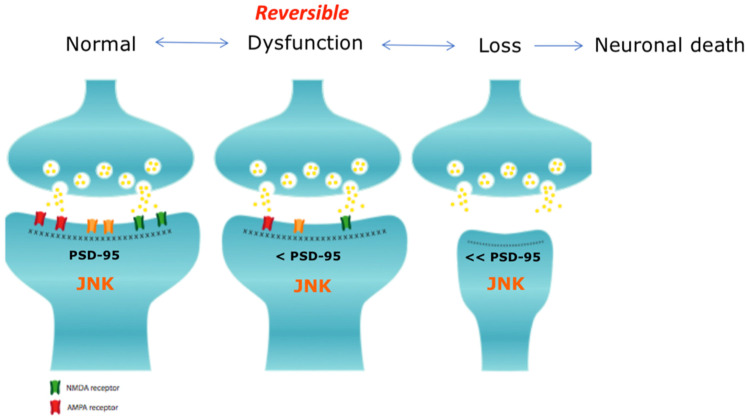
The c-Jun -terminal kinase 3 (JNK3) is the JNK isoform mainly expressed in the brain. It is the most responsive to many stress stimuli in the central nervous system from ischemia to Aβ oligomers toxicity. JNK3 activity is spatial and temporal organized by its scaffold protein, in particular JIP-1 and β-arrestin-2, which play a crucial role in regulating different cellular functions in different cellular districts. Extensive evidence has highlighted the possibility of exploiting these adaptors to interfere with JNK3 signaling in order to block its action. JNK plays a key role in the first neurodegenerative event, the perturbation of physiological synapse structure and function, known as synaptic dysfunction. Importantly, this is a common mechanism in many different brain pathologies. Synaptic dysfunction and spine loss have been reported to be pharmacologically reversible, opening new therapeutic directions in brain diseases. Being JNK3-detectable at the peripheral level, it could be used as a disease biomarker with the ultimate aim of allowing an early diagnosis of neurodegenerative and neurodevelopment diseases in a still prodromal phase.
c-Jun 氨基末端激酶 3(JNK3)是主要在脑中表达的 JNK 同工型。它对中枢神经系统中的许多应激刺激(从缺血到 Aβ 寡聚物毒性)最为敏感。JNK3 活性通过其支架蛋白(特别是 JIP-1 和β-arrestin-2)进行时空组织,在不同的细胞区室中调节不同的细胞功能方面发挥着关键作用。大量证据强调了利用这些衔接蛋白来干扰 JNK3 信号以阻断其作用的可能性。JNK 在第一个神经退行性事件中发挥关键作用,即生理突触结构和功能的破坏,称为突触功能障碍。重要的是,这是许多不同脑病理学的共同机制。已经报道突触功能障碍和棘突丢失具有药理学可逆性,为脑部疾病开辟了新的治疗方向。由于 JNK3 可在外周水平检测到,因此它可用作疾病生物标志物,最终目的是允许在神经退行性和神经发育疾病的仍处于前驱期进行早期诊断。