Barker Lisa T, Bond William F, Vincent Andrew L, Cooley Kimberly L, McGarvey Jeremy S, Vozenilek John A, Powell Emilie S
Jump Simulation (an OSF Healthcare and University of Illinois College of Medicine at Peoria Collaboration), OSF HealthCare and University of Illinois College of Medicine, 1306 N. Berkeley Avenue, Peoria, IL USA.
Department of Emergency Medicine, OSF HealthCare, University of Illinois College of Medicine, Peoria, USA.
Adv Simul (Lond). 2020 Sep 25;5:25. doi: 10.1186/s41077-020-00145-x. eCollection 2020.
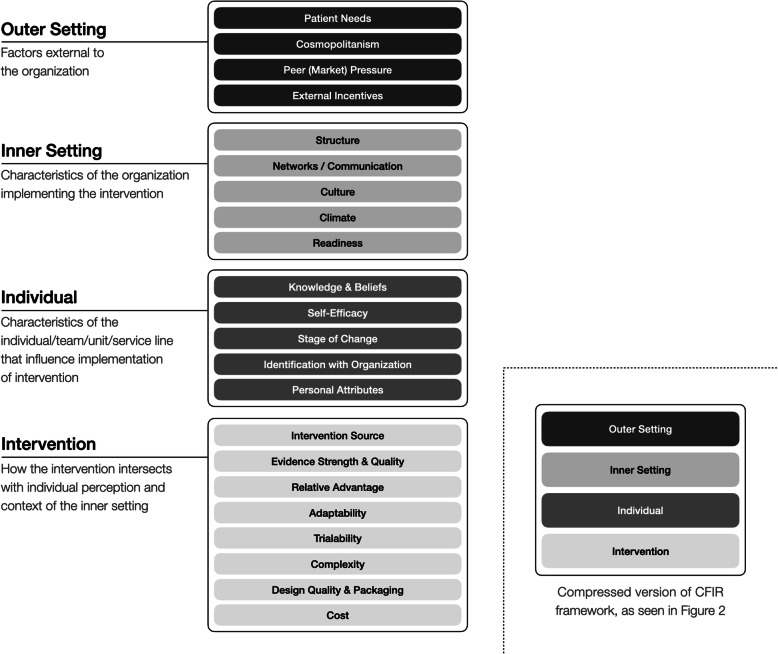
New technologies for clinical staff are typically introduced via an "in-service" that focuses on knowledge and technical skill. Successful adoption of new healthcare technologies is influenced by multiple other factors as described by the Consolidated Framework in Implementation Research (CFIR). A simulation-based introduction to new technologies provides opportunity to intentionally address specific factors that influence adoption.
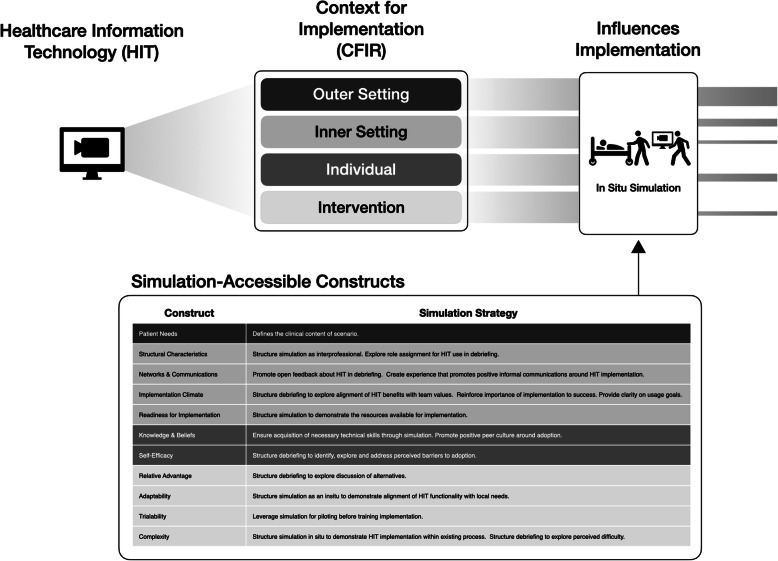
The new technology proposed for adoption was a telehealth cart that provided direct video communication with electronic intensive care unit (eICU) staff for a rural Emergency Department (ED). A novel 3-Act-3-Debrief in situ simulation structure was created to target predictive constructs from the CFIR and connect debriefing to specific workflows. The structure and content of the simulation in relation to the framework is described. Participants completed surveys pre-simulation/post-simulation to measure change in their readiness to adopt the new technology.
The scenario was designed and pilot tested before implementation at two rural EDs. There were 60 interprofessional participants across the 2 sites, with 58 pre-simulation and 59 post-simulation surveys completed. The post-simulation mean ratings for each readiness measure (feasibility, quality, resource availability, role clarity, staff receptiveness, and tech usability) increased significantly as a result of the simulation experience.
A novel 3-stage simulation-debriefing structure positively targets factors influencing the adoption of new healthcare technologies.
临床工作人员的新技术通常通过专注于知识和技术技能的“在职培训”来引入。如实施研究综合框架(CFIR)所述,新医疗技术的成功采用受多种其他因素影响。基于模拟的新技术引入为有意解决影响采用的特定因素提供了机会。
拟采用的新技术是一个远程医疗推车,可为农村急诊科(ED)提供与电子重症监护病房(eICU)工作人员的直接视频通信。创建了一种新颖的三幕三总结现场模拟结构,以针对CFIR中的预测性结构,并将总结与特定工作流程联系起来。描述了与该框架相关的模拟结构和内容。参与者在模拟前/模拟后完成调查,以测量他们采用新技术的准备程度的变化。
该场景在两个农村急诊科实施前进行了设计和试点测试。两个地点共有60名跨专业参与者,完成了58份模拟前和59份模拟后调查。由于模拟体验,每个准备程度指标(可行性、质量、资源可用性、角色清晰度、工作人员接受度和技术可用性)的模拟后平均评分显著提高。
一种新颖的三阶段模拟总结结构积极地针对影响新医疗技术采用的因素。