Goedken Cassie Cunningham, Guihan Marylou, Brown Charnetta R, Ramanathan Swetha, Vivo Amanda, Suda Katie J, Fitzpatrick Margaret A, Poggensee Linda, Perencevich Eli N, Rubin Michael, Reisinger Heather Schacht, Evans Martin, Evans Charlesnika T
Center for Access Delivery & Research and Evaluation (CADRE) Center, Iowa City VA Health Care System, 152, 601 Highway 6 West, Iowa City, IA, 52246, USA.
Center of Innovation for Complex Chronic Healthcare (CINCCH), Edward Hines Jr. VA Hospital, Hines, IL, USA.
Implement Sci Commun. 2021 Jun 29;2(1):69. doi: 10.1186/s43058-021-00170-5.
Infections caused by carbapenem-resistant Enterobacteriaceae (CRE) and carbapenemase-producing (CP) CRE are difficult to treat, resulting in high mortality in healthcare settings every year. The Veterans Health Administration (VHA) disseminated guidelines in 2015 and an updated directive in 2017 for control of CRE focused on laboratory testing, prevention, and management. The Consolidated Framework for Implementation Research (CFIR) framework was used to analyze qualitative interview data to identify contextual factors and best practices influencing implementation of the 2015 guidelines/2017 directive in VA Medical Centers (VAMCs). The overall goals were to determine CFIR constructs to target to improve CRE guideline/directive implementation and understand how CFIR, as a multi-level conceptual model, can be used to inform guideline implementation.
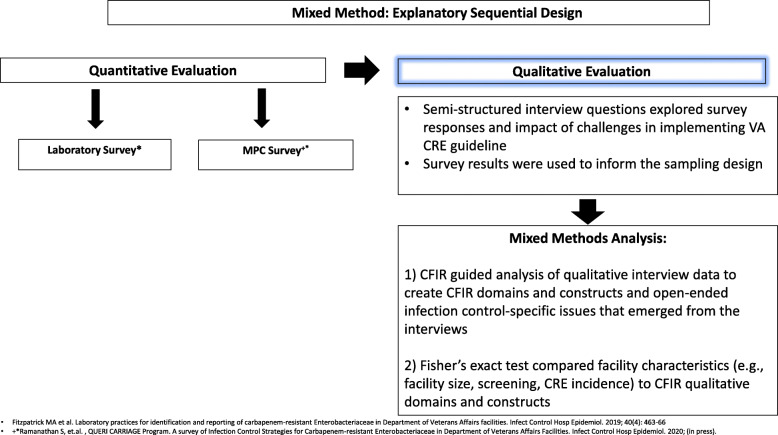
Semi-structured interviews were conducted at 29 VAMCs with staff involved in implementing CRE guidelines at their facility. Survey and VHA administrative data were used to identify geographically representative large and small VAMCs with varying levels of CRE incidence. Interviews addressed perceptions of guideline dissemination, laboratory testing, staff attitudes and training, patient education, and technology support. Participant responses were coded using a consensus-based mixed deductive-inductive approach guided by CFIR. A quantitative analysis comparing qualitative CFIR constructs and emergent codes to sites actively screening for CRE (vs. non-screening) and any (vs. no) CRE-positive cultures was conducted using Fisher's exact test.
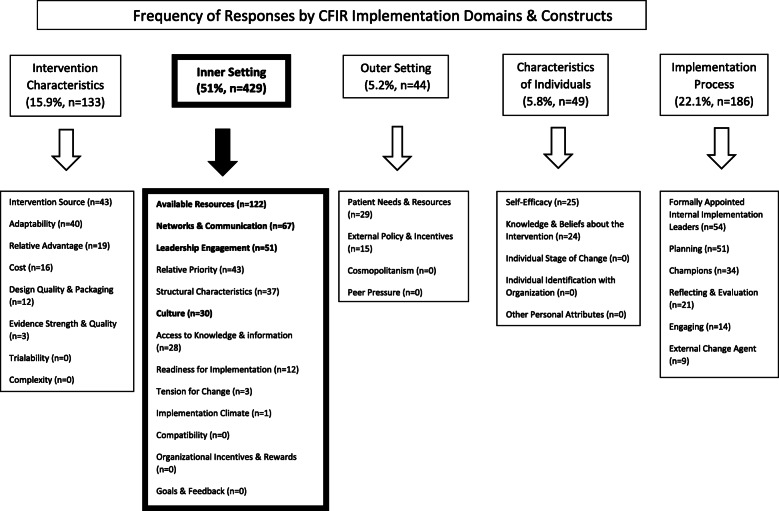
Forty-three semi-structured interviews were conducted between October 2017 and August 2018 with laboratory staff (47%), Multi-Drug-Resistant Organism Program Coordinators (MPCs, 35%), infection preventionists (12%), and physicians (6%). Participants requested more standardized tools to promote effective communication (e.g., electronic screening). Participants also indicated that CRE-specific educational materials were needed for staff, patient, and family members. Quantitative analysis identified CRE screening or presence of CRE as being significantly associated with the following qualitative CFIR constructs: leadership engagement, relative priority, available resources, team communication, and access to knowledge and information.
Effective CRE identification, prevention, and treatment require ongoing collaboration between clinical, microbiology, infection prevention, antimicrobial stewardship, and infectious diseases specialists. Our results emphasize the importance of leadership's role in promoting positive facility culture, including access to resources, improving communication, and facilitating successful implementation of the CRE guidelines.
耐碳青霉烯类肠杆菌科细菌(CRE)和产碳青霉烯酶(CP)的CRE引起的感染难以治疗,每年在医疗机构中导致高死亡率。退伍军人健康管理局(VHA)在2015年发布了指南,并在2017年发布了一项更新指令,用于控制CRE,重点是实验室检测、预防和管理。实施研究综合框架(CFIR)框架用于分析定性访谈数据,以确定影响VA医疗中心(VAMC)实施2015年指南/2017年指令的背景因素和最佳实践。总体目标是确定CFIR的目标构建要素,以改善CRE指南/指令的实施,并了解CFIR作为一个多层次概念模型如何用于为指南实施提供信息。
在29个VAMC对参与其机构实施CRE指南的工作人员进行了半结构化访谈。使用调查和VHA行政数据来确定具有不同CRE发病率水平的地理代表性大小VAMC。访谈涉及对指南传播、实验室检测、工作人员态度和培训、患者教育以及技术支持的看法。参与者的回答使用以CFIR为指导的基于共识的混合演绎-归纳方法进行编码。使用Fisher精确检验对定性CFIR构建要素和新出现的编码与积极筛查CRE的地点(与未筛查相比)以及任何(与无)CRE阳性培养物进行定量分析。
2017年10月至2018年8月期间,对实验室工作人员(47%)、多重耐药菌项目协调员(MPC,35%)、感染预防人员(12%)和医生(6%)进行了43次半结构化访谈。参与者要求提供更多标准化工具以促进有效沟通(例如电子筛查)。参与者还表示,需要为工作人员、患者和家庭成员提供CRE特定的教育材料。定量分析确定CRE筛查或CRE的存在与以下定性CFIR构建要素显著相关:领导参与、相对优先级、可用资源、团队沟通以及获取知识和信息。
有效的CRE识别、预防和治疗需要临床、微生物学、感染预防、抗菌药物管理和传染病专家之间的持续合作。我们的结果强调了领导在促进积极的机构文化中的作用的重要性,包括获取资源、改善沟通以及促进CRE指南的成功实施。