Pelgrift John Y, Lessac-Chenen Erik J, Adam Coralie D, Leonard Jason M, Nelson Derek S, McCarthy Leilah, Sahr Eric M, Liounis Andrew, Moreau Michael, Bos Brent J, Hergenrother Carl W, Lauretta Dante S
KinetX, Inc., Space Navigation and Flight Dynamics Practice Simi Valley CA USA.
NASA Goddard Spaceflight Center Greenbelt MD USA.
Earth Space Sci. 2020 Aug;7(8):e2019EA000938. doi: 10.1029/2019EA000938. Epub 2020 Aug 12.
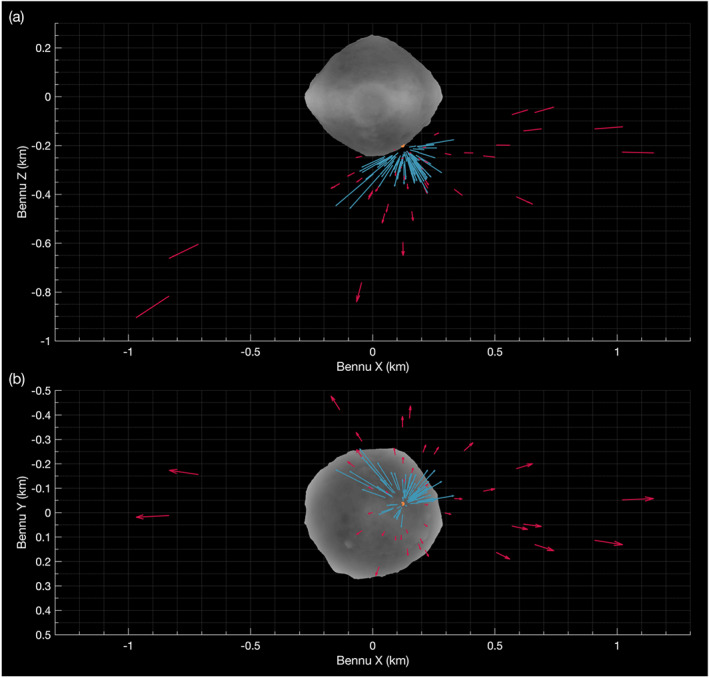
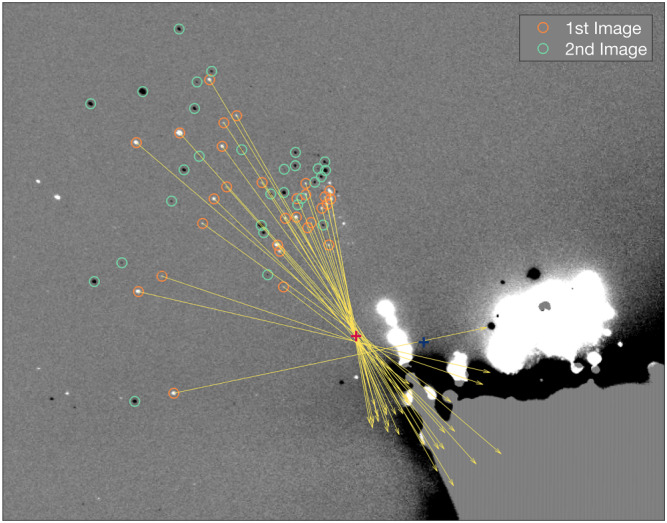
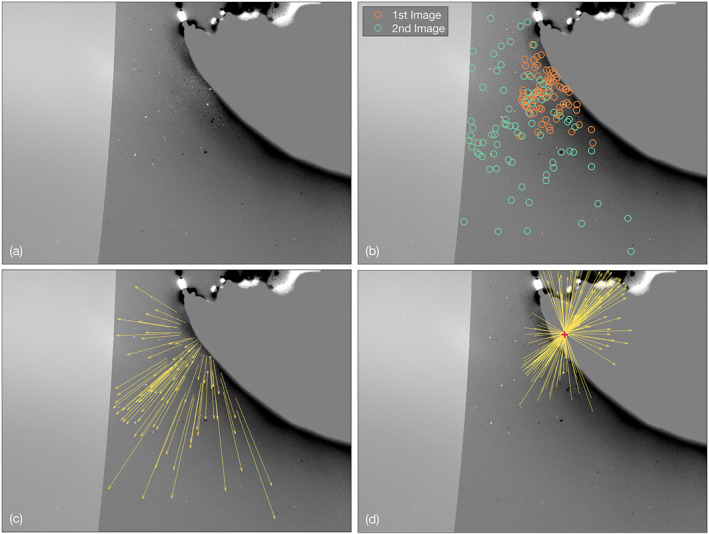
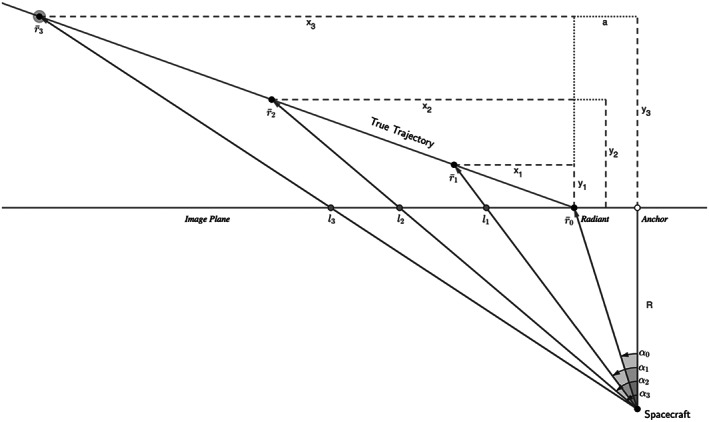
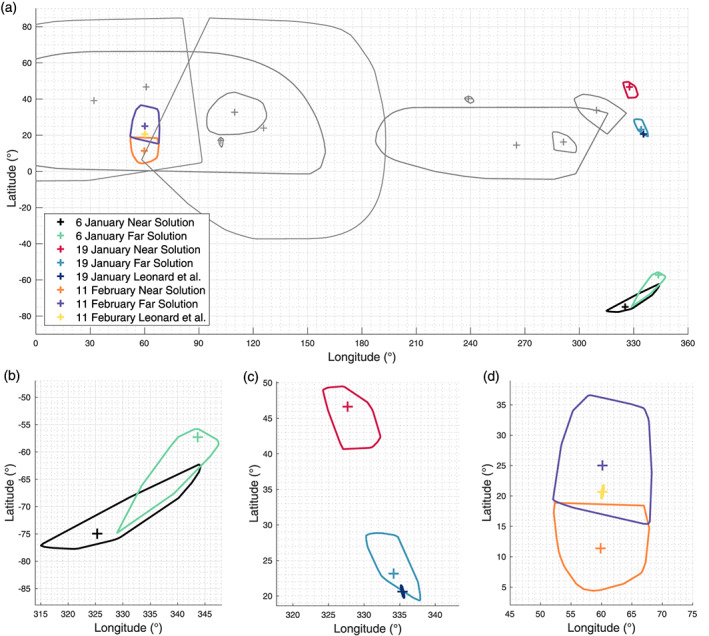
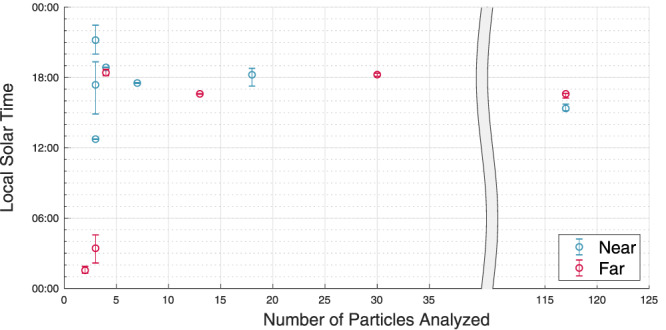
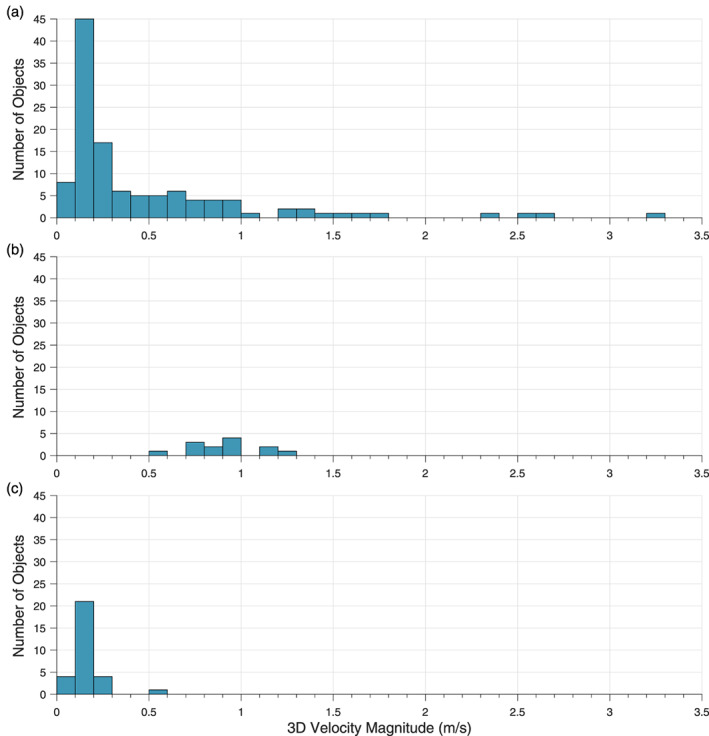
OSIRIS-REx began observing particle ejection events shortly after entering orbit around near-Earth asteroid (101955) Bennu in January 2019. For some of these events, the only observations of the ejected particles come from the first two images taken immediately after the event by OSIRIS-REx's NavCam 1 imager. Without three or more observations of each particle, traditional orbit determination is not possible. However, by assuming that the particles all ejected at the same time and location for a given event, and approximating that their velocities remained constant after ejection (a reasonable approximation for fast-moving particles, i.e., with velocities on the order of 10 cm/s or greater, given Bennu's weak gravity), we show that it is possible to estimate the particles' states from only two observations each. We applied this newly developed technique to reconstruct the particle ejection events observed by the OSIRIS-REx spacecraft during orbit about Bennu. Particles were estimated to have ejected with inertial velocities ranging from 7 cm/s to 3.3 m/s, leading to a variety of trajectory types. Most (>80%) of the analyzed events were estimated to have originated from midlatitude regions and to have occurred after noon (local solar time), between 12:44 and 18:52. Comparison with higher-fidelity orbit determination solutions for the events with sufficient observations demonstrates the validity of our approach and also sheds light on its biases. Our technique offers the capacity to meaningfully constrain the properties of particle ejection events from limited data.
“奥西里斯-雷克斯”号于2019年1月进入近地小行星(101955)贝努的轨道后不久,便开始观测粒子喷射事件。对于其中一些事件,对喷射出的粒子的唯一观测数据来自“奥西里斯-雷克斯”号导航相机1成像仪在事件发生后立即拍摄的前两张图像。如果没有对每个粒子进行三次或更多次观测,就无法进行传统的轨道确定。然而,通过假设对于给定事件,所有粒子都在同一时间和位置喷射,并近似认为它们在喷射后的速度保持恒定(对于快速移动的粒子,即速度在10厘米/秒或更高量级,鉴于贝努的弱引力,这是一个合理的近似),我们表明仅通过对每个粒子进行两次观测就有可能估计其状态。我们应用这种新开发的技术来重建“奥西里斯-雷克斯”号航天器在围绕贝努的轨道运行期间观测到的粒子喷射事件。估计粒子以7厘米/秒至3.3米/秒的惯性速度喷射,从而产生了各种轨迹类型。大多数(>80%)分析事件估计起源于中纬度地区,且发生在中午(当地太阳时间)之后,时间在12:44至18:52之间。将我们的方法与对有足够观测数据的事件的更高保真轨道确定解进行比较,证明了我们方法的有效性,同时也揭示了其偏差。我们的技术能够从有限的数据中有意义地约束粒子喷射事件的特性。