Department of Anesthesiology and Surgical Intensive Care Unit, Xinhua Hospital, Shanghai Jiao Tong University School of Medicine, Shanghai 200092, P.R. China.
Department of Anesthesiology, International Peace Maternity and Child Health Hospital, Shanghai Jiao Tong University School of Medicine, Shanghai 200030, P.R. China.
Mol Med Rep. 2020 Nov;22(5):4265-4277. doi: 10.3892/mmr.2020.11507. Epub 2020 Sep 14.
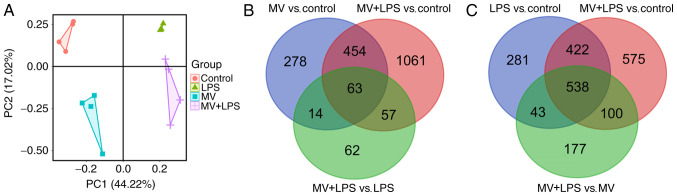
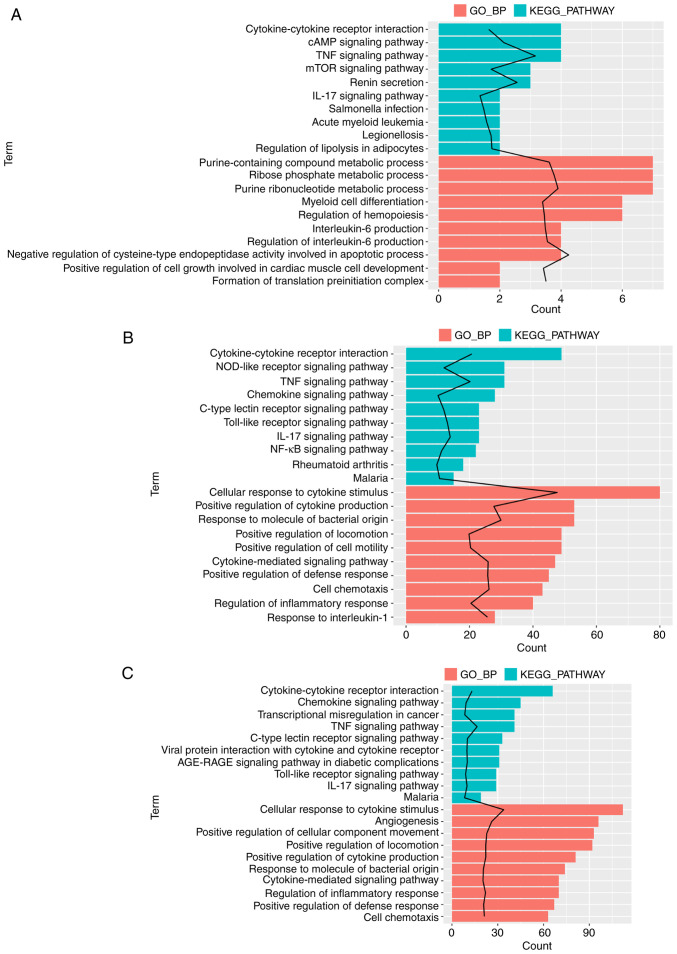
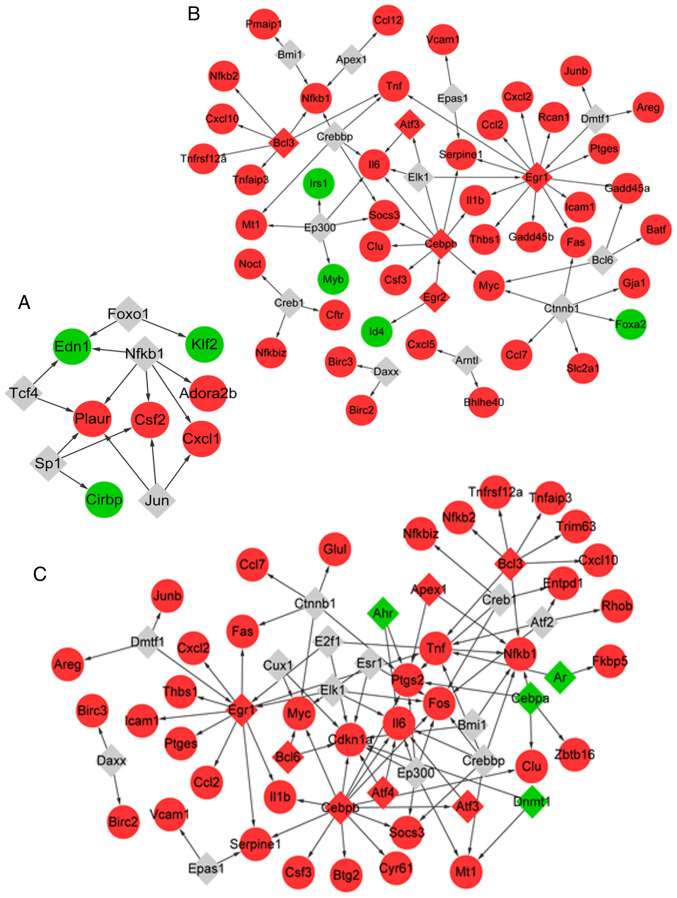
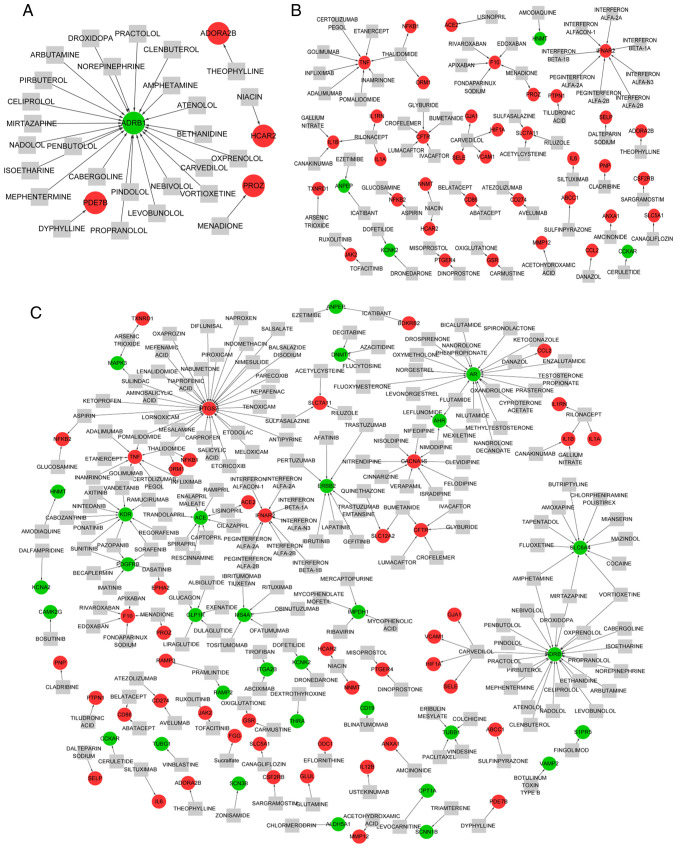
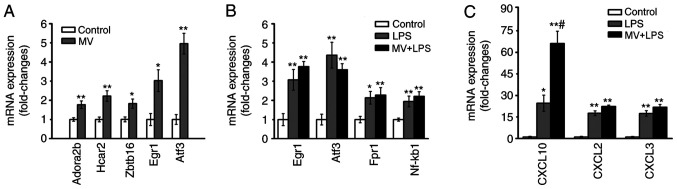
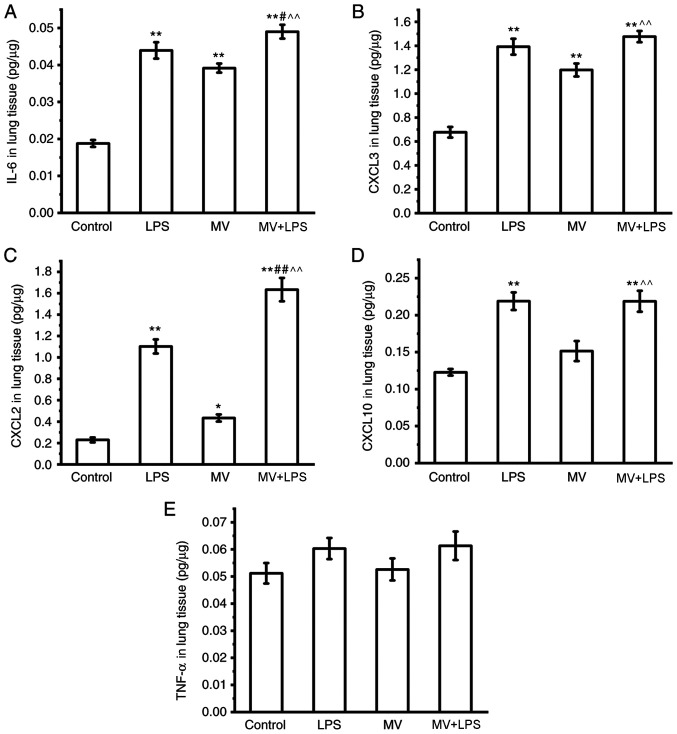
Mechanical ventilation (MV) and lipopolysaccharide (LPS) infection are common causes of acute lung injury. The aim of the present study was to identify the key genes and potential mechanisms involved in mechanical ventilation (MV) and lipopolysaccharide (LPS)‑induced acute lung injury (ALI). Gene expression data of adult C57BL/6 mice with ALI induced by inhaling LPS, MV and LPS + MV were downloaded from the Gene Expression Omnibus database. Differentially expressed genes (DEGs) associated with MV, LPS and LPS + MV were screened, followed by functional enrichment analysis, protein‑protein interaction network construction, and prediction of transcription factors and small molecule drugs. Finally, the expression of key genes was verified in vivo using reverse transcription‑quantitative PCR. A total of 63, 538 and 1,635 DEGs were associated with MV, LPS and LPS + MV, respectively. MV‑associated genes were significantly enriched in the 'purine ribonucleotide metabolic process'. LPS and LPS + MV‑associated genes were significantly enriched in 'cellular response to cytokine stimulus' and 'cell chemotaxis'. All three conditions were enriched in 'TNF signaling pathway' and 'IL‑17 signaling pathway'. Expression levels of C‑X‑C motif chemokine ligand (CXCL)2, CXCL3 and CXCL10 were upregulated in the LPS and LPS + MV groups. Adenosine A2b receptor, zinc finger and BTB domain‑containing 16 and hydroxycarboxylic acid receptor 2 were identified as DEGs in the MV group. Compared with the control group, Early growth response 1 and activating TF 3 was upregulated in all three groups. Similarities and differences were observed among the MV‑ and LPS‑induced ALI, and MV may enhance the effects of LPS on gene expression. MV may affect urine ribonucleotide metabolic‑related processes, whereas LPS may cause cell chemotaxis and cytokine stimulus responses in ALI progression. The inflammatory response was shared by MV and LPS. The results of the present study may provide insight into a theoretical basis for the study and treatment of ALI.
机械通气(MV)和脂多糖(LPS)感染是急性肺损伤的常见原因。本研究旨在确定与机械通气(MV)和脂多糖(LPS)诱导的急性肺损伤(ALI)相关的关键基因和潜在机制。从基因表达综合数据库中下载了 LPS 吸入诱导的成年 C57BL/6 小鼠 ALI 的 MV、LPS 和 LPS+MV 的基因表达数据。筛选与 MV、LPS 和 LPS+MV 相关的差异表达基因(DEGs),然后进行功能富集分析、蛋白质-蛋白质相互作用网络构建以及转录因子和小分子药物的预测。最后,使用逆转录-定量 PCR 在体内验证关键基因的表达。与 MV、LPS 和 LPS+MV 相关的基因分别有 63538 个、1635 个。MV 相关基因在“嘌呤核苷酸代谢过程”中显著富集。LPS 和 LPS+MV 相关基因在“细胞对细胞因子刺激的反应”和“细胞趋化”中显著富集。所有三种情况都在“TNF 信号通路”和“IL-17 信号通路”中富集。LPS 和 LPS+MV 组中 C-X-C 基序趋化因子配体(CXCL)2、CXCL3 和 CXCL10 的表达上调。在 MV 组中鉴定出腺苷 A2b 受体、锌指和 BTB 结构域包含蛋白 16 和羟基羧酸受体 2 为 DEGs。与对照组相比,所有三组中早期生长反应 1 和激活 TF3 均上调。在 MV 和 LPS 诱导的 ALI 中观察到相似和不同之处,并且 MV 可能增强 LPS 对基因表达的影响。MV 可能影响尿核苷酸代谢相关过程,而 LPS 可能导致 ALI 进展中的细胞趋化和细胞因子刺激反应。炎症反应在 MV 和 LPS 中共享。本研究的结果可为 ALI 的研究和治疗提供理论依据。