Institute of General Practice and Family Medicine, University Hospital of Bonn, Bonn, Germany.
Institute for General Medicine, University Hospital Essen, University of Duisburg-Essen, Essen, Germany.
PLoS One. 2020 Oct 1;15(10):e0240052. doi: 10.1371/journal.pone.0240052. eCollection 2020.
Practice assistants represent a highly relevant occupational group in Germany and one of the most popular training professions in Germany. Despite this, most research in the health care sector has focused on secondary care settings, but has not addressed practice assistants in primary care. Knowledge about practice assistants' workplace-related stressors and resources is particularly scarce. This cross-sectional study addresses the mental workload of practice assistants working in primary care practices.
Practice assistants from a network of 185 German primary care practices were invited to participate in this cross-sectional study. The standardized `Short Questionnaire for Workplace Analysis' (German: Kurzfragebogen zur Arbeitsanalyse) was used to assess practice assistants´ mental workload. It addresses eleven workplace factors in 26 items: versatility, completeness of task, scope of action, social support, cooperation, qualitative work demands, quantitative work demands, work disruptions, workplace environment, information and participation, and benefits. Sociodemographic and work characteristics were also obtained. A descriptive analysis was performed for sociodemographic data and "Short Questionnaire for Workplace Analysis" factors. The one-sided t-test and Cohen´s d were calculated for a comparison with data from 23 professional groups (n = 8,121).
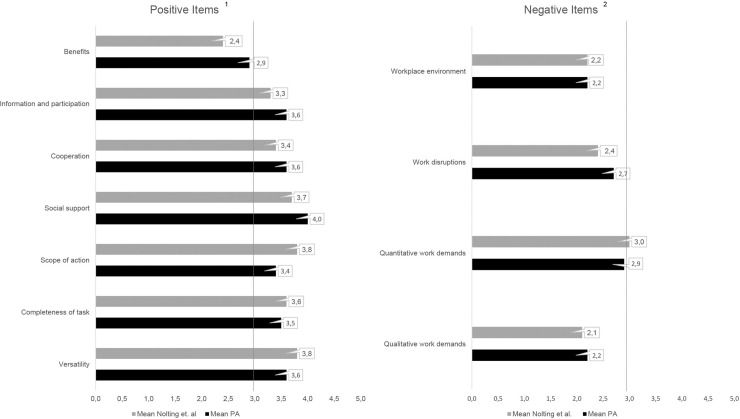
A total of 550 practice assistants from 130 practices participated. The majority of practice assistants was female (99.3%) and worked full-time (66.5%) in group practices (50.6%). Compared to the other professional groups, practice assistants reported higher values for the factor social support (4.0 versus 3.7 [d 0.44; p<0.001]), information and participation (3.6 versus 3.3 [d 0.38; p<0.001] as well as work disruptions (2.7 vs. 2.4 [d 0.42; p<0.001]), while practice assistants showed lower values regarding scope of action (3.4 versus 3.8 [d 0.43; p<0.001]).
Our study identified social support and participation within primary care practices as protective factors for mental workload, while work disruptions and scope of action were perceived as stressors.
在德国,实践助理是一个非常相关的职业群体,也是德国最受欢迎的培训职业之一。尽管如此,医疗保健领域的大多数研究都集中在二级保健环境,但没有涉及初级保健中的实践助理。关于实践助理工作场所相关压力源和资源的知识尤其匮乏。这项横断面研究旨在探讨在初级保健实践中工作的实践助理的心理工作量。
邀请来自德国 185 家初级保健实践网络的实践助理参加这项横断面研究。使用标准化的《工作场所分析短问卷》(德文:Kurzfragebogen zur Arbeitsanalyse)评估实践助理的心理工作量。它在 26 个项目中涵盖了 11 个工作场所因素:多样性、任务完整性、行动范围、社会支持、合作、定性工作要求、定量工作要求、工作中断、工作环境、信息和参与以及收益。还获得了社会人口统计学和工作特征。对社会人口统计学数据和“工作场所分析短问卷”因素进行描述性分析。与来自 23 个专业群体(n=8121)的数据进行单侧 t 检验和科恩氏 d 比较。
共有 130 家实践中的 550 名实践助理参加了这项研究。大多数实践助理是女性(99.3%),全职(66.5%)在团体实践中工作(50.6%)。与其他专业群体相比,实践助理报告的社会支持因素值较高(4.0 与 3.7 [d 0.44;p<0.001]),信息和参与度较高(3.6 与 3.3 [d 0.38;p<0.001]以及工作中断较高(2.7 与 2.4 [d 0.42;p<0.001]),而实践助理在行动范围方面的数值较低(3.4 与 3.8 [d 0.43;p<0.001])。
我们的研究确定了初级保健实践中的社会支持和参与是心理工作量的保护因素,而工作中断和行动范围被视为压力源。