Mental Health Center, Shantou University Medical College, Shantou 515065, China.
Master of Public Health Education Center, Shantou University Medical College, Shantou 515041, China.
Int J Environ Res Public Health. 2020 Sep 29;17(19):7140. doi: 10.3390/ijerph17197140.
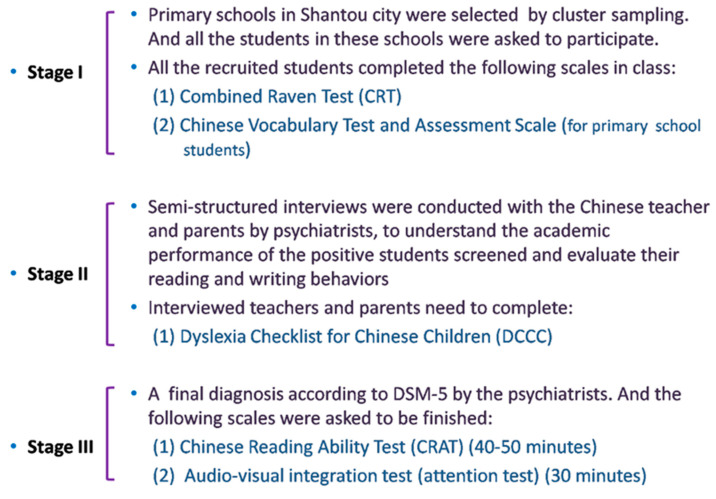
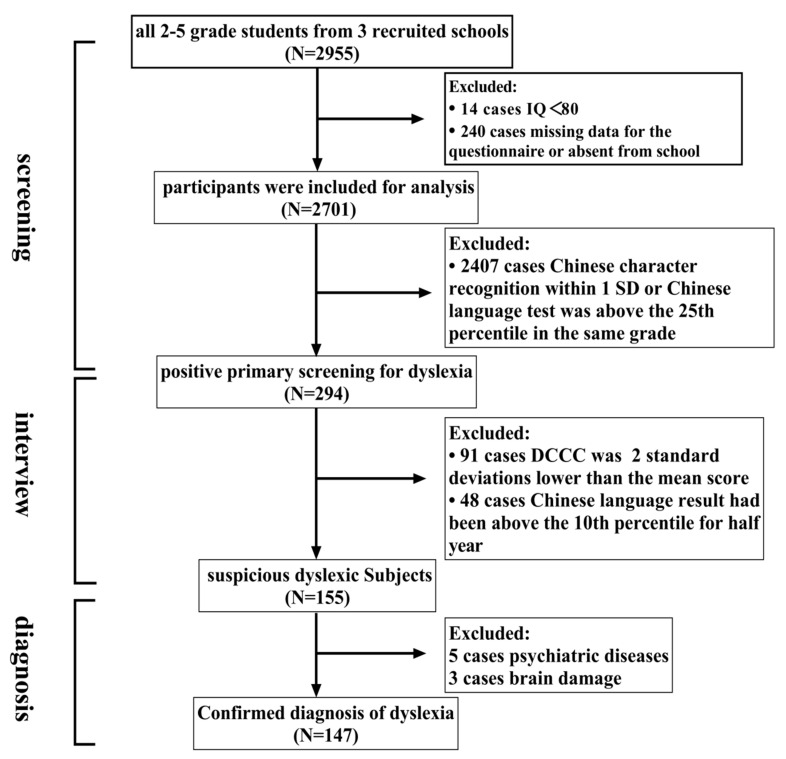
The epidemiological studies of Chinese developmental dyslexia (DD) in China are still limited. In addition, literacy assessment has seldom been performed for children with dyslexia, due to lack of uniform assessment tools. This study was aimed at investigating the prevalence rate of children with dyslexia, and to evaluate their Chinese reading ability. A total of 2955 students aged 7-12 years were enrolled by randomized cluster sampling. The study was divided into three stages. In stage I, all participating students were asked to finish the Combined Raven Test (CRT) and Chinese Vocabulary Test and Assessment Scale. In stage II, the Chinese teachers and parents of the children with suspected dyslexia were interviewed by psychiatrists, and finished the Dyslexia Checklist for Chinese Children (DCCC). In stage III, these children were evaluated by child psychiatrists for the diagnosis with or without dyslexia, according to the fifth edition of Diagnostic and Statistical Manual of Mental Disorders (DSM-5), and their Chinese literacy was further evaluated by using the Chinese Reading Ability Test (CRAT). The prevalence rate of children with dyslexia was 5.4% in Shantou city, 8.4% in boys and 2.3% in girls, with a gender ratio of 3.7:1.0. Children with dyslexia scored lower in all the five subscales of the CRAT tests. including phonological awareness, morphological awareness, rapid automatized naming, orthographic awareness, and reading ability than the control group (all < 0.001). This study suggested that the prevalence rate of Chinese dyslexia in Shantou city is roughly equivalent to that previously reported in China. Children with dyslexia have a relatively lower Chinese reading ability in all assessments.
中国发展性阅读障碍(DD)的流行病学研究仍然有限。此外,由于缺乏统一的评估工具,很少对阅读障碍儿童进行识字评估。本研究旨在调查阅读障碍儿童的患病率,并评估他们的中文阅读能力。采用随机整群抽样的方法,共纳入 2955 名 7-12 岁儿童。研究分为三个阶段。在第一阶段,所有参与的学生都被要求完成联合瑞文测验(CRT)和中文词汇测验和评估量表。在第二阶段,对有阅读障碍可疑的儿童的中文教师和家长由精神科医生进行访谈,并完成《中文儿童阅读障碍检查表》(DCCC)。在第三阶段,根据《精神障碍诊断与统计手册》第五版(DSM-5),由儿童精神科医生对这些儿童进行诊断,判断他们是否患有阅读障碍,并进一步使用中文阅读能力测验(CRAT)评估他们的中文识字能力。汕头市儿童阅读障碍的患病率为 5.4%,男孩为 8.4%,女孩为 2.3%,性别比为 3.7:1.0。阅读障碍儿童在 CRAT 测试的五个子量表中的得分均低于对照组(均<0.001)。包括语音意识、形态意识、快速自动命名、正字法意识和阅读能力。本研究表明,汕头市中文阅读障碍的患病率与中国以往报道的患病率大致相当。阅读障碍儿童在所有评估中都有相对较低的中文阅读能力。