School of Health Sciences, University of Southampton, Building 67, University Road, Southampton, SO17 1BJ, UK.
Department of Podiatry, Solent NHS Trust, Southampton, UK.
J Foot Ankle Res. 2020 Oct 1;13(1):61. doi: 10.1186/s13047-020-00429-5.
The study aim was to determine whether lifetime occupation was associated with the presence of radiographic osteoarthritis (ROA) of the first metatarsophalangeal joint (MTPJ) in women.
Data were collected from the prospective, population-based Chingford 1000 Women study. This cohort of women, aged 45-64 years at inception, was established in 1989 from a single general practice in Chingford, UK. Data has subsequently been collected repeatedly. Data from baseline, year six and year ten was used for the purposes of this cross-sectional study. The primary outcome was the presence of dorsal view ROA of the first MTPJ. The main exposure was lifetime occupation, categorised according to levels of occupation previously defined via international consensus: 1. Sedentary, 2. Light, 3. Light manual, 4. Heavy manual. Logistic regression analyses were conducted to quantify the relationship between lifetime occupation type and the presence of ROA of the first MTPJ, adjusting for age, body mass index and lifetime high-heeled footwear use as potential interactive variables for each decade.
Data for 209 women were included within this study. The mean (SD) age was 57 (±5.2) years. Predominant lifetime occupation was reported as sedentary by 51.7%, as light by 0%, as light manual by 33.5% and as heavy manual by 14.8% of participants. There were no statistical associations between lifetime occupation type and the presence of ROA of the first MTPJ in either the unadjusted (OR = 0.99, CI = 0.78-1.26,P = 0.96) partially adjusted (for age and BMI; OR = 1.00, CI = 0.78-1.29, P = 0.99) or fully adjusted models (for age, BMI and lifetime high heel footwear use for each decade of working life (OR = 1.02, CI = 0.79-1.31, P = 0.91); high-heel footwear use up to 20s (OR = 0.83, CI = 0.71-1.31, P = 0.83); high-heel footwear use in 20-30s (OR = 1.00, CI = 0.75-1.3, P = 0.98); high-heel footwear use in 30-40s (OR = 1.00, CI = 0.70-1.42, P = 0.99); high-heel footwear use in 40-50s (OR = 0.90, CI = 0.58-1.40, P = 0.65); high-heel footwear use in 50s (OR = 0.63,CI = 0.36-1.09, P = 0.10).
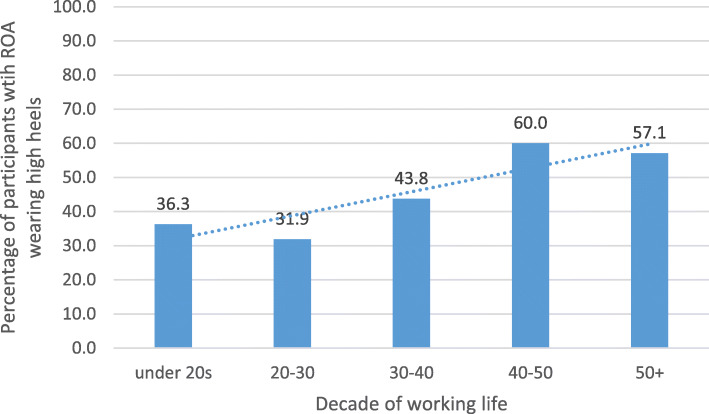
The findings suggest that lifetime occupation is not associated with the presence of ROA of the fist metatarsophalangeal joint. There does not appear to be any interactive effect between lifetime occupation, lifetime high-heel footwear use, age or BMI and ROA of the first MTPJ. In later life a positive trend towards increased ROA in those who reported lifetime high-heel footwear use was noted and this may be worthy of further research.
本研究旨在确定一生中的职业是否与女性第一跖趾关节(MTPJ)的放射影像学骨关节炎(ROA)的存在有关。
数据来自前瞻性、基于人群的 Chingford 1000 名女性研究。该女性队列在成立时年龄为 45-64 岁,于 1989 年从英国 Chingford 的一家普通诊所中招募。此后,数据已多次收集。本横断面研究使用基线、第 6 年和第 10 年的数据。主要结局是第一跖骨背侧视图 ROA 的存在。主要暴露是根据先前通过国际共识定义的职业水平分类的一生职业:1. 久坐,2. 轻体力,3. 轻体力劳动,4. 重体力劳动。进行逻辑回归分析以量化一生职业类型与第一 MTPJ 处 ROA 存在之间的关系,调整年龄、体重指数和一生高跟鞋使用情况作为每个十年的潜在交互变量。
本研究纳入了 209 名女性的数据。平均(SD)年龄为 57(±5.2)岁。主要的一生职业报告为久坐 51.7%,轻体力劳动 0%,轻体力劳动 33.5%,重体力劳动 14.8%。在未调整(OR=0.99,CI=0.78-1.26,P=0.96)部分调整(调整年龄和 BMI;OR=1.00,CI=0.78-1.29,P=0.99)或完全调整模型(调整年龄、BMI 和一生中高跟鞋使用情况,每十年工作年限(OR=1.02,CI=0.79-1.31,P=0.91);高跟鞋使用年限在 20 多岁(OR=0.83,CI=0.71-1.31,P=0.83);高跟鞋使用年限在 20-30 岁(OR=1.00,CI=0.75-1.3,P=0.98);高跟鞋使用年限在 30-40 岁(OR=1.00,CI=0.70-1.42,P=0.99);高跟鞋使用年限在 40-50 岁(OR=0.90,CI=0.58-1.40,P=0.65);高跟鞋使用年限在 50 岁(OR=0.63,CI=0.36-1.09,P=0.10)。
研究结果表明,一生的职业与第一跖趾关节 ROA 的存在无关。在一生的职业、高跟鞋使用、年龄或 BMI 和第一 MTPJ 的 ROA 之间似乎没有任何交互作用。在以后的生活中,报告一生高跟鞋使用的人 ROA 增加的趋势呈阳性,这可能值得进一步研究。