Department of Medicine, Gynecologic Medical Oncology Service, Memorial Sloan Kettering Cancer Center, New York, New York, USA
Department of Medicine, Gynecologic Medical Oncology Service, Memorial Sloan Kettering Cancer Center, New York, New York, USA.
J Immunother Cancer. 2020 Oct;8(2). doi: 10.1136/jitc-2020-001126.
There are limited treatment options for patients with metastatic or recurrent cervical cancer. Platinum-based chemotherapy plus the anti-vascular endothelial growth factor antibody bevacizumab remains the mainstay of advanced treatment. Pembrolizumab is Food and Drug Agency approved for programmed death ligand 1 (PD-L1) positive cervical cancer with a modest response rate. This is the first study to report the efficacy and safety of the PD-L1 antibody atezolizumab in combination with bevacizumab in advanced cervical cancer.
We report the results from a phase II, open-label, multicenter study (NCT02921269). Patients with advanced cervical cancer were treated with bevacizumab 15 mg/kg intravenous every 3 weeks and atezolizumab 1200 mg intravenous every 3 weeks. The primary objective was to measure the objective response rate (ORR). Secondary endpoints included disease control rate (DCR), progression-free survival (PFS), overall survival (OS), and safety.
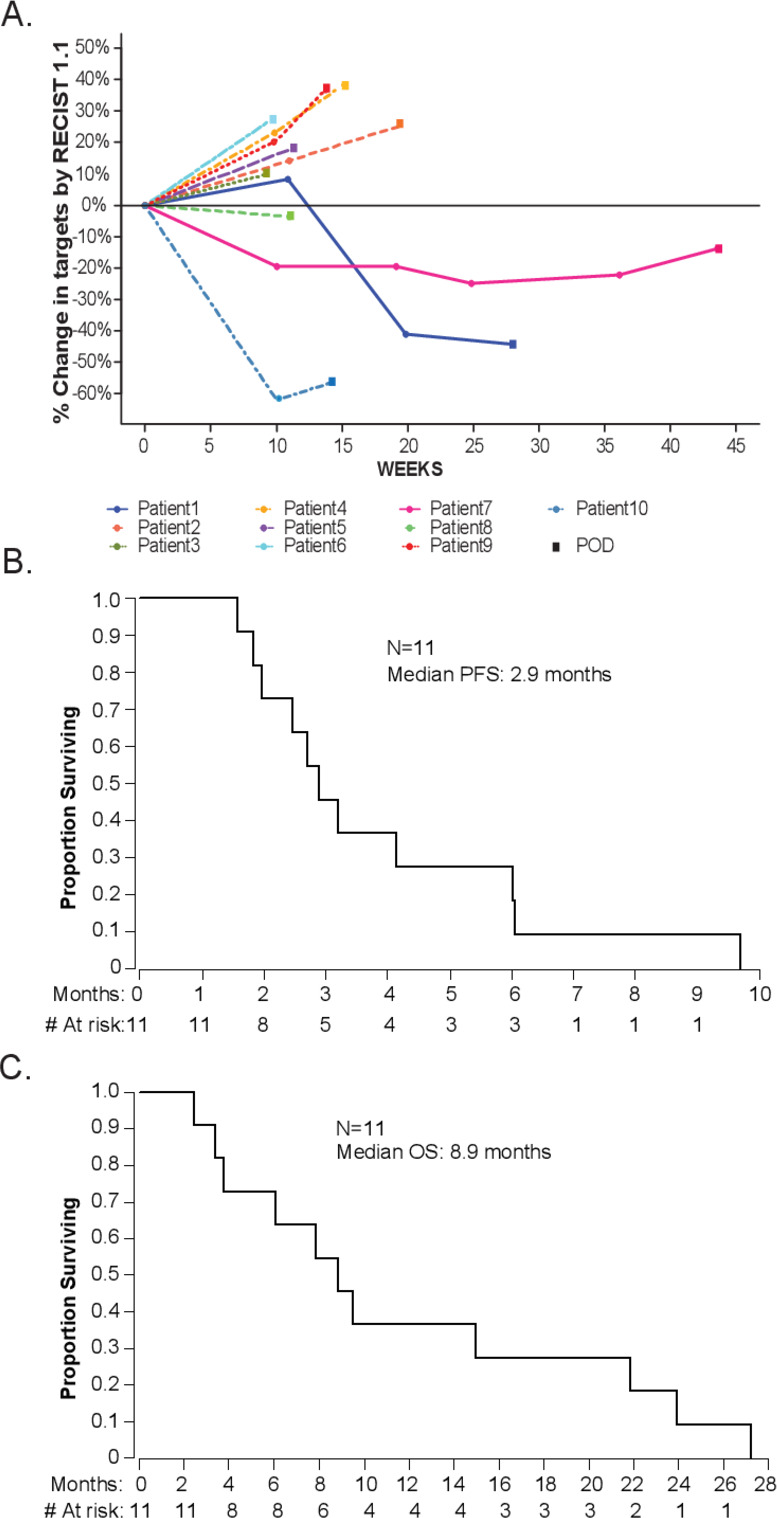
In the total evaluable population (n=10), zero patients achieved an objective response as assessed by Response Evaluation Criteria In Solid Tumors (RECIST) V.1.1, resulting in a confirmed ORR of 0%. Of note, there were two patients who achieved an unconfirmed PR. The DCR by RECIST V.1.1 was 60% (0% complete response, 0% partial response, 60% stable disease). Median PFS was 2.9 months (95% CI, 1.8 to 6) and median OS was 8.9 months (95% CI, 3.4 to 21.9). Safety results were generally consistent with the known safety profile of both drugs, notably with two high-grade neurologic events.
The combination of bevacizumab and atezolizumab did not meet the predefined efficacy endpoint, as addition of bevacizumab to PD-L1 blockade did not appear to enhance the ORR in cervical cancer.
转移性或复发性宫颈癌患者的治疗选择有限。含铂化疗加抗血管内皮生长因子抗体贝伐珠单抗仍然是晚期治疗的主要方法。帕博利珠单抗(pembrolizumab)已被美国食品和药物管理局(FDA)批准用于 PD-L1 阳性宫颈癌,其反应率适中。这是第一项报告 PD-L1 抗体阿特珠单抗(atezolizumab)联合贝伐珠单抗治疗晚期宫颈癌的疗效和安全性的研究。
我们报告了一项 II 期、开放标签、多中心研究(NCT02921269)的结果。晚期宫颈癌患者接受贝伐珠单抗 15mg/kg 静脉注射,每 3 周 1 次,阿特珠单抗 1200mg 静脉注射,每 3 周 1 次。主要目标是测量客观缓解率(ORR)。次要终点包括疾病控制率(DCR)、无进展生存期(PFS)、总生存期(OS)和安全性。
在总可评估人群(n=10)中,根据实体瘤反应评价标准(RECIST)V.1.1,没有患者达到客观缓解,因此确认的 ORR 为 0%。值得注意的是,有 2 例患者达到了未经确认的 PR。RECIST V.1.1 的 DCR 为 60%(0%完全缓解,0%部分缓解,60%稳定疾病)。中位 PFS 为 2.9 个月(95%CI,1.8 至 6),中位 OS 为 8.9 个月(95%CI,3.4 至 21.9)。安全性结果与两种药物已知的安全性特征基本一致,特别是有 2 例发生了 3 级神经事件。
贝伐珠单抗联合阿特珠单抗未达到预先设定的疗效终点,提示在宫颈癌中添加贝伐珠单抗似乎并未提高 ORR。