Walker Ryan, Wilder Shawn M, González Angélica L
Department of Biology Rutgers University Camden NJ USA.
Department of Integrative Biology Oklahoma State University Stillwater OK USA.
Ecol Evol. 2020 Aug 21;10(18):9696-9706. doi: 10.1002/ece3.6581. eCollection 2020 Sep.
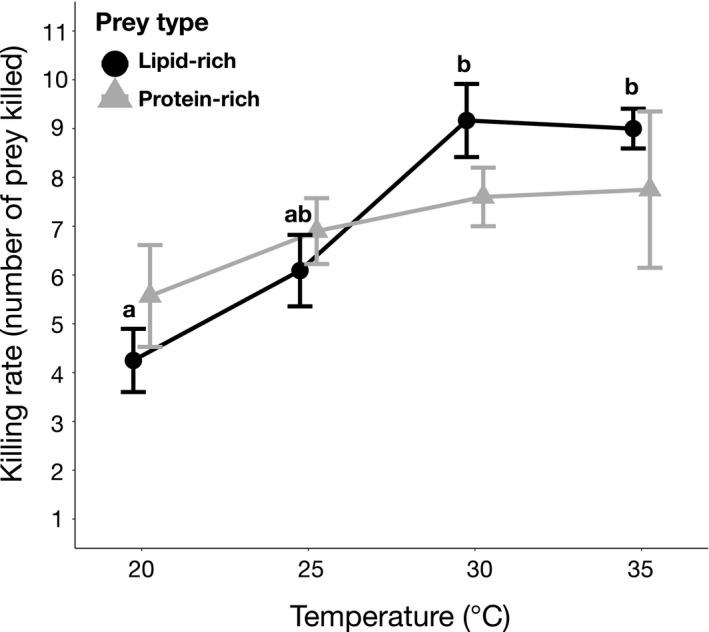
Temperature dependency of consumer-resource interactions is fundamentally important for understanding and predicting the responses of food webs to climate change. Previous studies have shown temperature-driven shifts in herbivore consumption rates and resource preference, but these effects remain poorly understood for predatory arthropods. Here, we investigate how predator killing rates, prey mass consumption, and macronutrient intake respond to increased temperatures using a laboratory and a field reciprocal transplant experiment. Ectothermic predators, wolf spiders ( sp.), in the lab experiment, were exposed to increased temperatures and different prey macronutrient content (high lipid/low protein and low lipid/high protein) to assess changes in their killing rates and nutritional demands. Additionally, we investigate prey mass and lipid consumption by spiders under contrasting temperatures, along an elevation gradient. We used a field reciprocal transplant experiment between low (420 masl; 26°C) and high (2,100 masl; 15°C) elevations in the Ecuadorian Andes, using wild populations of two common orb-weaver spider species ( sp. and sp.) present along the elevation gradient. We found that killing rates of wolf spiders increased with warmer temperatures but were not significantly affected by prey macronutrient content, although spiders consumed significantly more lipids from lipid-rich prey. The field reciprocal transplant experiment showed no consistent predator responses to changes in temperature along the elevational gradient. Transplanting sp. spiders to low- or high-elevation sites did not affect their prey mass or lipid consumption rate, whereas sp. individuals increased prey mass consumption when transplanted from the high to the low warm elevation. Our findings show that increases in temperature intensify predator killing rates, prey consumption, and lipid intake, but the responses to temperature vary between species, which may be a result of species-specific differences in their hunting behavior and sensitivity to temperature.
消费者 - 资源相互作用的温度依赖性对于理解和预测食物网对气候变化的响应至关重要。先前的研究表明,食草动物的消费率和资源偏好会随温度变化而改变,但对于捕食性节肢动物而言,这些影响仍知之甚少。在此,我们通过实验室和野外 reciprocal transplant 实验,研究捕食者的捕杀率、猎物质量消耗和常量营养素摄入量如何对温度升高作出反应。在实验室实验中,变温捕食者狼蛛( 属)被置于温度升高且猎物常量营养素含量不同(高脂肪/低蛋白和低脂肪/高蛋白)的环境中,以评估其捕杀率和营养需求的变化。此外,我们沿着海拔梯度,研究了在不同温度条件下蜘蛛对猎物质量和脂质的消耗情况。我们在厄瓜多尔安第斯山脉的低海拔(420 米海拔;26°C)和高海拔(2100 米海拔;15°C)之间进行了野外 reciprocal transplant 实验,使用了沿海拔梯度分布的两种常见圆蛛物种( 属和 属)的野生种群。我们发现,狼蛛的捕杀率随温度升高而增加,但不受猎物常量营养素含量的显著影响,不过蜘蛛从富含脂质的猎物中摄取的脂质显著更多。野外 reciprocal transplant 实验表明,捕食者对沿海拔梯度的温度变化没有一致的反应。将 属蜘蛛移植到低海拔或高海拔地点,并未影响其猎物质量或脂质消耗率,而将 属个体从温暖的高海拔移植到低海拔时,其猎物质量消耗增加。我们的研究结果表明,温度升高会加剧捕食者的捕杀率、猎物消耗和脂质摄取,但不同物种对温度的反应存在差异,这可能是由于它们在狩猎行为和对温度的敏感性方面存在物种特异性差异所致。